

So why is everyone everywhere talking about JFSL right now?
If you’ve been watching the stock market recently, you must have noticed one name coming up repeatedly, and that’s the Jio Financial Services share price. And to be honest, my friend, this is not just a hype. When a company supported by Mukesh Ambani enters the financial services sector, people tend to pay a lot of attention, given the current times.
I remember the day when JFSL was listed in the market after the demerger from Reliance Industries. My phone was flooded with messages from friends asking, ‘Hey, should I buy it right now?’ Honestly, that curiosity hasn’t gone away even now.
So today, let’s understand in full detail about the share price of Jio Financial Services in this article, what it is doing right now on the NSE, what its market cap is, and most importantly, whether this stock is worth making a place in your portfolio or not. No hype, no shortcuts—just talking in an honest and simple way in this article.
Highlight key
Before we go deep, here is a quick snapshot so you can get the key number fast.
The Jio Financial Services share price AS of June 19, 2026 was around ₹244.45 on Nas.
Here are the key numbers at a glance:
NSE Symbol: JIOFIN
Current Price: ~₹244–₹268 range (Fluctuates Daily)
52-Week High: ₹338.60 | 52-week low: ₹223.30
Market Cap: Aproximatically ₹1,61,183 cr
P/E ratio: ~99.29 | P/B ratio: ~1.26
Promoter Holdings: 47.10% | FII: 12.30% | DII: 8.50%
These numbers tell a story. Let us break it down properly.
What Is Jio Financial Services?
Tell me the truth, do you actually know what this company does? A lot of people buy stocks without even knowing the business. Let us fix that.
Jio Financial Services Limited, also known as JFSL, was originally incorporated as Reliance Strategic Investments Private Limited in July 1999. The financial services business was demerged from Reliance Industries Ltd into Jio Financial Services.
So, if you see, Reliance decided to turn its entire financial services arm into a separate company and list it in the stock market by giving it a separate identity. If you see, this is a smart move, right?
JFSL is an NBFC-ND-SI registered with the RBI and operates as a holding company. It runs its financial services business through consumer-facing subsidiaries like Jio Finance Limited, Jio Insurance Broking Limited, and Jio Payment Solutions Limited, along with a joint venture called Jio Payments Bank Limited.
In short, this company wants to be your one-stop shop for loans, insurance, payments, and more. Think of it like a financial services superstore backed by the Ambani name.
Jio Financial Services Share Price NSE: Current Price and Performance
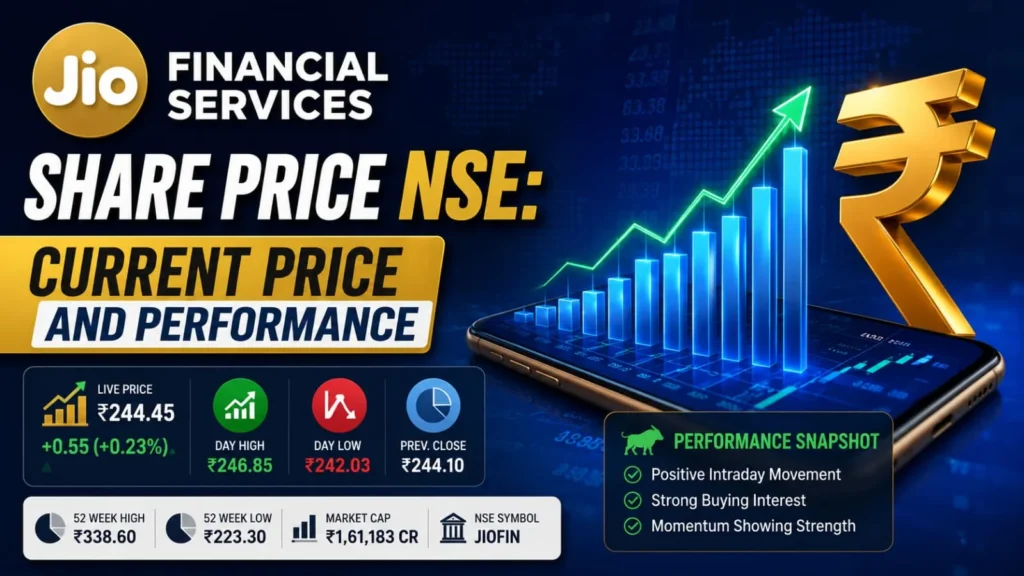
Now, let us get into the actual Jio Financial Stock Price Today details. This is the part most investors care about.
On June 19, 2026, JIOFIN opened at ₹244.00 with a previous close of ₹244.10. During that trading session, it reached a high of ₹246.85 and a low of ₹242.03. The average traded price for the day was ₹244.69.
Now, here is something important. If you look at the technical side:
The 50 DMA (Day Moving Average) stands at ₹240.27, and the 200 DMA is at ₹273.73.
The stock is currently trading below its 200 DMA. That is not a great sign for long-term bulls. It suggests the stock has been in a downtrend compared to its longer-term average.
However, on the brighter side, analyst price targets suggest a 1-year price target of ₹307, which represents about 25% upside from current levels. That is decent if you have patience.
In my experience, stocks like JFSL are not for people looking for quick money. They are for people who believe in the long-term story of financial inclusion in India.
Jio Financial Market Cap: Is It Too Big or Just Right?
Let us talk about the market cap, because this number confuses a lot of new investors.
Jio Financial has a market cap of approximately ₹1,61,414 Crore, which is down about 16.9% over one year. That is a big drop, buddy. It means the stock has lost significant value over the past year compared to its peak.
However, even at this level, it is still one of the larger companies in the NBFC (Non-Banking Financial Company) space.
Now, let us compare it with peers to understand if the valuation makes sense:
Jio Financial’s P/E ratio at around 101 significantly exceeds the industry average of 20.6, which signals caution.
If you think as I do, this is the most important red flag. When a company’s P/E is 5 times higher than the industry average, it means investors are paying a very high price for every rupee of earnings. The stock needs to grow its profits very fast to justify this valuation. And right now, the earnings are not at that level yet.
The company has a low return on equity of just 1.23% over the last 3 years, and working capital days have increased significantly from 4,699 days to 14,113 days. These are numbers that show the business is still building itself up, not yet firing on all cylinders.
JFSL Share Price History: How Did We Get Here?
Let me give you a quick background so you understand the full picture.
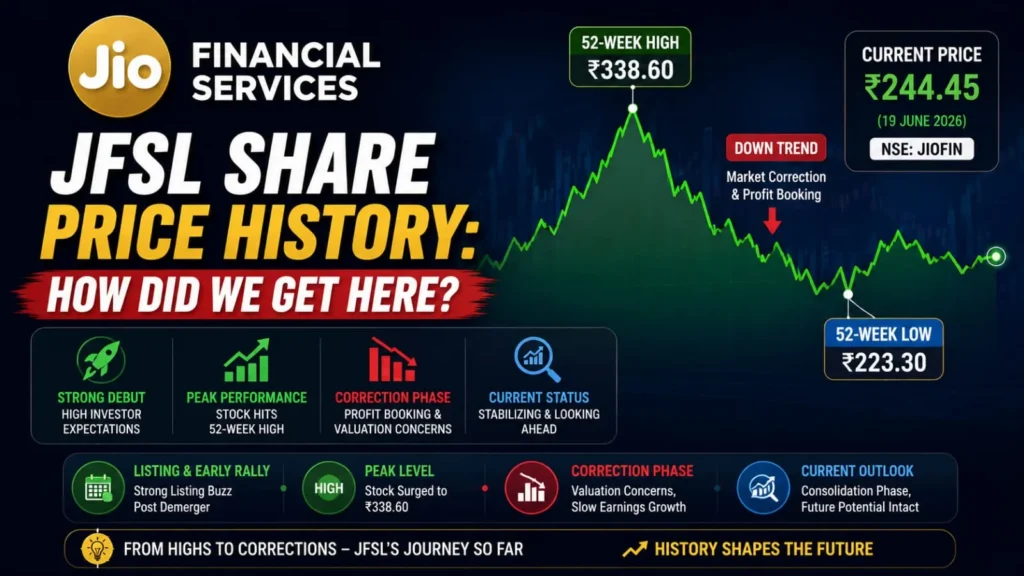
When JFSL got demerged from Reliance Industries and started trading independently, there was massive excitement. Looking at 2026, in the past 52 weeks, the stock has seen a surge to a high of around ₹338. But since then, it has come down considerably.
The 52-week high was ₹338.60, and the 52-week low was ₹223.30. The current price of around ₹244 means the stock is much closer to its 52-week low than its high.
Why did it fall? A few reasons:
- Investors realised the earnings were not catching up with the valuation.
- There was a downgrade from Hold to Sell by some analysts due to valuation concerns, and long-term returns have lagged benchmark indices.
- The NBFC space in India is competitive, and JFSL is still building its lending book.
However, here is the thing. This could also be an opportunity if you believe in the company’s 10-year potential. That is a personal call.
Jio Financial Services Shareholding Pattern: Who Owns This Stock?
Understanding who owns a stock tells you a lot about confidence levels.
As of June 2026, promoters hold 47.10%, FIIs hold 12.30%, DIIs hold 8.50%, and public shareholders hold 26.10%.
Promoter holding at 47% is decent. It means the Ambani family and Reliance group still have significant skin in the game, which is a good sign. However, notice that the FII holding is at 12.30%. Foreign investors are watching this stock but have not gone all-in yet.
Jio Financial Services Stock: Buy or Sell Right Now?
Okay, this is the question everyone wants answered. Should you buy JFSL today or not?
Let me be honest with you, because I do not believe in sugarcoating things.
Reasons to be cautious (if you want to buy):
- The P/E ratio significantly exceeds the industry average, signaling expensive valuation.
- Return on equity is very low at around 1.23% over three years.
- The stock is trading below its 200 DMA, which is a bearish signal.
- Earnings growth has been slow so far.
Reasons to be hopeful (long-term view):
- Backed by Reliance and the Ambani name, which brings trust and distribution power
- India’s financial services market is growing fast, and JFSL wants a big piece of that.
- Analyst price targets suggest around 25% upside over one year.
- The company is still in early stages, building its product range and customer base.
- JFSL is part of the Nifty 50, which means large mutual funds and ETFs are forced to hold it
If you think as I do, this is a stock you buy in small quantities over time (SIP style) if you believe in the long-term India financial services story. But if you are looking for quick returns in 3 to 6 months, this is probably not the right pick right now based on current data.
How to Check Jio Financial Services Share Price Live Today
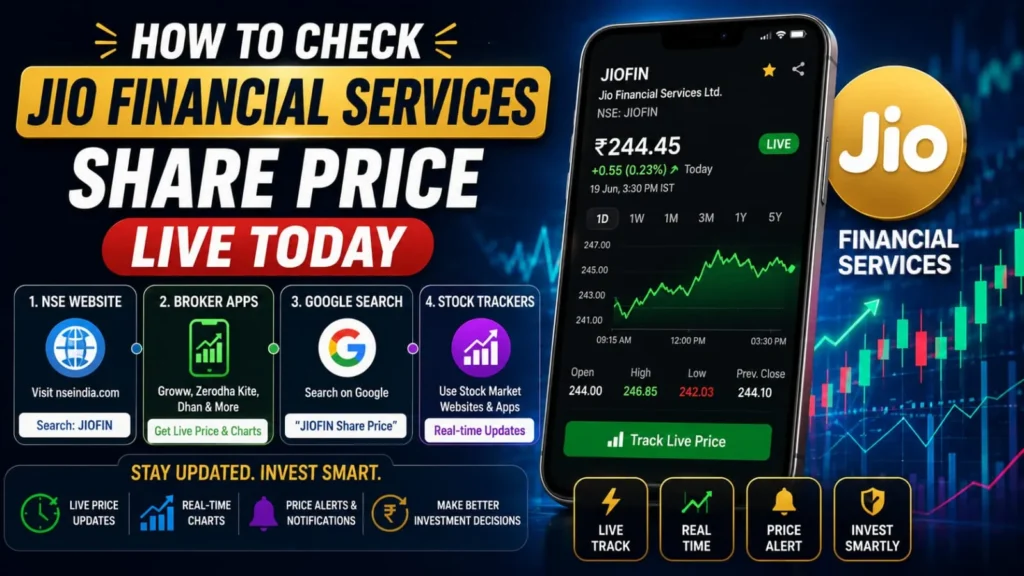
If you want to track the JFSL share price today live, here are the best ways:
- NSE Website: Go to nseindia.com and search for JIOFIN
- Groww App: Search JIOFIN, you get live prices and charts
- Zerodha Kite or Dhan App: Great for real-time tracking
- Google Search: Just type “JIOFIN share price” and you will see the live price directly on Google.
I personally use both Google and my broker app. Google gives you a quick glance, while the broker app gives you proper charts and technical data.
Jio Financial Services vs Competitors: Where Does It Stand?
Let us do a quick peer comparison so you know where JFSL stands.
Compared to peers like Bajaj Finance (which has a P/E of around 33) and Shriram Finance, JFSL’s valuation looks much more expensive.
Bajaj Finance is a well-established lender with strong profits and much better ROE. Shriram Finance has a strong customer base in vehicle finance. Both are more mature businesses with better earnings visibility.
JFSL, on the other hand, is still at an early stage. Think of it like a startup that has a very famous parent. The brand is strong, but the actual business performance needs to catch up with the market’s expectations.
Key Things to Watch for JFSL Going Forward
Here are the things that will move the Jio Financial Services share price in the coming months:
- Quarterly Earnings: Watch the profit numbers every quarter. If profits start growing fast, the stock could re-rate upward.
- Lending Book Growth: How fast is JFSL growing its loan book through Jio Finance Limited?
- JioBlack and Payment Products: New product launches could drive retail interest
- RBI Regulations: Any changes in NBFC rules could affect the business
- Reliance Group News: Any big announcement from Mukesh Ambani about JFSL’s future plans
The company reported revenue of ₹3,513 Crore and profit of ₹1,561 Crore in its recent financials. These numbers need to grow significantly for the high P/E to make sense.
Final Verdict: My Honest Take on JFSL
Tell me the truth, friends, are you willing to take a risk and pay a super-high price for a restaurant that is not even fully open yet, just because the owner is famous? Today, the situation of JFSL is similar.
The brand is strong. The ambition is big. But the math is not easy for short-term investors compared to the current price and current earnings.
For long-term investors with a 5-year or longer outlook, it may be prudent to invest at lower levels gradually. But don’t invest completely just by looking at Ambani’s name. Let the income story develop first.
Always invest based on your own research, not just name or hype. And of course, don’t forget to talk to a SEBI-registered financial advisor before making any investment decision.
Disclaimer:
This article is for informational purposes only and is not financial advice. Please consult a SEBI-registered financial advisor before making any investment decisions. Stock prices change daily and past performance does not guarantee future results.