
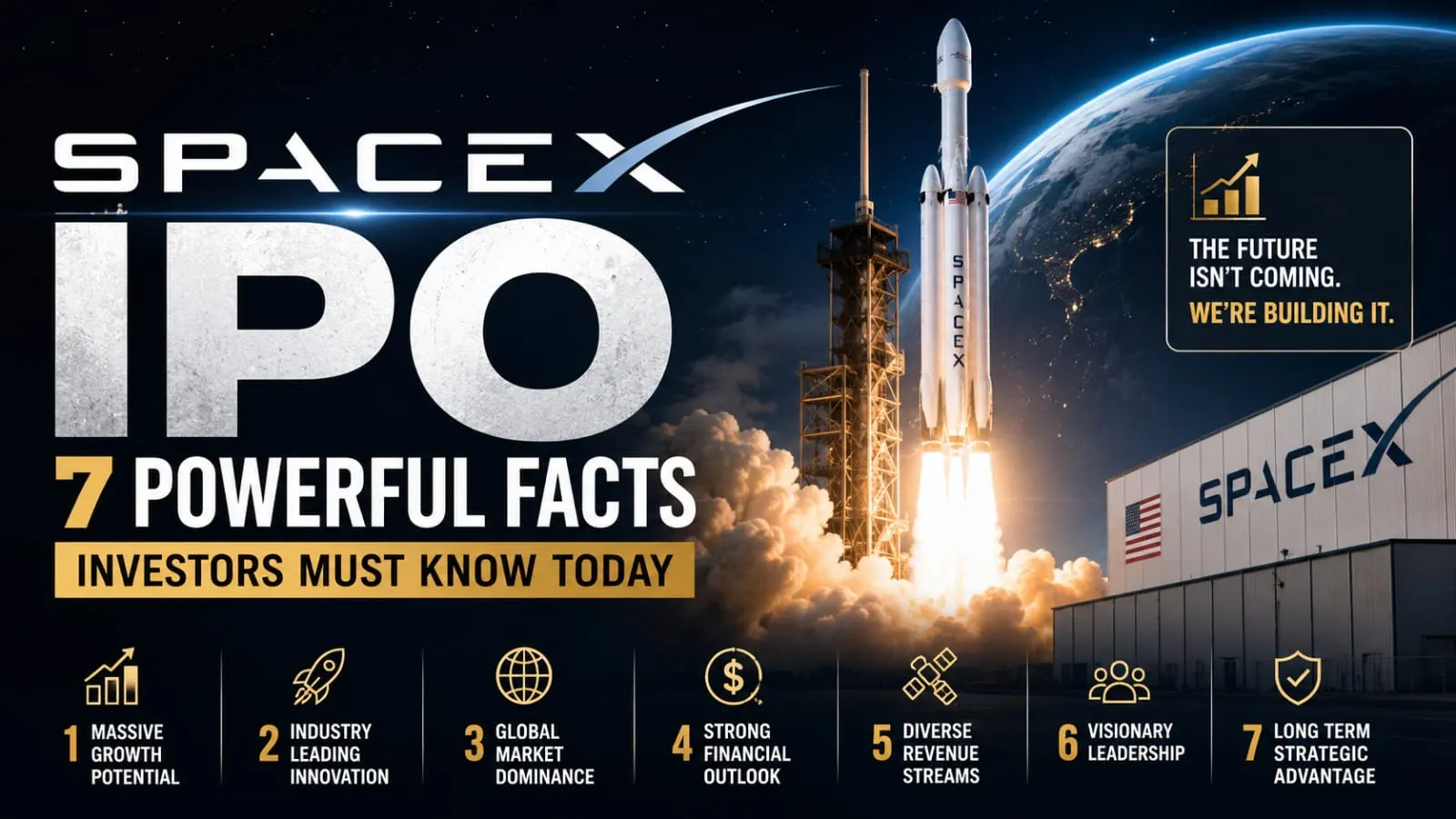
Okay, let me get straight to the point. I’ve been following the stock market and gathering IPO information for a while, and I’ve seen some amazing IPOs come and go. But when I heard that retail investor demand for the SpaceX IPO had surpassed $100 billion, I literally stopped looking at any more IPOs and just stared at my screen for a minute.
That’s not a typo. A hundred billion dollars. From ordinary people like you and me.
Retail investors bidding for shares in SpaceX’s initial public offering have already submitted orders worth more than $100 billion, as its record-breaking debut nears its final stages.
And it’s not just coming from big hedge funds or Wall Street bigwigs. It’s everyday investors sitting at home on Robinhood or Fidelity, investing their money and hoping for profits because they have greater confidence in what SpaceX is building. So in this article, we’re going to tell you everything you need to know about the SpaceX IPO.
What do you think? Why are retail investors so crazy about it? What’s the price looking like, and frankly, is all the hype really worth it? Let’s get started, in simple terms.
Highlight key
Before we go deep, here’s a quick summary of the most important facts:
- IPO Price: $135 per share
- Total Raise Target: $75 billion
- Valuation: $1.75 trillion
- Ticker Symbol: SPCX (Nasdaq)
- Listing Date: June 12, 2026
- Retail Allocation: 30% of total shares
- Total Demand (All Investors): Over $250 billion
- Retail Demand Alone: Over $100 billion
- Lead Underwriter: Goldman Sachs
- Retail Platforms: Fidelity, Robinhood, Charles Schwab, SoFi, E*TRADE
These numbers alone tell you this isn’t just another IPO. This is a once-in-a-generation event.
SpaceX IPO Price and Launch Details
What Is the IPO Price and When Did It List?
SpaceX priced its IPO after market close on June 11, 2026, with the Nasdaq debut set for June 12. The deal attracted more than $250 billion in investor demand, roughly 3.5 to 4 times the $75 billion the company is seeking to raise.
So the IPO price is set at $135 per share, and the company is targeting a massive $75 billion raise. To put this in simple words, if you wanted one share of SpaceX on listing day, you’d need roughly ₹ 11,000+. Not cheap, but for a rocket company that literally launches things to space? Some people feel it’s worth every rupee.
Goldman Sachs is leading the deal, with retail investors receiving 30% of the total float, three times the standard mega-cap norm, and the valuation more than doubling after including the December 2025 tender offer.
Now here’s something interesting. Normally, in big IPOs, regular investors get maybe 5–10% of total shares. SpaceX actually gave retail investors 30%. That’s huge. It shows Elon Musk and SpaceX actually want normal people owning a piece of this company. That was a smart move, and honestly, it made people even more excited to buy.
Why Is SpaceX's IPO Attracting So Much Retail Investor Demand?
The $100 Billion Retail Story: Tell Me the Truth.
Tell me the truth: when was the last time you saw retail investors pour $100 billion into a single IPO? Never, right? This is literally unprecedented in stock market history.
Retail investor enthusiasm is driven by the scale of the deal, SpaceX’s prominence, and trends of supporting large tech companies, with demand surpassing $100 billion.
But beyond just numbers, there’s emotion involved. SpaceX is Elon Musk’s baby. It’s the company that built the Falcon 9 rocket, which launched astronauts to the ISS, that’s building Starship, the rocket that could take humans to Mars. People aren’t just buying stock here. They’re buying into a dream.
In my experience, when people feel emotionally connected to a brand or a mission, they invest without even thinking twice. That’s exactly what’s happening here. Investors don’t just want returns. They want to say, “I own a part of SpaceX.”
SpaceX made an unusually concerted effort to draw in individual investors, including those based in Europe. Retail participants placed approximately $100 billion in orders via platforms such as Robinhood, Fidelity, and SoFi throughout the IPO process.
That level of interest alone exceeded the company’s $75 billion fundraising objective, highlighting the enthusiasm from smaller investors ahead of the stock’s launch.
Let that sink in. Retail demand alone was more than the entire amount SpaceX wanted to raise. That’s unheard of.
What Does SpaceX Actually Do? The Business Behind the IPO
Three Big Businesses Under One Rocket
If you think SpaceX is just about rockets, buddy, you’re missing a big part of the picture. SpaceX today is three businesses in one:
SpaceX is made up of three businesses: space exploration, including its Falcon and Starship rockets; connectivity, such as its Starlink satellite constellation providing high-speed internet access; and artificial intelligence, through its xAI division.
Let’s break this down:
1. Space Exploration (Rockets)
This is what most people know: Falcon 9, Falcon Heavy, and Starship. SpaceX dominates the commercial rocket launch market. No other company comes close.
2. Starlink (Internet from Space)
This is actually the money-making machine right now. Starlink provides satellite internet to millions of people around the world, including remote villages where no cable company has ever reached. This segment is profitable and growing fast.
3. xAI (Artificial Intelligence)
xAI lost $6 billion in 2025 and is on pace to burn $10 billion in 2026. This is the part that worries investors a little. AI is expensive, and SpaceX is spending heavily here. It’s a bet on the future, but it’s burning cash right now.
SpaceX IPO Valuation: Is $1.75 Trillion Really Worth It?
The Honest Numbers, Good and Bad Both
If you think as I do, you probably want someone to just be honest about valuations instead of selling you hype. So here it is.
At a $1.75 trillion valuation, the company is being priced at roughly 94 times its 2025 annual revenue of $18.7 billion. For context, Nvidia, one of the most highly valued technology firms in the market, trades at less than a quarter of that multiple.
That means SpaceX is being valued at 94x revenue. Ninety-four times. That is, a lot. Even Nvidia, the AI chip king, doesn’t trade at that kind of multiple. So yes, the valuation is ambitious. You cannot sugarcoat that.
Now the good part. SpaceX’s growth is real. Starlink keeps adding subscribers. The rocket business keeps winning government contracts. And if Starship succeeds and Mars missions become a reality someday, the upside could be enormous.
But here’s the honest truth: the company is still losing money.
SpaceX had an accumulated deficit of $41.3 billion as of March 31 and reported a net loss of $4.27 billion in the first quarter.
So, this is a growth story, not a profitable-right-now story. If you’re okay with that kind of bet, like investing in Amazon in 2002 when it was burning cash, then maybe SpaceX makes sense for you. But if you need steady profits and dividends, this is probably not your stock.
How Much Retail Demand Did the SpaceX IPO Receive, And Will You Actually Get Shares?
The Harsh Reality of Getting Allocated
Here’s where things get a little sad for retail investors. Even though $100 billion in orders came in, most people probably won’t get the shares they asked for.
SpaceX reserved as much as 30% of the deal for retail investors, around $22.5 billion in stock. That is well above the 5% to 10% slice that everyday buyers typically receive in large listings. On paper, the tranche looks generous. In practice, it is precisely why fills are being rationed. Retail orders alone topped $100 billion, meaning that segment is oversubscribed by more than three times its allocation.
So, here’s the math: $100 billion in demand, but only $22.5 billion in shares available for retail. That means even if you applied perfectly through Robinhood or Fidelity, there’s a good chance you got much less than you asked for, or possibly nothing.
Even investors who qualified, applied, and received confirmation may end up with a single share or nothing at all. Sovereign wealth funds, including Saudi Arabia’s Public Investment Fund and the Kuwait Investment Authority, placed orders worth billions, squeezing the pool further.
That’s the brutal reality of a hot IPO. Everyone wants in, but the pie is only so big.
SpaceX IPO Latest News: What Happened on Listing Day?
June 12, The Day SpaceX Went Public
The IPO price was set at $135 per share, with a total raise of $75 billion across 555.6 million shares, priced on June 11. The stock then officially started trading on Nasdaq under the ticker SPCX on June 12, 2026, which is today, as I’m writing this.
The excitement in the market was palpable. Musk’s fan base in the retail trading community was a crucial component of the deal; they placed more than $100 billion in orders for the stock, far more than the 20% of shares that had been reserved for them.
Now here’s an interesting note for long-term investors: estimates suggest that between $22 billion and $27 billion in passive investment could flow into SpaceX once it joins the Nasdaq 100, generating additional demand from index-tracking funds.
That means even people who didn’t buy directly on IPO day will end up owning SpaceX through their index funds eventually. Big deal.
Should You Invest in the SpaceX IPO? Honest Opinion
My Take, Genuine, Not Paid
Okay, this is just my personal opinion and not financial advice. Please remember that. But here’s how I see it.
The good stuff first. SpaceX is genuinely a world-changing company. Starlink is solving real problems. The rocket tech is unmatched. And the brand loyalty, as shown by $100 billion in retail demand, is off the charts.
However, I’d also be careful. A 94x revenue valuation is aggressive. The company is losing billions per quarter. And history gives us a warning: research from University of Florida professor Jay Ritter found that while IPOs from 2012 to 2021 gained an average of 23.6% on their first trading day, they delivered only 10.6% over the subsequent three years.
So, the first-day pop might be real, but long-term gains are not guaranteed. If you’re thinking about investing, be honest with yourself about your risk appetite. Don’t invest money you can’t afford to lose.
If you’re a long-term believer in space tech, Starlink growth, and Elon Musk’s vision, then even a small position might feel worth it to you. If you’re chasing a quick flip, that’s a much riskier game.
What the $100 Billion Retail Demand Means for the SpaceX IPO's Future
A New Era for Public Markets
Here’s the bigger picture, buddy. The SpaceX IPO isn’t just a business event. It’s a cultural moment. When $100 billion pours in from regular people, not just banks or billionaires, it signals that the relationship between companies and their investors is changing.
People want to own pieces of the companies they believe in. Tesla made Elon Musk fans into investors. Now SpaceX is doing the same thing, but on an even bigger scale. This is the new reality of public markets, where mission-driven companies command emotional loyalty that translates into financial demand.
Whether SpaceX delivers on that financial promise remains to be seen. But one thing is certain: the SpaceX IPO has already made history before the stock even finished its first trading day.
Final Thoughts, SpaceX IPO in Summary
Let’s wrap this up quickly. Here’s what you need to remember:
- The SpaceX IPO is priced at $135/share and will be listed on Nasdaq as SPCX on June 12, 2026.
- Retail demand exceeded $100 billion, the largest ever for an IPO.
- Total demand exceeded $250 billion, 3.5 times the target of $75 billion.
- The valuation is $1.75 trillion, which is high but reflects growth expectations.
- SpaceX is still in the red, with a net loss of $4.27 billion in Q1 2026 alone.
- Starlink is a profitable engine; the rest of the business is a bet on the future.
In my experience, the best investments are those where you understand both the dream and the risk. You see both in the SpaceX IPO. If you believe humans will someday be on Mars and Starlink will connect that planet to this planet, then this stock could truly be in your portfolio for the long term.
But go into it with your eyes wide open. The $100 billion in retail demand proves just how excited many people are about it. Just make sure your enthusiasm is based on your own research, not just rocket emojis on social media.
Disclaimer: This article is for informational purposes only; it’s not financial advice. Always consult a financial advisor before making any investment decisions.