
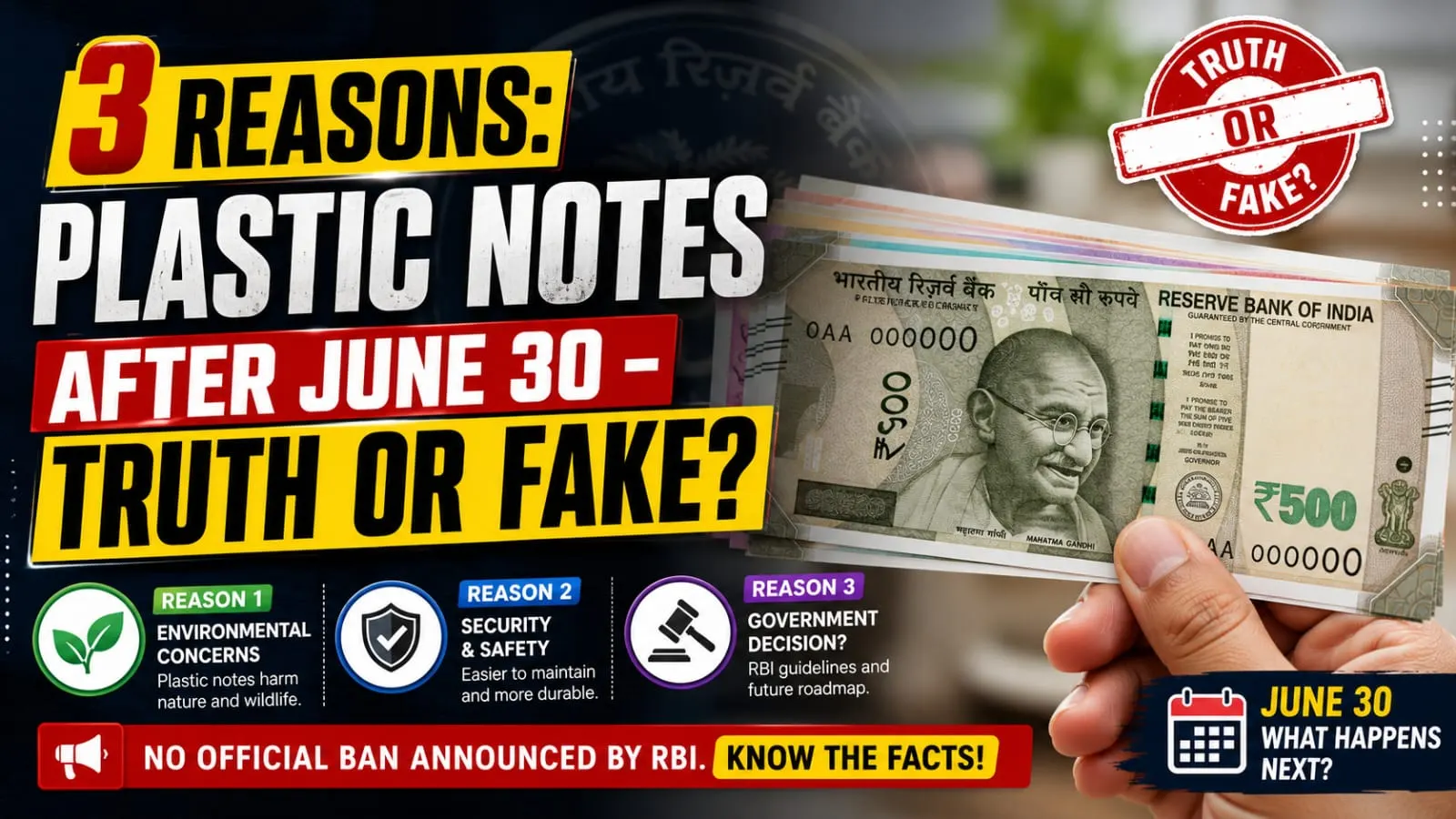
Tell me the truth, you’ve seen that message, right? Someone in your family or friends’ WhatsApp group must have forwarded it to you. You might have heard it from your neighbor or at a tea stall. The message reads something like this: “From June 30th, only plastic notes will be valid. Paper currency will become useless, just like the 500 and 1000 rupee notes. You might have seen it after 2014. The RBI is launching plastic currency notes for everyone. This is going to be the first time in India.”
And just like that, panic sets in. People start wondering, ” Should I exchange all the notes I have at the bank right now? Will all my savings be wasted? Is the government secretly going to switch to polymer currency?
I understand this completely in this article. When you’ve earned something through hard work, you start taking it very seriously. I was shocked when I first heard this message. My brother (Sugandh Kumar) called me and asked if he should go to the bank to resolve the issue. That’s when I decided to really look into it and find out what’s really going on with plastic notes in India. Why is this news going so viral?
So let’s talk about the truth, no drama, no hype, just simple facts.
Highlights at a Glance
Before we go deep, here’s a quick summary of what this article covers:
- What exactly is the viral claim about plastic notes
- What the Indian government and RBI actually said
- History of plastic currency notes in India
- What polymer notes are and how they work
- Are plastic notes really launching on June 30?
- What you should (and shouldn’t) do right now
Now let’s talk about the real story.

What Is the Viral Claim About Plastic Notes?
So the viral message going around says that the RBI, Reserve Bank of India, is going to launch plastic currency notes from June 30. According to the rumour, after this date, all paper notes will stop being valid. Only plastic notes will work. People will have to exchange their old paper money before the deadline or lose it all.
Sounds scary, right?
This kind of message spreads super fast because it hits you where it hurts your wallet. When people hear that their money might become invalid, they panic. That’s exactly how these viral rumours work. They use fear to travel fast.
Now, plastic notes or polymer notes, as they’re technically called, are actually real. They exist in countries like Australia, Canada, and the UK. These notes are made from a special plastic-like material that is more durable, harder to fake, and water-resistant. So this idea is not completely made up out of thin air.
But the big question is, is India actually switching to plastic currency notes from June 30? Let’s find out.
RBI Clarification on Plastic Notes: What Did the Government Actually Say?

Here’s the important part, so please read this carefully.
The RBI has NOT announced any new plastic notes launch for June 30 or any other date in 2025 or 2026. There is no official circular, no government press release, and no formal notification that says paper notes will stop working after June 30.
This is a completely false viral claim. The government has not made any such announcement. The Press Information Bureau (PIB), which is the official fact-checking body of the Indian government, has also flagged similar rumours in the past as fake news.
So if you’re worried about your paper currency notes becoming useless, please don’t be. Your ₹100, ₹200, and ₹500 notes are completely valid and will continue to be. There is no deadline.
In my experience, these kinds of rumours pop up every few months. Remember the fake demonetisation rumours? Same pattern. Someone creates a scary message, it goes viral on WhatsApp, and millions of people panic for no reason.
The truth about plastic note news in India is simple India has not yet officially moved to polymer currency for public use, and no such switch is happening on June 30.
So What Are Plastic Notes? A Simple Explanation
Okay, now that we’ve cleared the fear, let’s talk about plastic currency notes in a friendly way, because they’re actually quite interesting.
Polymer notes, also called plastic notes, are made from a material called biaxially oriented polypropylene (BOPP). Don’t worry about that big word, just think of it as a very thin, tough plastic film that looks and feels somewhat like paper, but is much stronger.
Here’s why countries love polymer notes:
They last longer: A polymer note can survive 2 to 3 times longer than a regular paper note.
Water resistant: You can wash it, spill tea on it, and it still works.
Harder to fake: polymer notes are much more difficult to counterfeit.
Eco-friendly in the long run: Fewer replacements mean less printing waste.
They can be recycled: Old polymer notes can be melted and reused.
Countries like Australia switched to polymer notes back in 1988. The UK introduced polymer notes in 2016. So this technology is not new: it’s tried and tested.
India's History With Polymer Notes: Did RBI Ever Try This?
Here’s a fun fact that not many people know: India actually did experiment with plastic notes once.
Back in 2000, the RBI launched a pilot project for ₹10 polymer notes. These were tested in five cities: Kochi, Mysore, Shimla, Bhubaneswar, and Patna. The idea was to see how the public reacted and whether the notes performed well in Indian conditions.
The result? Mixed feedback.
- The notes stuck together in hot weather.
- They were slippery and hard to handle for some people.
- Vending machines and ATMs had trouble reading them.
- People weren’t fully comfortable with the new texture.
After the pilot, the project was quietly dropped. The RBI did not roll out polymer notes on a larger scale.
Since then, there have been occasional talks about revisiting the idea, but nothing concrete has happened. The RBI plastic notes pilot from 2000 remains India’s only real experiment with plastic currency.
Are Plastic Notes Launching in India on June 30? The Fact Check

Let me be very direct here. No. Plastic notes are not launching in India from June 30.
This is a rumour. A fake claim. A piece of misinformation designed to make you panic.
Here’s how you can verify it yourself:
Go to rbi.org.in, the official RBI website. Search for “polymer notes” or “plastic notes 2025.” You’ll find nothing about a June 30 launch.
Check pib.gov.in, the Press Information Bureau. They regularly bust fake news. You can search for this claim there.
Search on trusted news websites if something this big were happening, every newspaper in India would be covering it. NDTV, The Hindu, Times of India, none of them have any such report.
If you think as I do, before forwarding any message about money or government policy, just take 60 seconds to check one official source. That’s all it takes.
The plastic notes’ latest news in India is simply this: there is no new launch. The rumour is false. Your paper notes are safe.
Why Do These Rumours Spread So Fast?
This is something worth understanding, buddy, because it helps you spot fake news in the future.
Rumours about currency spread fast because of three reasons:
1. They involve fear of losing money
Money is emotional. The moment someone says, “Your notes will become invalid,” your brain goes into panic mode. You stop thinking clearly and just share the message.
2. They sound half-believable
The plastic note rumour works because plastic currency is a real thing in other countries. So it doesn’t sound completely crazy. That’s what makes it dangerous.
3. WhatsApp is the perfect rumour machine
Messages travel fast on WhatsApp because people trust those from whom they receive messages. If your mother sends you a message, you believe it more than a random news article.
The solution? Always check official sources before panicking. RBI’s website, PIB’s fact-check portal, and credible newspapers are your friends.
Will Paper Currency Be Replaced by Plastic Notes in India? Future Outlook

Now, this is a fair question even if the June 30 rumour is fake, could India switch to polymer notes in the future?
Honestly? It’s possible but not imminent.
The RBI has discussed the idea of reintroducing polymer notes in the past. There have been occasional mentions in budget discussions and currency management reports. But as of now, there’s no timeline, no announcement, and no government order.
A few challenges still exist for India:
- Climate: India’s diverse weather conditions (extreme heat, humidity, floods) create unique challenges for polymer notes.
- Infrastructure: ATMs, POS machines, and currency counting machines would need upgrades
- Public comfort: Indian users, especially in rural areas, are used to paper notes
- Cost: Initial investment in switching would be massive
So even if India does move to plastic currency notes someday, it won’t happen overnight or without massive public communication. There will be months of preparation, pilot testing, and public education before any switch. No government would silently change the currency system with just a WhatsApp forward as the announcement.
What Should You Do Right Now?
Here’s my practical advice for you:
Do NOT panic. Your paper notes ₹10, ₹20, ₹50, ₹100, ₹200, ₹500, ₹2000 (those already being returned) are valid legal tender as per RBI guidelines.
Do NOT rush to the bank to exchange notes based on this rumour. There’s no need.
Do NOT forward the viral message. If you’ve already sent it, you can send a correction message. Help stop the panic.
DO verify before you share. One quick Google search or a visit to rbi.org.in is enough to save you and others from unnecessary stress.
DO educate others, especially older family members who might be more vulnerable to these kinds of rumours.
Final Thoughts: The Truth About Plastic Notes in India
The viral claim that only plastic notes will be valid in India after June 30th is completely and 100% false. The government has yet to make any official announcement. The RBI has not issued any circular regarding the replacement of paper currency with polymer notes. All your money is safe. All the paper notes you have will be valid.
Plastic currency notes are a real technology used in many countries, and India experimented with them in 2000. But to date, there is no concrete plan to replace paper notes with plastic notes in India, certainly not by June 30th, 2026. This is just a rumor spread on social media.
The next time you receive a scary message about currency on WhatsApp, take a deep breath. First, visit the RBI’s official website and see for yourself. Check out the PIB fact-check. Then, decide whether to share it or not.
Because in my own experience, most of these scary messages are just rumors. And all your own money? All your own money, friend.
Stay informed, stay calm, and don’t let rumors dictate your decisions.