

Friends, have you ever been in a situation where you suddenly needed money but did not know what to do? Many people face this problem. A few years ago, one of my family members needed money for an emergency, and we quickly realized how important it is to understand the personal loan Guide process before applying.
That experience inspired this guide. In this article, I will explain everything about personal loans in simple and easy English. You will learn how to choose the right loan, compare lenders, and get the lowest interest rate in 2026. There are no difficult words or confusing terms—just clear, practical information that anyone can understand.
Highlight key
- A complete Personal Loan Guide for beginners and experienced borrowers alike
- Current personal loan interest rates in India for 2026
- Personal loan eligibility criteria explained in simple terms
- Documents required for a personal loan
- Tips to improve your approval chances and get instant personal loan approval
- Personal loan EMI calculator explained.
- Best banks for personal loans in India
- Common mistakes to avoid when taking a personal loan
What Is a Personal Loan and Why This Guide Matters
A personal loan is money you borrow from a bank or NBFC without giving anything as security. No car, no house, no gold, nothing. That is why people also call it an unsecured personal loan. You get the money, you use it for whatever you need, and you pay it back in monthly parts called EMI.
This Personal Loan Guide exists because most people do not compare their options. They walk into their own bank, take whatever rate is offered, and never check if another lender would have given them a better deal. Tell me the truth: have you ever done this? Most of us have.
The truth is, personal loan interest rates can differ by five to eight percent between two lenders for the exact same person. That difference adds up to lakhs of rupees over a few years. So spending one extra hour comparing lenders before you sign anything is one of the smartest money moves you can make.
Personal Loan Eligibility Criteria Explained
Before any bank gives you money, they check if you can pay it back. This is called personal loan eligibility, and it is the starting point of any Personal Loan Guide. Here is what most lenders look at:
- Age: Usually between 21 and 60 years
- Income: Salaried people usually need a minimum monthly income of 15,000 to 25,000 rupees, depending on the city and lender
- Credit Score: A CIBIL score of 750 or above gives you the best rates. Below 700, your options shrink fast.
- Employment Stability: At least one to two years of work experience, with some months at your current job
- Existing Debts: If you already have many loans or credit cards, banks may hesitate
In my experience, the credit score matters the most. I have seen people with the same salary get completely different rates just because one had a 780 score and the other had a 650 score. If your score is low, it is worth waiting a few months and fixing it before you apply.
Documents Required for a Personal Loan
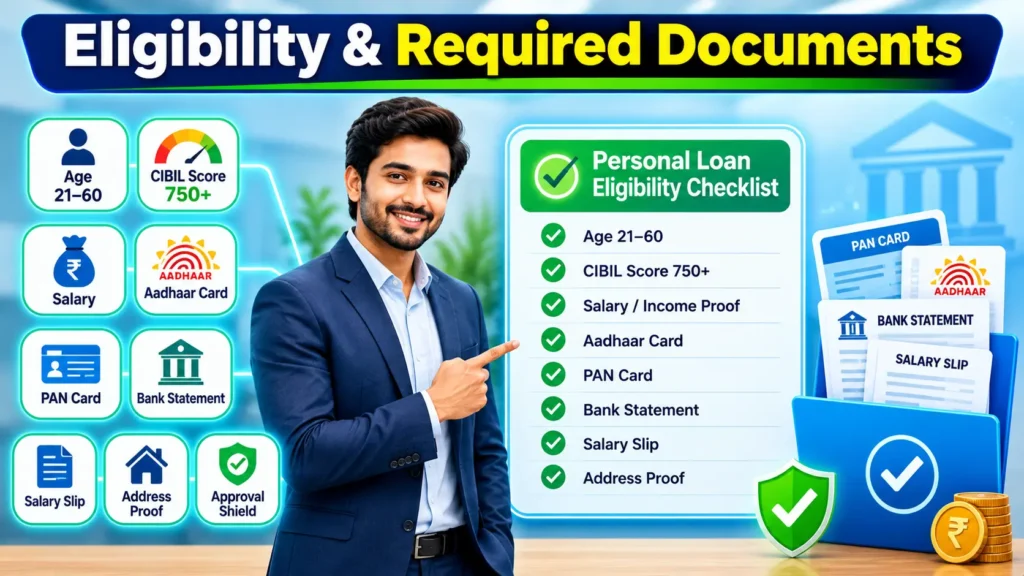
Getting your documents ready in advance makes the whole process much faster. Here is a simple checklist:
- PAN card and Aadhaar card
- Passport-size photographs
- Salary slips for the last three months (for salaried employees)
- Bank statements for the last six months
- Income tax returns (for self-employed individuals)
- Address proof, like a utility bill or rent agreement
- Business proof, if you are self-employed
If you think like I do, you will keep scanned copies of all these documents saved on your phone. It saves so much time when you apply online, and honestly, half the delay in loan approval happens simply because people forget to upload one document.
Personal Loan Interest Rate in 2026: What to Expect
Now let’s talk about the number that matters most, the personal loan interest rate. As of mid 2026, personal loan interest rates in India generally start around 9.99% per year for the best borrowers and can go up to 36% or higher for riskier profiles.
Here is a rough idea of starting rates from major banks this year:
- HDFC Bank: starting around 9.99% p.a.
- State Bank of India: starting around 10.00% p.a.
- ICICI Bank: starting around 10.45% p.a.
- Kotak Mahindra Bank: starting around 10.50% p.a.
- Axis Bank: starting around 10.99% p.a.
- IDFC FIRST Bank: starting around 10.49% p.a.
Please remember, these are starting rates for the strongest applicants. Your actual rate depends on your credit score, income, employer, and your relationship with the bank. NBFCs and digital lenders usually charge more, sometimes 12% to 24% or even higher for instant personal loan products.
Government employees and people working at large, well-known private companies often get better deals. Banks trust stable jobs, and it shows in the rate they offer.
How Personal Loan Interest Is Calculated
Understanding how personal loan interest is calculated helps you avoid surprises. Most Indian lenders use the reducing balance method. This means interest is charged only on the amount you still owe, not on the original loan amount.
So every time you pay an EMI, a part goes toward interest, and a part goes toward reducing your actual loan amount. As your outstanding balance drops, the interest portion of your EMI also drops slowly over time, while the principal portion increases.
This is different from the flat rate method, where interest is calculated on the full loan amount for the entire tenure. Flat rate loans always end up more expensive, even if the advertised rate looks similar. Before you sign, ask your lender how they calculate it.
Personal Loan EMI Calculator: How It Helps You Plan
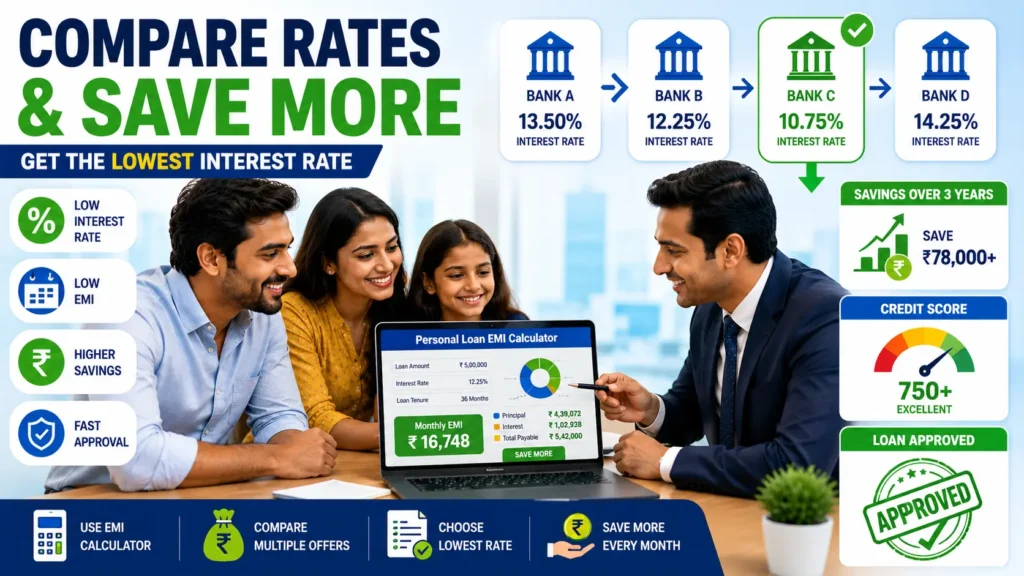
A personal loan EMI calculator is a free tool available on almost every bank website. You simply enter the loan amount, interest rate, and tenure, and it shows you the exact monthly payment.
For example, if you borrow 5 lakh rupees for three years at 15% interest, your EMI comes to around 17,333 rupees per month, with total interest of about 1.24 lakh rupees over the loan period. Now, if you find a lender offering 12% instead, that same loan would cost you less every month and save you a good amount overall.
I always tell friends to run three or four different combinations on a personal loan calculator before applying. It only takes two minutes, and it can save you thousands of rupees. This small step is honestly one of the most underrated parts of any good Personal Loan Guide.
Best Indian Banks for Personal Loans in 2026
There is no single “best” bank for everyone. The right choice depends on your profile. However, here is a general idea:
- For government employees and pensioners: SBI is usually a strong and reliable choice
- For private sector salaried professionals: HDFC Bank and ICICI Bank are popular for competitive rates and fast processing.
- For quick digital approval: fintech apps and online lenders provide instant personal loans, but they often charge higher interest rates.
- For self-employed individuals: NBFCs like Bajaj Finance and Tata Capital are often more flexible with documentation.
Before choosing any option, first check if your salary account bank already has a pre-approved loan offer for you. These offers are often cheaper than what you will find applying cold at another bank.
How to Apply for a Personal Loan Online
Every good Personal Loan Guide should also cover the actual application steps, not just theory. Applying for an online personal loan today is much simpler than it used to be. Here is the basic process:
- Check your credit score first, ideally through a free platform.
- Compare interest rates across at least three to four lenders.
- Use a personal loan EMI calculator to estimate your monthly payment.
- Fill out the online application form with your personal and income details.
- Upload the required documents.
- Wait for verification, which can take anywhere from a few hours to a few days.
- Once approved, the loan amount is usually transferred directly to your bank account.
Many lenders now offer instant personal loan approval for existing customers with a clean repayment history, sometimes within minutes. However, do not rush blindly. Always read the loan agreement carefully before accepting.
Personal Loan for Salaried vs Self-Employed Individuals
Banks treat salaried and self-employed applicants a bit differently. Salaried employees usually get faster approval because their income is easy to verify through salary slips and bank statements.
Self-employed individuals, on the other hand, need to show income tax returns, business proof, and sometimes profit and loss statements. The process can take a little longer, and interest rates might be slightly higher due to perceived income instability.
If you are self-employed, keep at least two to three years of clean financial records ready. It genuinely makes a big difference in both approval speed and the interest rate you are offered.
Personal Loan vs Credit Card Loan: Which Is Better?
This is a common question, and honestly, the answer depends on your need. A personal loan usually offers a lower interest rate than a credit card loan, especially for larger amounts. Credit card loans are convenient for very small, short-term needs but can carry interest rates of 30% or higher.
If you need a large sum, say for a wedding, medical emergency, or home renovation, a personal loan is almost always the smarter and cheaper choice. If it is a small, one-time expense you can repay within a month or two, a credit card might work fine.
Personal Loan Tips: How to Improve Approval Chances
This part of the Personal Loan Guide is where the real savings happen. Here are a few honest personal loan tips that actually work:
- Keep your credit score above 750 whenever possible.
- Avoid applying to multiple lenders at the same time, as it can hurt your score.
- Reduce existing debt before applying for a new loan.
- Choose a shorter tenure if you can afford higher EMIs, since it usually means a lower interest rate.
- Maintain a good relationship with your primary bank.
Personal Loan Taking Mistakes You Should Avoid
Friends, I have seen people make the same mistakes again and again, even after reading a full Personal Loan Guide. Here are the biggest ones to avoid:
- Not comparing rates across multiple lenders before applying.
- Ignoring processing fees and hidden charges
- Borrowing more than what is actually needed
- Choosing a longer tenure just to reduce the EMI, without checking total interest paid
- Missing EMI payments, which damages your credit score badly
Avoiding these simple mistakes can save you a lot of money and stress in the long run.
Disclaimer
The information in this article is meant to help readers understand personal loans. It is not financial advice. Interest rates, loan terms, and eligibility rules may change over time. Always verify the latest details directly with your bank or NBFC before making any loan decision.
FAQ's
What is the lowest personal loan interest rate available in India in 2026?
Answer: The lowest starting rates are around 9.99% per year, offered by select banks to applicants with excellent credit scores and stable income sources.
What CIBIL score is needed for the best personal loan interest rate?
Answer: A CIBIL score of 750 or above generally gets you the lowest personal loan interest rates and faster approval from most banks and NBFCs.
How much loan amount can I get on a personal loan?
Answer: Personal loan amounts usually range from 50,000 rupees up to 50 lakh rupees, depending on your income, credit score, and chosen lender.
Is it better to choose a bank or an NBFC for a personal loan?
Answer: Banks usually offer lower interest rates, while NBFCs approve loans faster with flexible documentation, often at slightly higher rates.
Can self-employed individuals get an instant personal loan?
Answer: Yes, but approval may take longer since lenders need income tax returns and business proof to verify repayment capacity properly.
Does a personal loan affect my credit score?
Answer: Yes, timely EMI payments improve your credit score over time, while missed payments or defaults can lower it significantly.