

Have you ever noticed that the money you received was less than what you were expecting? Maybe your salary was lower than the amount mentioned in your offer letter, or your bank paid less interest than you calculated. The reason is usually TDS (Tax Deducted at Source).
In simple words, TDS is a tax that is deducted before the money is paid to you. Instead of collecting the full tax later, the government asks the payer to deduct a small amount in advance and deposit it on your behalf.
I remember when I received my first salary. I was surprised because the amount in my bank account was less than what I had expected. After asking my HR, I learned about TDS in just a few minutes. Once I understood how it worked, handling taxes became much easier.
In this guide, I’ll explain TDS basics in the simplest way possible. There are no complicated tax terms or confusing explanations—just clear, easy language that anyone can understand.
Highlight key
- TDS means Tax Deducted at Source, cut before payment reaches you
- Applies to salary, bank interest, rent, professional fees, and more
- TDS rates in 2026 range from 1% to 30% depending on payment type
- Form 16 and Form 26AS help you check your TDS records.
- You can claim a TDS refund while filing your income tax return.
- Many senior citizens now get higher exemption limits on interest income.
What Is TDS? Simple Meaning For Beginners
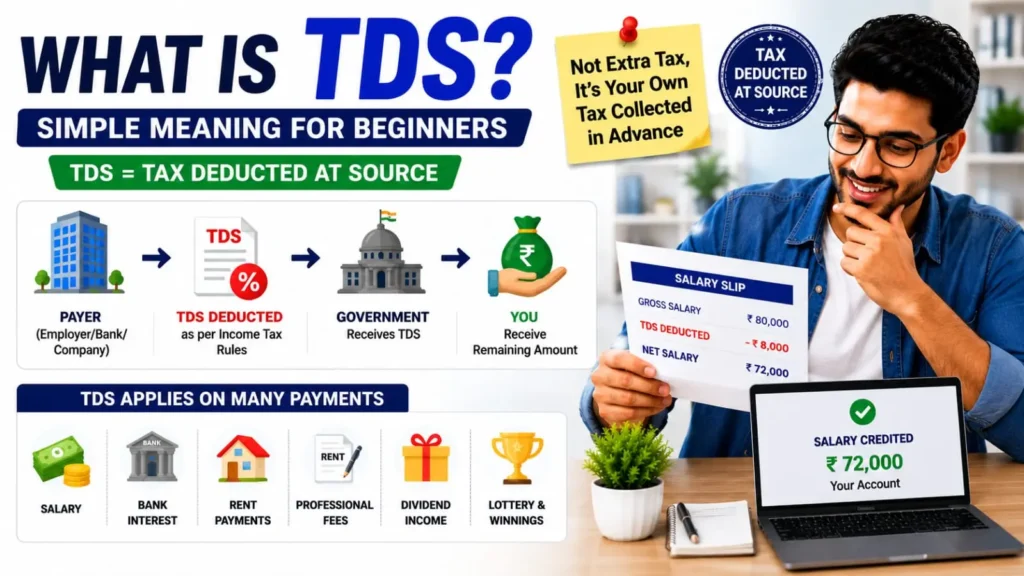
Let us start from the basics. What is TDS in the easiest words? It is a system where the government collects tax little by little, right at the time income is paid to you, instead of waiting for you to pay it all at year end.
Think of it like this. Your office wants to pay you salary. Before the money reaches your bank account, your employer removes a small tax portion and sends it directly to the government. You get the rest. That removed portion is TDS.
Friends, this system exists so that tax collection stays steady through the year, and people do not forget to pay tax later. It also helps the government catch tax evasion early, because every payment gets recorded.
TDS is not extra tax. It is your own tax, just collected in advance. After filing the return, the tax already deducted is considered part of your total tax payment, which gets included in your final tax calculation. Sometimes you get money back too, which we will talk about ahead.
In my experience, once you understand this one point, that TDS is advance tax collection and not a punishment, everything else becomes much easier to follow.
Who Deducts TDS And Why It Matters
Now let us talk about who actually deducts TDS. It is usually the person or company making the payment, not the person receiving it. This payer is called the deductor, and the person receiving payment is called the deductee.
Common deductors include employers paying salary, banks paying interest, companies paying rent, and businesses paying professional fees to freelancers or consultants. If you run a small business and pay a contractor more than a certain limit, you may also need to deduct TDS and deposit it with the government.
Tell me the truth, have you ever wondered why your bank suddenly sends you a message about TDS on fixed deposit interest? That happens because banks are legally required to deduct tax before crediting your interest, once it crosses the threshold limit set by the government.
This TDS rules structure matters for both sides. If you are a deductor and you forget to deduct or deposit TDS on time, you face penalty and interest charges. If you are a deductee, this system ensures your tax record stays clean and visible in government records, which actually helps you during loan applications and visa processes too.
TDS Rates For FY 2026-27 You Should Know
Friends, TDS rates depend completely on the type of income. Let me break down the common ones so this stays practical and not confusing.
- Salary: TDS is calculated based on your income tax slab, after your deductions and chosen tax regime, so there is no fixed flat rate here
- Bank interest (Section 193/194A): 10% TDS applies once interest crosses ₹50,000 for regular individuals, and the limit is now ₹1,00,000 for senior citizens
- Rent payments: TDS applies once rent crosses ₹6,00,000 in a year, a big relief compared to older limits
- Professional or technical fees: TDS is usually deducted once payment crosses ₹50,000 in the year
- Dividend income: 10% TDS if dividend exceeds ₹10,000
- Lottery, game show, and online game winnings: flat 30% TDS, and for online games, TDS applies from the very first rupee with no minimum threshold
- Purchase of goods under Section 194Q: continues to apply for larger businesses
If your PAN is not linked or not provided, TDS gets deducted at a higher rate, often 20% or more. So friends, always keep your PAN updated wherever payments are involved.
However, do remember that under the new Income Tax Act, 2025, many old sections have been renumbered, mainly grouped under Section 393 now. The rates and thresholds stayed mostly similar, but the section numbers changed. If you see a new section number on your Form 16 or 26AS, do not panic, it usually means the same old rule with a new tag.
How To Calculate TDS: A Simple Example
Let us make TDS calculation easy with a real example. Suppose your annual salary is ₹8,00,000 after standard deductions, and this falls into a tax slab where your total yearly tax works out to ₹40,000.
Your employer will not deduct this whole amount in one shot. The company doesn’t deduct the entire ₹40,000 at once; instead, the ₹40,000 TDS amount is spread evenly across 12 months, so about ₹3,333 is deducted from your salary each month. This way, by the end of the year, your full tax liability is already paid through monthly deductions.
Now take another example for bank interest. Say you earned ₹70,000 interest from a fixed deposit in a year, and you are below 60 years of age. Since this crosses the ₹50,000 threshold, the bank will deduct 10% TDS, which comes to ₹7,000. You receive ₹63,000, and ₹7,000 already sits with the government as your advance tax payment.
If you think like I do, once you see actual numbers like this, TDS calculation stops feeling scary and starts feeling like simple arithmetic. Now let’s talk about how TDS on salary works in more detail, because this affects almost every working person in India.
TDS On Salary: What Every Employee Should Know
TDS on salary is probably the most common form of TDS that touches almost every earning Indian. Your employer estimates your total yearly income, subtracts eligible deductions like 80C investments, HRA, and standard deduction, then calculates tax on the remaining amount based on the tax slab you choose.
This estimated tax gets divided across the months, and that monthly portion is deducted from your salary. If you switch your tax regime, submit late investment proofs, or your income changes mid-year, your employer adjusts the TDS calculation accordingly in later months.
Here is something honest I want to tell you. Many people submit their investment proofs late, near January or February, and this causes very high TDS deduction in the last two or three months of the financial year. Friends, my honest advice is to submit your proofs early, this small habit saves you from a cash crunch later.
At year end, your employer issues Form 16, a certificate showing your total salary, deductions, and TDS deposited on your behalf. This document becomes very important during income tax return filing, so keep it saved safely.
Form 16, Form 26AS, And How To Verify TDS Online
Friends, two documents matter a lot when you deal with TDS basics: Form 16 and Form 26AS.
Form 16 is given by your employer and shows your salary breakup along with TDS deducted through the year. Form 26AS, on the other hand, is a consolidated tax statement available on the income tax portal, showing all TDS deducted by every deductor, whether it is your employer, bank, or any other payer.
To check TDS online, log in to the income tax e-filing website, go to the “Income Tax Forms” or “AIS” section, and download your Form 26AS or Annual Information Statement. This lets you verify that whatever TDS was deducted from your income has actually been deposited with the government under your PAN.
In my experience, checking Form 26AS at least twice a year is a smart habit. Sometimes deductors make mistakes or delay deposits, and catching this early saves you from mismatch issues while filing your return.
Difference Between TDS And Income Tax
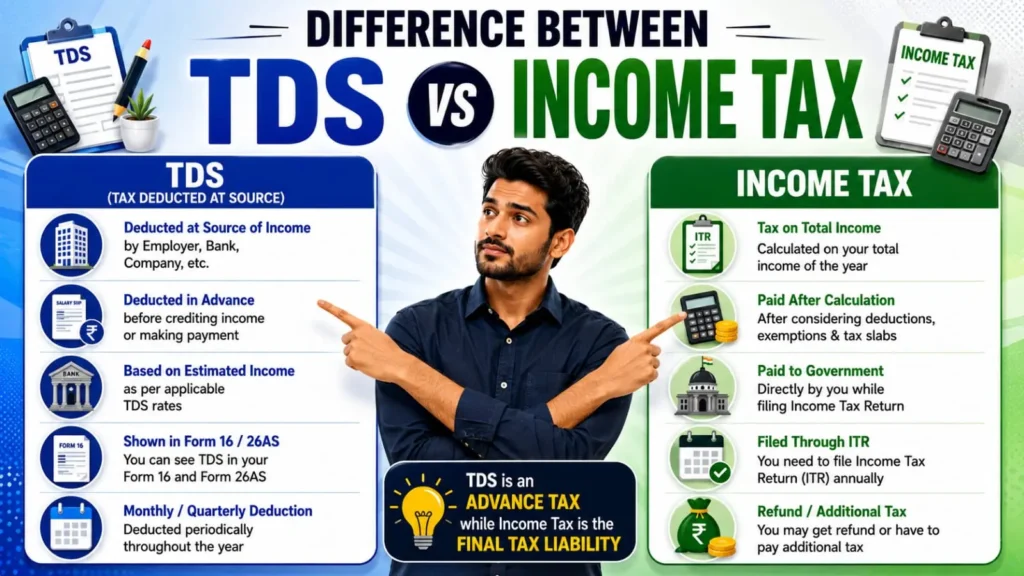
A lot of beginners get confused here, so let me clear this up simply. TDS is not a separate tax. It is a part, or an advance payment, of your total income tax.
Income tax is the full tax amount you owe to the government based on your total yearly income from all sources. TDS is just the portion collected in advance, at the source of specific payments, throughout the year.
When you file your income tax return, you calculate your total tax liability, then subtract whatever TDS was already deducted. If your total tax owed is less than TDS deducted, you get a refund. If your TDS deducted is less than your actual tax liability, you pay the remaining balance.
So friends, TDS and income tax are not two different things fighting each other, they are simply two stages of the same tax journey.
How To Claim TDS Refund
If more TDS got deducted than your actual tax liability, you can claim that extra amount back. This usually happens when your total income falls below the taxable limit, but a bank or company still deducted TDS due to threshold rules.
To claim this refund, file your income tax return honestly showing your full income and the TDS already deducted, as reflected in Form 26AS. The income tax department processes your return, calculates your real tax liability, and refunds the extra amount directly to your bank account, usually within a few weeks to a couple of months.
Tell me the truth, many beginners simply skip filing returns thinking their income is too small. If you don’t pay attention to this mistake, it’s possible that your refund may never reach your account. Filing on time is the only way to claim back that extra TDS.
Common TDS Mistakes To Avoid
Let me be honest and practical here, because this section can save you real trouble.
- Not updating PAN details, which leads to higher TDS deduction
- Submitting investment proofs late, causing heavy deduction in later months
- Ignoring Form 26AS mismatch, which can delay your refund
- Forgetting that freelance or professional income also attracts TDS
- Missing TDS return filing deadlines if you are a deductor running a business
If something is bad, I will say it clearly: many small business owners still treat TDS compliance casually, and this leads to notices and penalties later. It is far easier to stay updated month by month than to fix a full year mess at once.
TDS Return Filing: A Quick Overview
If you are a deductor, meaning you deduct TDS from someone else’s payment, you also need to file TDS returns quarterly. These returns report how much TDS you deducted and deposited during that quarter, along with details of the person from whom it was deducted.
The process generally involves collecting PAN details of deductees, calculating correct TDS as per applicable rates, depositing the amount with the government before the due date, and then filing the quarterly return using the correct form. Late filing attracts fees and interest, so staying on schedule really matters.
However, if you are only a salaried employee or someone simply receiving payments, you generally do not need to worry about TDS return filing yourself, your employer or the deductor handles it.
Final Thoughts On TDS Basics
Friends, the basics of TDS are not as difficult as they sound. Once you understand that it’s just an advance tax collection, which is later matched with your actual tax liability, the whole system starts making a lot of sense very easily. Keep your PAN updated, regularly check Form 26AS, submit investment proofs on time, and file your return honestly every year, considering it your duty. These small habits make your TDS journey very easy and stress-free.
Disclaimer
This article is for general information only and should not be treated as professional tax advice. TDS rates, thresholds, and rules mentioned here are based on information available for FY 2026-27 and may change through future government notifications. Please consult a qualified tax professional or refer to the official Income Tax Department website before making financial decisions.
FAQ's
Q1. What is TDS in simple words?
TDS means Tax Deducted at Source. It is tax cut from your income, like salary or interest, before the payment actually reaches your bank account.
Q2. How is TDS different from income tax?
TDS is not separate tax, it is advance payment of your income tax. It gets deducted early and later adjusted against your total yearly tax liability.
Q3. What is the TDS rate on salary?
There is no fixed TDS rate on salary. Your employer calculates tax based on your income slab, deductions, and chosen tax regime, then deducts it monthly.
Q4. How can I check my TDS online?
Log in to the income tax e-filing portal and download Form 26AS or your Annual Information Statement. It shows all TDS deducted under your PAN.
Q5. Can I get a refund if extra TDS is deducted?
Yes, if your total tax liability is lower than TDS deducted, you can claim refund by filing your income tax return with accurate income details.
Q6. What is the difference between Form 16 and Form 26AS?
Form 16 is issued by your employer showing salary and TDS details. Form 26AS is a consolidated statement showing TDS from all deductors under your PAN.