
Hearing the words income tax can make almost anyone feel a little uneasy. I know that feeling because I experienced it myself. When I received my very first paycheck, I was excited to see my hard-earned money. But that excitement quickly turned into confusion after noticing that a portion of my salary had been deducted as tax. I had so many questions and very few answers. That moment inspired me to understand the basics of income tax in the simplest way possible.
If you’re starting your first job, filing taxes for the first time, or managing income from a small business, you’re in the right place. This beginner-friendly guide explains income tax basics using clear, everyday language that anyone can understand. There are no complicated financial terms or lengthy explanations—just practical information shared in a simple, friendly way, as if we’re chatting over a cup of tea.
Highlight key
- Income tax basics mean understanding how the government taxes your yearly income.
- India has two tax systems now: the new tax regime and the old tax regime.
- Income up to ₹4 lakh is tax-free under the new regime, and up to ₹12 lakh can be effectively tax-free with a rebate.
- The old regime still gives you deductions like Section 80C and 80D.
- Filing your Income Tax Return (ITR) on time saves you from penalty and stress.
- Tax saving is legal and smart, not something to fear.
What Is Income Tax? A Simple Explanation
Let’s start with the basics. Income tax is the money you pay to the government from what you earn in a year. This is one of the most important income tax basics every person should know. The government uses this money to build roads, run schools, pay for hospitals, and manage the country.
Now here is the good part. You don’t pay tax on every rupee you earn. The government sets some limits, called tax slabs. Only the income above these limits gets taxed. So if your income is low, you may pay zero tax. If your income is higher, you pay tax step by step, not on the full amount at one high rate.
In my experience, most beginners get confused here. They think that if they cross a tax slab, their entire income gets taxed at the higher rate. That is wrong. Only the extra amount above that slab gets the higher rate. This is called a progressive tax system, and once you understand this, income tax basics start to feel much less scary.
How Income Tax Works in India
Income tax basics also include knowing who needs to pay tax. In India, any person whose income is above the basic exemption limit must pay income tax. This includes salaried employees, business owners, freelancers, and even people who earn from rent or investments.
The financial year in India runs from April to March. Whatever you earn in this period becomes your income for that year. Then, based on your total income, tax slabs decide how much tax you owe. Tell me the truth, did you know that even interest from your savings account can be taxable after a certain limit? Many beginners miss this small detail.
Now let’s talk about how the tax gets calculated. First, you add all your income sources. This can be salary, business profit, rental income, or capital gains. Then you subtract any allowed deductions or exemptions. What remains is called your taxable income. Tax is charged only on this taxable income, not your total income.
How Income Tax Works in India
Income tax basics also include knowing who needs to pay tax. In India, any person whose income is above the basic exemption limit must pay income tax. This includes salaried employees, business owners, freelancers, and even people who earn from rent or investments.
The financial year in India runs from April to March. Whatever you earn in this period becomes your income for that year. Then, based on your total income, tax slabs decide how much tax you owe. Tell me the truth, did you know that even interest from your savings account can be taxable after a certain limit? Many beginners miss this small detail.
Now let’s talk about how the tax gets calculated. First, you add all your income sources. This can be salary, business profit, rental income, or capital gains. Then you subtract any allowed deductions or exemptions. What remains is called your taxable income. Tax is charged only on this taxable income, not your total income.
Taxable Income Meaning With Examples
This part of income tax basics confuses a lot of people, so let’s make it simple. Taxable income is not the same as your total salary. It is your income after removing deductions and exemptions allowed by law.
For example, suppose you earn ₹8 lakh a year as salary. If you claim deductions worth ₹1.5 lakh under Section 80C, and you get a standard deduction too, your taxable income becomes much lower than ₹8 lakh. Tax is calculated only on this lower amount.
If you think as I do, this is actually good news. It means smart planning can genuinely reduce how much tax you pay, legally and safely. Understanding taxable income is one of the most useful income tax basics for saving money every year.
New Tax Regime vs Old Tax Regime Explained
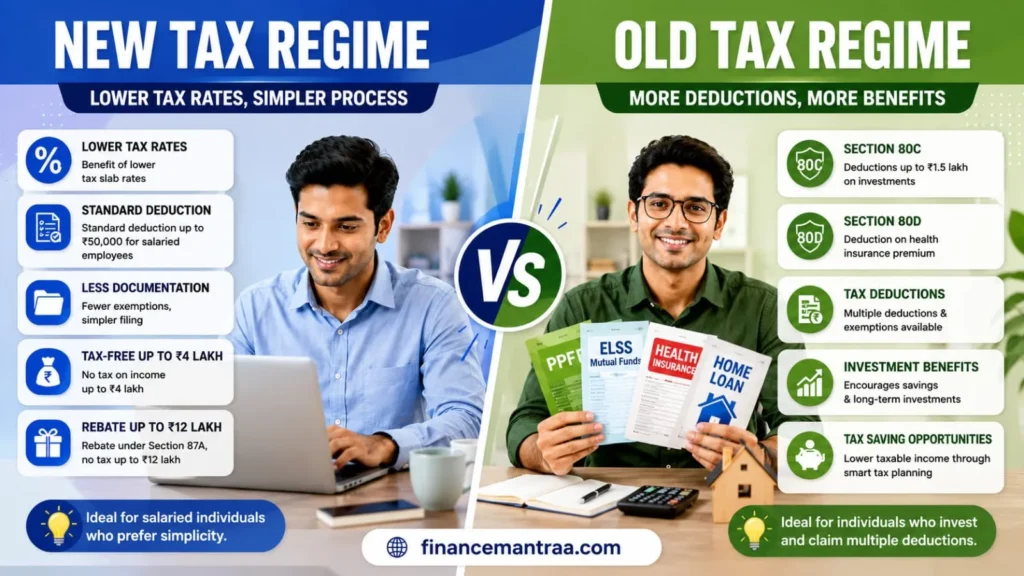
This is probably the biggest confusion in income tax basics today. India currently has two tax regimes, and you can choose either one.
New Tax Regime: This is now the default option. It offers lower tax rates but very few deductions. For the financial year 2026-27, income up to ₹4 lakh is tax-free. After that, tax rates rise slowly from 5% up to 30% as income increases. Thanks to a special rebate, people with taxable income up to ₹12 lakh pay no tax at all. Salaried people also get a standard deduction, which pushes this tax-free limit even higher.
Old Tax Regime: This regime has higher tax rates but allows many deductions and exemptions. Income up to ₹2.5 lakh is tax-free here. If you invest in things like PPF, ELSS, life insurance, or pay for health insurance, you can claim deductions and lower your taxable income significantly.
So which one is better? Honestly, it depends on your situation. If you invest a lot and claim many deductions, the old regime might save you more. If you prefer simple filing without too much paperwork, the new regime works well. In my experience, salaried people with fewer investments usually benefit from the new regime, while people who actively invest for tax savings often prefer the old one.
Income Tax Slabs Explained for Beginners
Understanding income tax slabs is a core part of income tax basics.
Here is how the new tax regime slabs look for the financial year 2026-27:
- Up to ₹4 lakh: No tax
- ₹4 lakh to ₹8 lakh: 5%
- ₹8 lakh to ₹12 lakh: 10%
- ₹12 lakh to ₹16 lakh: 15%
- ₹16 lakh to ₹20 lakh: 20%
- ₹20 lakh to ₹24 lakh: 25%
- Above ₹24 lakh: 30%
Under the old tax regime, the slabs are different:
- Up to ₹2.5 lakh: No tax
- ₹2.5 lakh to ₹5 lakh: 5%
- ₹5 lakh to ₹10 lakh: 20%
- Above ₹10 lakh: 30%
Senior citizens get some extra relief in the old regime, with a higher basic exemption limit. These income tax slabs change from time to time based on the yearly budget, so always check the latest numbers before filing.
How to Calculate Income Tax in India
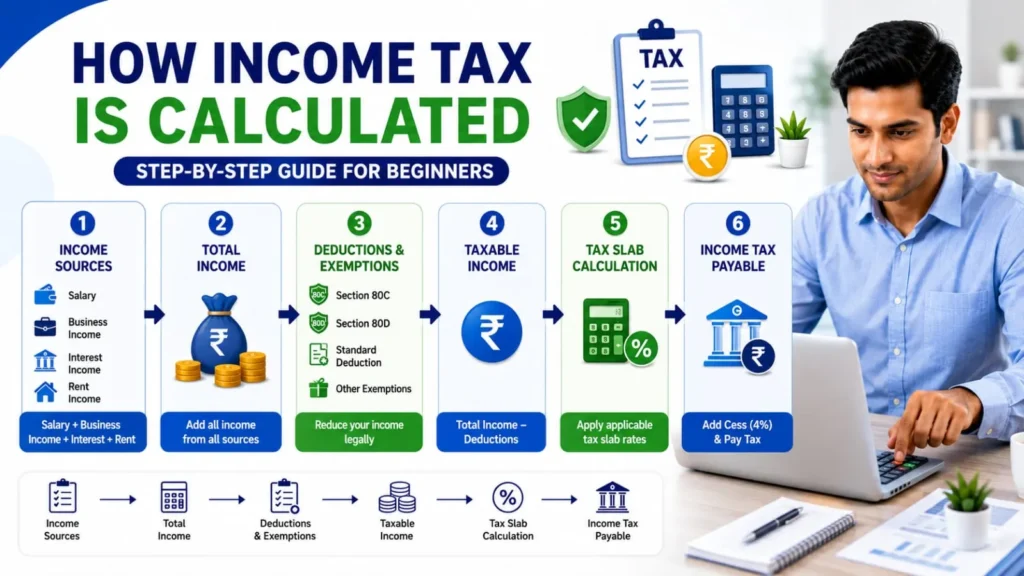
Now let’s talk about the actual income tax calculation, step by step. This part of income tax basics feels tricky at first, but it’s simpler than it looks.
Step one, add up all your income for the year, salary, business income, rent, or interest. Step two: subtract eligible deductions and exemptions, like Section 80C or the standard deduction. Step three: Use the tax slab rates on the remaining taxable income, applying each rate only to the portion of income in that slab. Step four: add any applicable cess, which is usually 4% on the total tax amount.
For example, if your taxable income is ₹10 lakh under the new regime, you won’t pay 10% on the full ₹10 lakh. You pay nothing on the first ₹4 lakh, 5% on the next ₹4 lakh, and 10% only on the remaining ₹2 lakh. This slab-wise calculation is exactly why income tax basics matter so much. Once you see the real math, taxes feel much less scary.
Income Tax Deductions Under Section 80C and Others
Now let’s talk about tax saving, because this is where income tax basics become genuinely useful. Under the old regime, Section 80C allows you to claim deductions up to ₹1.5 lakh. This includes investments like PPF, ELSS mutual funds, life insurance premiums, and even your child’s tuition fees.
There are more sections too. Section 80D allows deductions for health insurance premiums paid for yourself and your family. Home loan interest can also give you tax benefits under certain sections. However, most of these deductions are not available under the new tax regime, so this is an important point while choosing between the two.
I’ll be honest with you here. If something is good, I will say it clearly, and if something is bad, I will say that too. The new regime is simple, but you lose these deduction benefits. The old regime is more work with paperwork and proof collection, but it rewards people who plan and invest wisely. Choose based on your own financial habits, not just what others are doing.
Income Tax Filing Process for Salaried Employees
Filing your Income Tax Return, commonly called ITR, is a key part of income tax basics that many people delay till the last moment. Please don’t do that. Filing on time keeps you safe from penalties and stress.
For salaried employees, the process usually starts with your Form 16, which your employer gives you. It shows your salary details and the tax already deducted. You then log in to the income tax portal, choose the right ITR form, fill in your income details, claim your deductions, and submit the return.
In my experience, first-time filers often panic when looking at the portal. My honest advice is to keep all your documents ready first: salary slips, Form 16, bank interest details, and investment proofs. Once you have everything organised, the actual filing takes less time than you expect.
Income Tax Basics for Students and Young Professionals
If you are a student who just started earning through freelancing, internships, or part-time work, income tax basics still apply to you. Even a small income can require filing if it crosses the exemption limit.
Now let’s talk about why young professionals should care early. Understanding income tax basics now saves you from confusion later when your salary grows. Start tracking your income, save your salary slips, and learn simple terms like taxable income and deductions from day one. Trust me, this habit becomes very valuable within a few years.
Common Income Tax Mistakes to Avoid
However, many beginners make small mistakes that create big problems later. Let’s go through a few common ones so you can avoid them.
- Not filing ITR because income seems too small.
- Forgetting to report interest income from savings accounts
- Missing the last date for filing returns
- Not comparing both tax regimes before choosing one.
- Ignoring Form 26AS, which shows your actual tax records
- Not keeping proof of deductions claimed
Avoiding these simple mistakes can save you from notices, penalties, and unnecessary stress later.
Tax Saving Tips That Actually Work
Now let’s talk about practical tax-saving tips, one of the most searched income tax basics topics every year. If you choose the old regime, investing in PPF, ELSS, or health insurance can genuinely reduce your tax. If you choose the new regime, focus on claiming your standard deduction correctly and reporting income accurately.
Buddy, one more honest tip. Never invest in something only for tax savings if it doesn’t fit your financial goals. Choose products that help you save tax and also build wealth over time. That is real smart planning, not just a shortcut.
Final Thoughts
Friends, learning the basics of income tax is much easier than most people imagine. At first, tax rules may seem confusing, but once you understand concepts like taxable income, tax slabs, deductions, and how the old and new tax regimes differ, the whole system starts to make sense. Begin by reviewing your salary slip, understand where your income comes from, and improve your knowledge step by step.
Now, be honest—does handling income tax feel a bit less overwhelming than it did before? Hopefully, this guide has helped you see that income tax isn’t just about paying taxes; it’s about understanding your finances and making smarter financial decisions with confidence.
Disclaimer
The information shared in this article is intended solely for educational and informational purposes. It should not be considered legal, tax, financial, or professional advice. Since income tax laws, tax slabs, deductions, and rebate provisions may change with each Union Budget or government notification, readers are strongly encouraged to verify the latest updates on the official Income Tax Department website or seek guidance from a qualified Chartered Accountant (CA) or certified tax professional before making any financial or tax-related decisions.
While every effort has been made to ensure the accuracy and reliability of the content at the time of publication, we cannot guarantee that it is free from errors or omissions. We are not liable for any loss, damage, or consequences resulting from the use of the information provided in this article.
FAQ's
What is income tax and how does it work?
Income tax is the tax you pay to the government on your yearly earnings. It works on tax slabs, so higher income gets taxed at higher rates step by step.
Which is better, the new tax regime or the old tax regime?
It depends on your investments. The new regime suits simple filers, while the old regime benefits people who claim deductions like 80C and 80D regularly.
Is income up to ₹12 lakh really tax-free under the new regime?
Yes, due to a special rebate, taxable income up to ₹12 lakh attracts zero tax under the new regime for eligible individual taxpayers this year.
Do students need to file income tax returns?
Yes, if their total income crosses the basic exemption limit, even students earning through freelancing or internships must file their income tax return.
What happens if I miss the ITR filing deadline?
You may face late fees, interest charges, and lose certain benefits like carrying forward losses. Filing on time is always the safer choice.
Can I switch between the new and old tax regimes every year?
Salaried individuals can usually switch regimes each year while filing returns, but business owners have limited flexibility, so check current rules carefully.