

Friends, did you already file your ITR and now keep checking your bank account to see if your tax refund has arrived? You’re not alone. I have done the same thing too. After filing my return last year, I checked my refund status again and again because I was eager to know when the money would reach my account.
That is why I created this guide. In this article, I will explain the complete Tax Refund Process in very simple words. You will learn how the refund process works, how long it usually takes, and what you can do to receive your refund without unnecessary delays.
Let’s be honest, everyone wants their own money back as soon as possible. The good news is that in 2026, the Tax Refund Process is faster and more efficient than before, provided you file your return correctly and complete all the required steps. So, let’s go through everything step by step in easy language.
Highlight key
- The Tax Refund Process begins only after you correctly file and verify your ITR.
- Refunds are usually credited within 4 to 6 weeks after verification, sometimes faster.
- Bank account details must be pre-validated for smooth refund credit.
- You can track your refund status online anytime on the income tax portal.
- Small mistakes like wrong bank details or mismatched PAN can delay your refund.
- Filing early and verifying quickly speeds up the entire process.
What Is the Tax Refund Process in India?
In simple words, the Tax Refund Process is what happens when you have paid more tax than you actually owed to the government. This extra amount comes back to you as a refund. This can happen because of excess TDS deducted by your employer or bank, advance tax paid more than needed, or extra self-assessment tax.
Now let’s talk about how this works in real life. Suppose your employer deducted TDS every month based on an estimate of your income. But when you actually filed your return, your real tax liability turned out to be lower because of deductions you claimed under 80C or health insurance. That difference becomes your refund.
In my experience, most salaried people are eligible for some refund almost every year, simply because employers often deduct slightly more TDS to stay safe. The Income Tax Department processes these refunds through the Centralized Processing Centre, which handles lakhs of returns every single day. If you think like I do, this system has actually improved a lot in the last few years compared to how slow it used to be earlier.
Tax Refund Eligibility – Who Can Claim It?
Not everyone gets a refund, so let us clear this up. You are eligible for a tax refund if:
- You paid more TDS than your actual tax liability.
- You paid advance tax based on estimated income that turned out higher than real income.
- You forgot to claim deductions during the year and claimed them later while filing.
- You have made investments under 80C, 80D, or other sections that reduce your taxable income.
Basically, if your total tax paid is more than your total tax due, you qualify. This is the very foundation of the Tax Refund Process, so make sure you check your Form 26AS and AIS carefully before filing, so you know exactly how much tax has already been paid on your behalf.
Step-by-Step Tax Refund Process in India
Friends, this is the main part everyone wants to know. Here is the complete step-by-step Tax Refund Process explained simply.

Step 1: File Your ITR Correctly
The first step of the entire Tax Refund Process is filing your Income Tax Return accurately. Choose the correct ITR form based on your income sources. If you are a salaried employee, ITR-1 usually works. If you have capital gains or business income, you will need a different form. Fill in your income details, deductions, and bank account information carefully. One wrong digit in your bank account number can delay everything, so double-check before submitting.
Step 2: Verify Your ITR
Filing alone is not enough. You must verify your return within 30 days of filing; otherwise it will be treated as not filed at all. You can verify using Aadhaar OTP, net banking, or by sending a signed physical copy to CPC Bangalore. In my experience, Aadhaar OTP verification is the fastest option, it takes literally two minutes.
Step 3: Bank Account Verification for Tax Refund
This step is very important and often ignored. Your bank account must be pre-validated on the income tax portal for the refund to be credited. Go to the portal, add your bank account, and complete the validation process. If your account is not validated, your refund will simply sit there waiting, even if everything else is correct.
Step 4: Wait for Processing and Refund Credit
Once verification is done, the Centralized Processing Centre processes your return. If everything matches and there are no issues, your refund gets credited directly to your validated bank account. You will also receive an intimation under section 143(1) confirming the refund amount.
How to Check Income Tax Refund Status Online
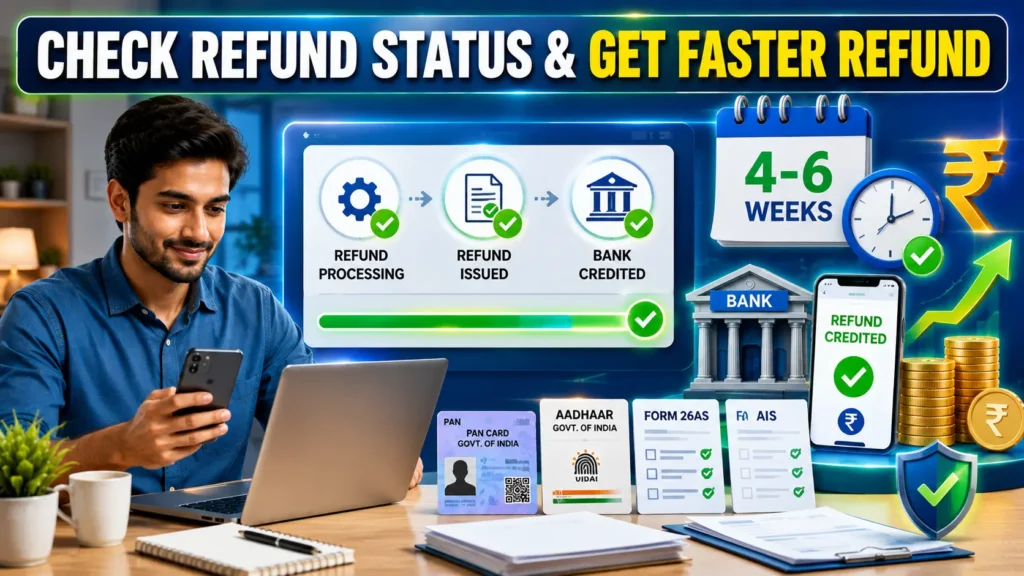
Checking your refund status is very easy now. You just need to log in to the income tax e-filing portal, go to the “e-File” section, then “Income Tax Returns,” and click on “View Filed Returns.” Your refund status will be shown there clearly, whether it is issued, processing, or if there is any failure.
You can also check refund status through the NSDL TIN portal by simply entering your PAN and assessment year. Friends, checking this once a week is enough, no need to become obsessed like I once was, checking it every single hour did not make the refund come any faster.
Income Tax Refund Timeline – How Much Time Does It Take?
This is one of the most common questions people search for every year. Based on general trends, once your ITR is verified, refunds are usually credited within 4 to 6 weeks. Some people get it within 10 days if everything is clean and straightforward. However, during peak filing season, it can take longer because the system is handling a huge number of returns together.
The Tax Refund Process timeline also depends on how complicated your return is. Simple salaried returns with no discrepancies move faster. Returns with capital gains, multiple income sources, or claims that need extra scrutiny naturally take more time to process.
Reasons for Tax Refund Delay
Friends, refund delay is honestly one of the most frustrating things, and there are usually clear reasons behind it:
- Bank account not pre-validated or details mismatched.
- PAN not linked with Aadhaar.
- Errors or mismatches between ITR data and Form 26AS or AIS.
- Return selected for scrutiny or additional verification.
- Outstanding tax demand from a previous year adjusted against current refund.
- Return not verified within the deadline.
If something is bad, I will say it clearly, the system does sometimes take longer than promised, especially if your return gets flagged for manual review. This is not something you can control fully, so patience is genuinely needed here.
What to Do If Your Income Tax Refund Is Delayed
If your refund is taking longer than expected, don’t worry. Simply check your refund status online to see its current stage and latest update. If it shows “failed,” this usually means a bank detail issue, so update and revalidate your bank account immediately.
You can also raise a grievance directly on the income tax portal under the “Grievance” section. Explain your issue clearly and attach your acknowledgment number. In my experience, grievances submitted with complete details get resolved faster than vague complaints. If more than two months have passed with no update, following up through the grievance portal is your best option.
Common Mistakes That Delay Tax Refund Processing
Let me be honest with you, most delays happen because of small avoidable mistakes:
- Entering wrong bank account number or IFSC code.
- Not linking PAN with Aadhaar.
- Forgetting to verify the ITR after filing.
- Mismatched income figures compared to Form 26AS.
- Using an outdated or inactive bank account.
- Filing under the wrong ITR form.
Avoiding these simple mistakes can genuinely speed up your Tax Refund Process by weeks. I always recommend double-checking every field before final submission, it takes five extra minutes but saves weeks of waiting later.
How to Get Faster Income Tax Refund in India
If you want your refund quickly, here is honestly what works. File your return early, do not wait until the last date. Early filers generally get processed faster since the system load is lower.
Verify your return immediately after filing, same day if possible. Keep your bank account pre-validated and active well in advance. Match your income details with Form 26AS and AIS before submitting, so there are no mismatches to flag your return.
Friends, this is not a guaranteed hack, but it genuinely improves your chances of a smooth and fast Tax Refund Process without unnecessary delays.
Tax Refund Process for Salaried Employees vs First-Time Taxpayers
For salaried employees, the Tax Refund Process is usually simpler because most income details are already reflected in Form 16 and Form 26AS, making verification easier and faster.
For first-time taxpayers, things can feel a bit confusing initially. If you are filing for the first time, make sure your PAN, Aadhaar, and bank account are all properly linked and validated before you even start filing.
First-time filers sometimes face delays simply because their bank account was never pre-validated earlier. So if this is your first ITR, treat the bank validation step as seriously as the filing itself.
Tax Refund Process After Filing ITR for AY 2026–27
For Assessment Year 2026-27, the overall Tax Refund Process remains largely similar to previous years, with continued focus on faster digital processing. After filing and verifying your ITR for this assessment year, the department cross-checks your return with available data including TDS records, AIS, and Form 26AS.
If everything matches, refund processing generally moves quickly. As always, keeping your documents and bank details updated well before filing season begins is the smartest approach.
Disclaimer
This article is for general informational purposes only and is based on commonly known income tax processes in India. Tax rules, timelines, and procedures can change, so please refer to the official income tax department website or consult a qualified tax professional before making any financial or tax-related decisions.
FAQ's
How long does income tax refund take after ITR filing?
Usually 4 to 6 weeks after verification, though some refunds come within 10 days depending on how simple and clean your return is.
How can I check my income tax refund status online?
Log in to the income tax e-filing portal, go to filed returns, and check refund status, or use the NSDL TIN portal with your PAN.
Why is my income tax refund delayed?
Common reasons include unvalidated bank accounts, PAN-Aadhaar mismatch, data mismatch with Form 26AS, or your return being selected for scrutiny.
What should I do if my tax refund is not received?
Check refund status first, revalidate bank details if failed, and raise a grievance on the income tax portal if delay continues beyond two months.
Is bank account verification necessary for tax refund?
Yes, pre-validating your bank account on the income tax portal is compulsory; otherwise your refund cannot be credited even after processing.
Can first-time taxpayers claim income tax refund easily?
Yes, as long as PAN, Aadhaar, and bank account are properly linked and validated before filing, the refund process works smoothly for them too.