

Should you pick a fund where a manager hunts for winners, or one that simply copies an index? That is the core of the active vs passive funds debate, and it confuses a lot of new investors.
In this guide, we will look at Active vs Passive Funds: 5 Key Differences in 2026, using current Indian data, so you can decide with confidence.
In This Article
ToggleHighlight key
- Active funds try to beat the market. Passive funds try to match it.
- Passive funds usually cost much less.
- Over the 10 years ended June 30, 2026, more than 70% of active funds underperformed in every category covered by the SPIVA India Scorecard.
- Past results do not guarantee future returns, and active funds can still outperform in some categories and years.
- Many investors use a mix of both.
What Are Active Funds?
Active mutual funds have a fund manager and a research team. They choose which stocks to buy and sell. The aim is to beat a benchmark such as the Nifty 50.
For example, if the Nifty 50 gives 10% in a year, a good active fund tries to give more than 10%. You pay for this effort through a higher fee.
What Are Passive Funds?
Passive mutual funds do not try to beat an index. They aim to copy its performance. If the Nifty 50 has 50 stocks, a Nifty 50 index fund holds those same stocks in approximately the same proportions, subject to index changes and tracking differences.
This is why people often compare an active fund vs. an index fund. An index fund is the most common passive fund. ETFs are another type of passive investment.
Active vs Passive Funds: 5 Key Differences
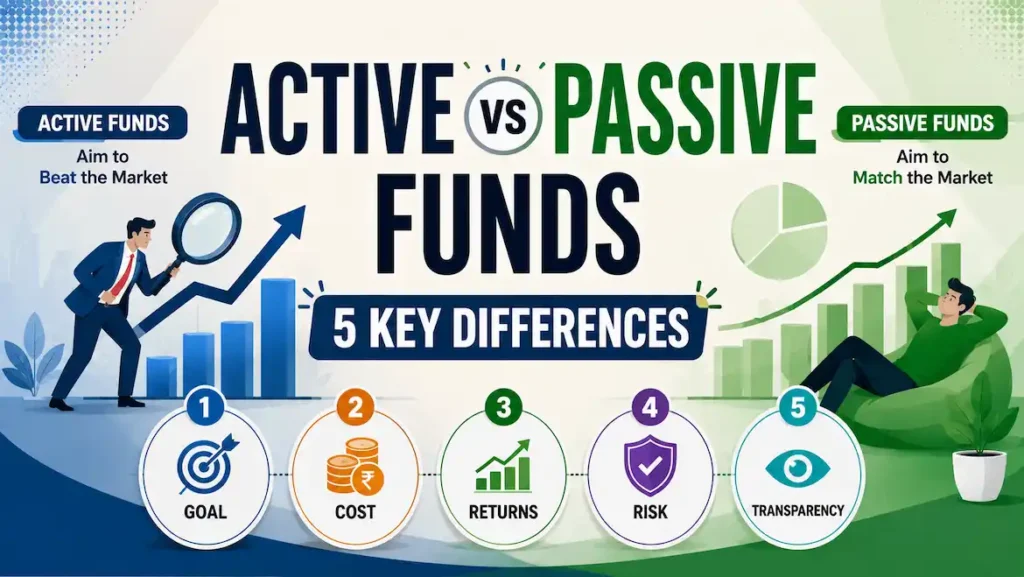
1. Goal
An active fund aims to beat the market. A passive fund aims to match its benchmark, minus expenses and tracking differences. So passive investing is about earning returns close to the index, while active investing is about trying to earn extra returns.
2. Cost
Cost is one of the biggest differences. Every mutual fund has an expense ratio, which represents the annual expenses charged to the scheme as a percentage of its assets.
In India, direct-plan index funds and ETFs can have very low costs, while active equity funds generally charge higher expenses because they involve research and active portfolio management. The actual expense ratio varies by scheme, fund house, and plan. Regular plans usually cost more than direct plans because they include distribution expenses.
You can compare the actual costs of schemes using the AMFI Total Expense Ratio Database.
Also note that SEBI changed how mutual fund expenses are disclosed. From April 1, 2026, the revised framework under the SEBI Mutual Funds Regulations, 2026 introduced the Base Expense Ratio (BER) and clarified the calculation and disclosure of the Total Expense Ratio (TER).
BER excludes certain costs such as brokerage, transaction costs, and statutory levies. TER provides a broader picture by including applicable expenses and charges. The new framework improves cost transparency, but it does not mean every mutual fund will automatically become cheaper.
Here is what a small cost gap can do over time. Assume a ₹10,000 monthly SIP for 20 years (₹24 lakh invested) and a 12% effective annual return before costs. For this illustration, assume the SIP is invested at the beginning of each month, and the annual fund costs reduce the effective annual return.
These are illustrative calculations, not predictions.
| Fund Cost | Net Annual Return | Value After 20 Years |
|---|---|---|
|
0.2% (low-cost index fund) |
11.8% |
About ₹89.8 lakh |
|
1.0% (active fund example) |
11.0% |
About ₹81.6 lakh |
The difference is roughly ₹8 lakh. However, an active fund that beats its benchmark by enough to overcome its additional costs can close this gap.
3. Active Fund Returns vs Passive Fund Returns
This is where active vs passive fund performance gets interesting. Many active funds struggle to beat their benchmarks over long periods.
According to the SPIVA India Mid-Year 2026 Scorecard, 74% of active Indian large-cap funds underperformed their benchmark over the 10 years ended June 30, 2026. The report also showed that more than 70% of active funds underperformed in every category covered over the same 10-year period.
However, active fund performance can vary across categories and periods. Mid-cap and small-cap funds may offer different opportunities for active managers because stock selection and market conditions can influence results.
Be careful with these numbers too. Some analysts argue that SPIVA’s benchmark choices and methodology can influence how active large-cap funds appear in performance comparisons. They point out that benchmark changes can affect comparisons over time. Treat any single scorecard as one useful input, not the final answer.
You can read the SPIVA India Mid-Year 2026 Scorecard for detailed category-wise results and methodology.
4. Risk and Manager Dependence
Both fund types carry market risk. If the underlying market index falls 15%, an index fund may also experience a similar decline, although tracking differences and expenses can affect its actual return.
Active funds add another risk: dependence on the fund manager’s decisions. A poor stock selection, a manager change, or an investment style that goes out of favour can hurt returns.
On the other hand, a skilled manager may protect the portfolio better during a falling market, though this is never guaranteed.
5. Effort and Transparency
Passive funds are generally simple to understand. You know which index the fund tracks, and you do not need to evaluate a manager’s stock-picking ability regularly.
Active funds need more homework, such as checking performance consistency, portfolio style, fund manager experience, and expenses.
Benefits and Risks at a Glance
Benefits of Active Mutual Funds
- Chance to beat the market.
- Flexibility to avoid weak stocks or sectors.
- More opportunities for skilled stock selection in certain market segments.
Risks of Active Mutual Funds
- Generally higher costs.
- Many funds fail to beat their benchmarks over long periods.
- Results depend partly on the fund manager’s decisions.
Benefits of Passive Mutual Funds
- Generally low cost.
- Simple and transparent investment strategy.
- Less dependence on active stock selection.
Risks of Passive Mutual Funds
- Passive funds do not aim to beat their benchmark.
- They can fall when their underlying index falls.
- Tracking error is the difference between a fund’s returns and its benchmark’s returns.
Active vs Passive Funds: Which Is Better in 2026?
There is no single winner. Passive investing has shown strong long-term evidence in large-cap categories, where many active funds have struggled to beat their benchmarks.
Interest in passive investments is also growing. According to AMFI data reported in February 2026, passive funds received record net inflows of ₹39,955 crore in January 2026. Gold ETFs contributed significantly to these inflows, so this figure should not be viewed as demand for equity index funds alone.
However, active funds can make sense in categories where skilled managers may have more opportunities to add value.
Many beginners can consider a simple core portfolio of low-cost index funds, along with a smaller active fund allocation if it suits their investment goals and risk tolerance.
Common Mistakes to Avoid
- Picking a fund only because of last year’s returns.
- Ignoring the expense ratio.
- Choosing a regular plan when a direct plan may be more suitable.
- Switching funds too often without considering exit loads and tax consequences.
- Expecting an active fund to outperform every year.
Tax on Active vs Passive Equity Mutual Funds
For FY 2026-27, the capital gains tax treatment of eligible equity-oriented active and passive mutual funds is generally the same.
Under the applicable equity-oriented mutual fund tax rules:
- Long-term capital gains (LTCG) are taxed at 12.5% on eligible gains exceeding ₹1.25 lakh in a financial year.
- Short-term capital gains (STCG) are generally taxed at 20% when the applicable STT conditions are met.
Applicable health and education cess and surcharge, where relevant, may also apply.
These rates apply to eligible equity-oriented mutual funds, not automatically to every index fund, ETF or passive mutual fund. Debt-oriented, international and certain other funds may have different tax treatment depending on their structure and acquisition date.
You can check the latest details through the Income Tax Department’s Capital Gains Guide and the AMFI Mutual Fund Taxation Guide.
Conclusion
Active funds offer a chance to beat the market, but at a generally higher cost and with manager-related risk. Passive funds offer low-cost market returns with less dependence on active stock selection.
The five key differences are goal, cost, returns, risk, and effort. Match them to your own goals, time horizon, and comfort level, and check current costs before you invest.
Disclaimer: This article is for educational purposes only and is not investment advice. Mutual fund investments are subject to market risks. Past performance does not guarantee future returns. Figures, rules, and tax rates may change, so check official sources or speak to a SEBI-registered investment adviser before making investment decisions.
FAQ's
Which is better, active or passive mutual funds?
Neither wins every time. Passive funds are generally cheaper and simpler, and many active large-cap funds have lagged their benchmarks over long periods. Active funds may suit investors who accept higher costs and manager-related risks.
What is the difference between active and passive mutual funds?
Active funds use a fund manager to select investments and try to beat the market. Passive funds track an index and aim to match its performance, usually at a lower cost.
Are passive funds safer than active funds?
Not necessarily. Both carry market risk. Passive funds reduce dependence on active stock selection, but they can fall with their underlying index. Safety depends on the assets held by the fund, not just whether it is active or passive.
Do active funds give higher returns in India?
Sometimes, but not consistently. SPIVA data shows that many active large-cap funds have underperformed their benchmarks over long periods. Results can vary across mid-cap, small-cap, and other categories.
Should I invest in active or passive mutual funds as a beginner?
Many beginners consider low-cost index funds for their simplicity and transparency. You can explore active funds later if they suit your investment goals. Check costs, your time horizon, and risk tolerance first, or consult a SEBI-registered investment adviser.

My name is Subodh Kumar, and I am a finance blogger at Financemantraa.com with a strong interest in personal finance, investing, and financial research spanning 4–5 years.
I enjoy researching financial topics and explaining complex money concepts in simple, easy-to-understand language. My areas of interest include stock market basics, IPOs, mutual funds, financial planning, insurance, saving strategies, and wealth building.
Through Financemantraa.com, I aim to help readers improve their financial knowledge, understand investment concepts, and make informed financial decisions. I focus on creating practical, beginner-friendly guides that make personal finance easier to understand and apply in everyday life.
I believe that financial education and smart money habits can help people work toward long-term financial stability. My goal is to make reliable, accessible, and informative financial content available to everyone.
Disclaimer: The information published on Financemantraa.com is for educational and informational purposes only. It should not be considered professional financial or investment advice.