
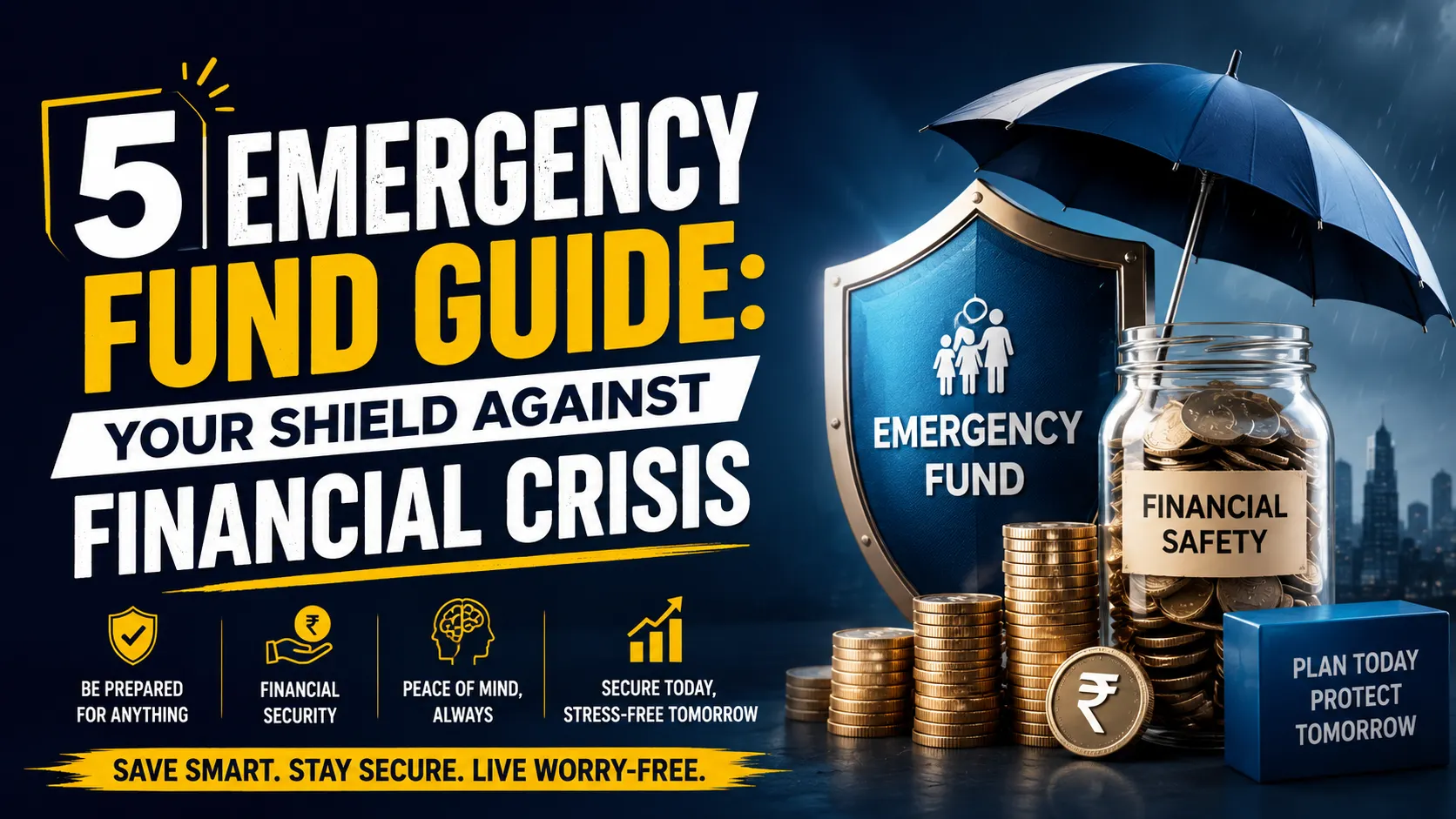
Hey friends, in today’s life, anything can happen. One day, everything is going smoothly, and the next day, suddenly you lose your job, someone at home needs emergency surgery, or the car breaks down, and you get a huge repair bill. In all these situations, the Emergency Fund Guide can be your real helper. I am Subodh, an ordinary person from Varanasi, and today I am sharing this Emergency Fund Guide with you in full detail. This is not just theory but is filled with real experiences and practical tips.
I myself was stuck in a bike accident in 2018. I couldn’t go to work for four months. At that time, if my emergency fund had been ready, it wouldn’t have been so stressful. Today, I am writing this complete Emergency Fund Guide for you so that you can also be prepared. Let’s start step by step.
Highlight key
- Emergency Fund = money set aside only for real emergencies (job loss, hospitalization, repairs).
- How much should you keep? Equal to 3-6 months of monthly expenses (Family: 6-9 months).
- Best Places: High-interest Savings Account + Liquid Mutual Funds + FD Ladder.
- How to create it? Track expenses – Set up auto-transfers – Add bonuses/refunds.
- Common Mistakes: Withdraw money from it for weddings/vacations and invest it in stocks.
- Biggest Benefit: Avoid financial stress and provide mental peace.
What is an Emergency Fund? Simple and Straight Answer
Let’s first understand the basic idea. An Emergency Fund is money that you have set aside only for difficult times. It is not for shopping, a new phone, a vacation, or any fun things. The first thing in this Emergency Fund Guide is that this fund should be completely separate from your regular savings.
Think about it, you have money in your regular bank account. Whenever you feel like it, you might think, ‘Let’s withdraw a little.’ That’s why it is necessary to keep it in a separate account or investment. Many people in India make this mistake and regret it later.
This Emergency Fund Guide will tell you how to actually keep and manage your emergency fund separately. This is not a fund only for the rich – a middle-class family can easily build it too.
Why Does Every Indian Need an Emergency Fund? Real Reasons
The reality of India is different, yaar. Here, family responsibilities are very high. Parents, children, siblings – everyone depends on you. Medical expenses are so unpredictable that, according to one report, the average hospital bill can range from 50,000 to 2 lakh. The job market is also not very stable.
In this Emergency Fund Guide, I will tell you how much risk there is without it. I remember the story of one of my friends. His wife had a sudden appendectomy. The hospital charged 3.5 lakh. Since they had an emergency fund, they managed it without taking a loan. Another friend, who did not have a fund, is still paying EMIs on a personal loan. The stress is on a different level.
This Emergency Fund Guide is not just about saving money, but also about mental peace. When you have a cushion, small problems don’t seem big.
How much money should you have in your emergency fund? Practical calculation
Now the biggest question: how much should you have? This part of this emergency fund guide is very important.
Basic formula: Equal to your monthly expenses for 3 to 6 months.
If your monthly expenses (rent, food, electricity, EMI all combined) are ₹50,000, you should have a minimum of ₹1.5 lakh to ₹3 lakh. For those with families, 6-9 months is better.
Target in Different Situations:
Single boy/girl living alone: 3-4 months
Married couple without kids: 4-6 months
Family with children: 6-8 months
Job unstable (sales, startup, freelance): 8-12 months
Start with a small target. First think of 25,000, then 50,000, then 1 lakh. In this Emergency Fund Guide, I always say – big things are made with small steps.
I myself started with just 5,000 per month. Today, my fund is solid, and I also sleep peacefully.
Where to Keep Emergency Funds? Best Options in India 2026
Choosing the right place to keep your money is crucial. In this Emergency Fund Guide, I’ll share the best options:
1. High-Interest Savings Account
Banks like HDFC, Kotak, IDFC First, and AU Small Finance offer 6-7.5% interest. Instant withdrawal is available.
2. Liquid Mutual Funds
Slightly better returns (7-8%) and tax-efficient. You can withdraw money within a day.
3. Fixed Deposits with Ladder Strategy
Make FDs with different maturity dates so you don’t incur penalties when needed.
My personal mix: 60% savings account, 30% liquid funds, 10% FDs. Liquidity, return, and safety all remain in balance.
Step-by-Step: How to Build an Emergency Fund? (Beginner Friendly)
Now for the real work. This is the most practical section of this Emergency Fund Guide.
Step 1: Track Your Expenses
Record your expenses for a full month. Note every expense – from shade to Netflix.
Step 2: Create a Budget
You can try the 50/30/20 rule – 50% needs, 30% wants, 20% savings (including an emergency fund).
Step 3: Set Up Auto Transfer
As soon as your salary arrives, automatically 10-15% should go to your emergency fund. I usually set up UPI auto-pay and leave it at that.
Step 4: Use Extra Income
Bonus, tax refund, Diwali bonus, side hustle – all of it directly into the emergency fund.
Step 5: Keep Reviewing
Check it every year. If expenses increase, increase the fund target.
I remember the first time I deposited 10,000 rupees. I felt a small sense of happiness. Thinking back on it, I realize these small steps made a big difference.
Real Life Stories: How People Created and Benefited
This Emergency Fund Guide doesn’t just talk about numbers. It also shares real stories.
I have a neighbor in Varanasi. His daughter had dengue. The expense was 1.8 lakh. Since he had a 6-month fund, he handled it comfortably. On the other hand, a cousin had to take a loan.
Another example – my sister works as a freelancer. Her project was canceled for 3 months. Her emergency fund gave her time to find new clients.
There are many such cases where this Emergency Fund Guide has made people’s lives easier.
Common Mistakes People Make (Avoid These)
Many people make these mistakes:
Putting their emergency fund into the stock market
Withdrawing money from it for a wedding or vacation
Keeping only 20,000-30,000 rupees and thinking, “That’s it.”
Telling family and meeting their emergencies
In this Emergency Fund Guide, I’m warning you – don’t touch this money unless there’s a real emergency.
Extra Tips for Indians: Inflation, Taxes, and Family
Inflation in India stays at 5-7%. So, adjust your target every year. Also, keep tax savings in mind – tax rules are different for liquid funds.
Talk with your family, but set clear rules. Instill the habit of saving in children from a young age, too.
Emergency Fund Guide: Advanced Level Tips
Once your basic fund is ready:
Get the right insurance (health and term insurance).
Create multiple accounts.
Keep some cash at home (10-15,000).
Be prepared both digitally and physically.
Plan to Start from Today
Take a small step today itself. Calculate your monthly expenses. Then put 5,000 rupees in a separate account. Next month, 7,000. Gradually, you will build it up.
This Emergency Fund Guide is written for you so that you can become financially strong. Surprises will keep coming in life, but you will be prepared.
People who follow the Emergency Fund Guide sleep peacefully. You start too. In the comment section, tell how much your current fund is and what your target is.
Stay prepared, stay strong.
Jai Hind!