

Friends, have you ever given money to a friend and then that friend stops paying you back? This is a very annoying topic, isn’t it? Well, banks face the same problem, just on a much larger scale. At this point, it’s necessary to talk about NPAs. So, what is NPA? In simple words, NPA means a loan on which the bank is no longer getting money back from the customer. Today, I will explain this topic to you in the easiest way possible, just like I talk to any friend about any topic.
I remember a few years ago when my dad took a business loan from a local bank. Everything went fine for a few years, but then his business faced some losses. And then he missed a few payments, and shortly after, the bank marked his loan account differently. That’s when I first heard the term NPA in banking, and honestly, I had no idea what it meant. So today, we will cover everything about this subject, from the basic meaning of NPA to its types, causes, and how it affects the entire banking sector.
Highlight key
- NPA meaning: A loan where the borrower has stopped paying interest or principal for 90 days or more.
- Types of NPA: Sub-standard, Doubtful, and Loss assets.
- Main causes of NPA: Bad loan decisions, economic slowdown, wilful default, and poor recovery systems.
- • More NPAs put pressure on the bank’s balance sheet, which can affect profits, loan growth, and investor confidence.
- RBI NPA guidelines help banks classify and manage bad loans properly.
- Gross NPA vs Net NPA: One shows total bad loans; the other shows bad loans after provisions.
What Is NPA? Meaning In Simple Words
Let’s start with the basics. What is NPA? NPA full form is Non-Performing Asset. Now, don’t let this fancy term scare you. In easy words, when a bank gives a loan to someone, that loan is called an asset for the bank because it earns interest. But when the borrower stops paying interest or the principal amount for 90 days in a row, the bank cannot call it a “performing” asset anymore. It becomes a Non-Performing Asset, or NPA.
Tell me the truth: have you ever forgotten to pay a bill for a month or two? Now imagine that happening for three straight months on a loan of lakhs or crores of rupees. That is exactly what happens when a loan turns into an NPA in banking.
In my experience, understanding NPA meaning becomes much easier once you connect it with your own daily money habits. If you stop paying your credit card bill for three months, your bank starts treating your account very differently. The same logic applies here, just on a much bigger scale with business and personal loans.
So basically, NPA in banking is a warning sign. It tells the bank, “hey, this loan is in trouble, you may not get your full money back.” This directly affects how banks calculate their profit and how much money they have left to lend to new customers.
NPA Full Form And Basic Definition
As we already discussed, NPA full form is Non-Performing Asset. But let’s go a little deeper here. According to RBI NPA guidelines, an asset becomes non-performing when it stops generating income for the bank. This mainly happens with loans, but it can also happen with other credit facilities like overdrafts or cash credit accounts.
If you think as I do, numbers alone don’t tell the full story. What matters more is why the loan stopped performing. Was it because the business genuinely failed? Or did the borrower simply refuse to pay even after having money? Both cases are technically NPA, but the reasons are completely different.
Now let’s talk about the actual number banks use. If a loan account does not receive any payment of interest or principal for 90 days, RBI rules for Non-Performing Assets say that the account must be classified as NPA. This is a strict rule, and banks cannot ignore it, even if they personally trust the borrower.
Types Of NPA In Banking Explained
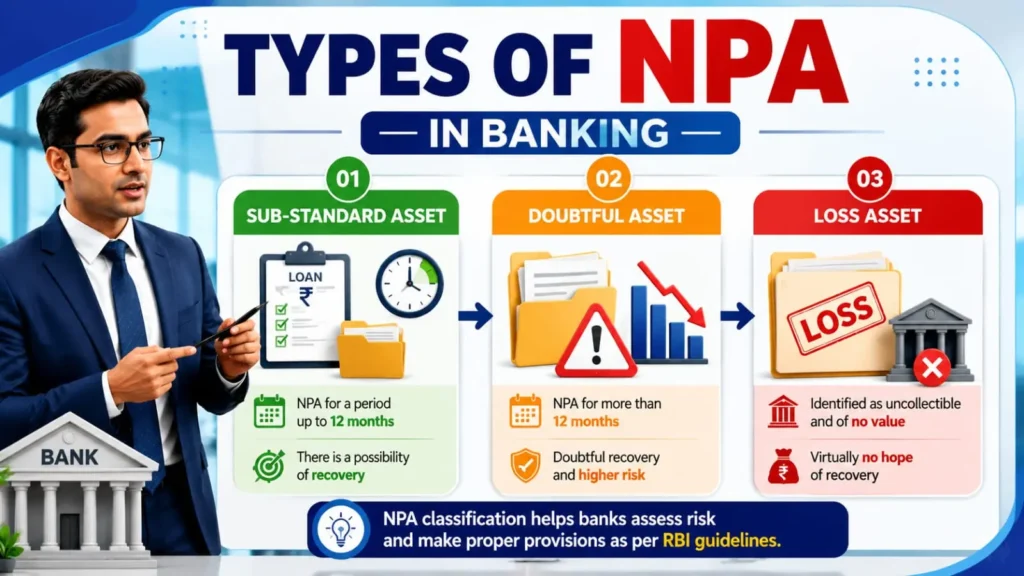
Friends, this is where things get interesting. NPA classification is not just one single category. RBI has divided NPA into three main types based on how long the loan has been unpaid and how risky it has become.
Sub-Standard Assets
This is the first stage. When a loan remains an NPA for less than or equal to 12 months, it is called a sub-standard asset. At this stage, there is still some hope of recovery. The bank usually keeps trying to recover the money through reminders, restructuring, or one-time settlement offers.
Doubtful Assets
If the loan continues to remain unpaid for more than 12 months after becoming sub-standard, it moves into the doubtful category. Here, the bank starts doubting whether it will ever get the money back fully. This stage is more serious, and banks have to set aside a much bigger provision for expected losses.
Loss Assets
This is the final and worst stage of NPA classification. A loss asset is one where the bank, along with auditors or RBI inspectors, has already accepted that the loan cannot be recovered. However, it is still not written off completely from the books because there might be some small recovery value left, like from selling collateral.
Understanding types of NPA in banking helps you see that not every bad loan is equally dangerous. Some can still be saved, while others are almost a complete loss for the bank.
Gross NPA Vs Net NPA: What Is The Difference?
Now, this is a topic that confuses a lot of people, so let me simplify it for you.
Gross NPA is the total value of all bad loans a bank has, without subtracting anything. It’s like the raw, unfiltered picture of how many loans have gone bad.
Net NPA, on the other hand, is calculated after subtracting the provisions the bank has already set aside for those bad loans. So, Net NPA gives a more realistic picture of how much loss the bank might actually face.
In simple words, think of Gross NPA as your total unpaid bills, and Net NPA as unpaid bills minus the emergency fund you have already saved to cover them. The difference between Gross NPA and Net NPA basically tells you how well-prepared a bank is for handling its bad loans.
Causes Of NPA In Banks
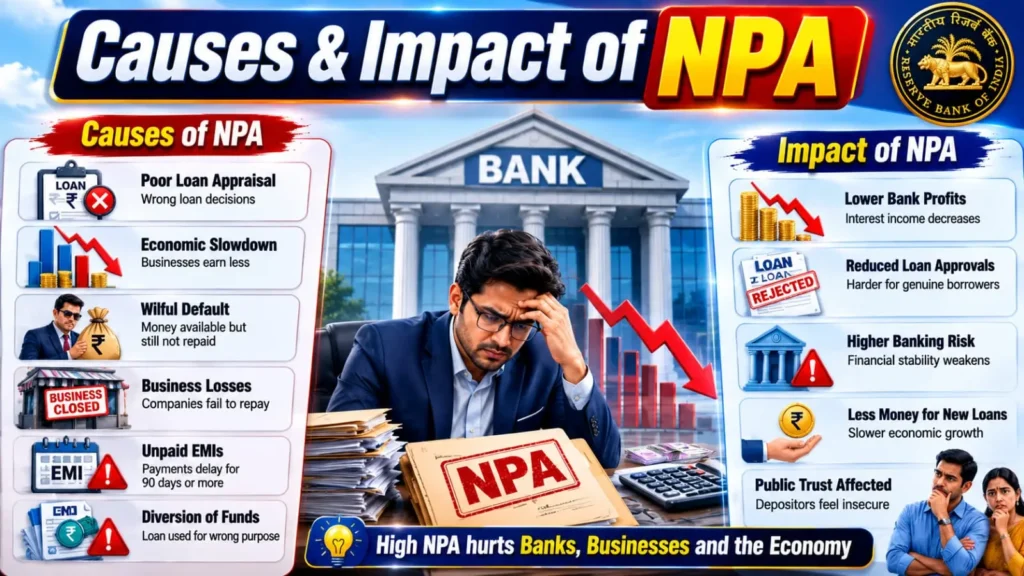
Now let’s talk about the real question: why do NPAs happen in the first place? Trust me, it’s not just bad luck. There are several genuine reasons behind it.
- Poor loan appraisal: Sometimes banks approve loans without checking the borrower’s real repayment capacity.
- Economic slowdown: When the overall economy slows down, businesses earn less, and they struggle to repay loans on time.
- Wilful default: Some borrowers have the money but still choose not to repay, hoping to escape through legal loopholes.
- Natural disasters or unexpected events: Floods, pandemics, or sudden market crashes can destroy a borrower’s ability to repay.
- Diversion of funds: Many times, borrowers use loan money for a different purpose than what was approved, leading to failure of the original business plan.
- Weak recovery systems: If the legal and recovery process is slow, banks find it hard to recover money quickly, and small NPAs turn into big NPAs over time.
Friends, honestly speaking, most of the causes of NPA in banks come down to poor judgment, either from the bank’s side or the borrower’s side. That’s the harsh truth, and I won’t sugarcoat it for you.
Effects Of NPA On Banks And The Economy
Now let’s find out why this topic is being made so important. The effects of NPA on banks are not limited to just the bank itself. It actually touches the whole economy in some way.
When NPAs increase, banks earn less profit because they are not receiving interest income from those loans. This directly hits their overall financial health. To cover this loss, banks often have to set aside more money as provisions, which reduces the amount available for giving fresh loans to new customers.
This means if NPA in banking keeps rising, it becomes harder for genuine borrowers, like small business owners or students, to get new loans easily. Banks become extra cautious, and interest rates on loans may also increase to cover the risk.
Also, if NPAs go too high, it can shake public trust in that particular bank. Depositors may start worrying about the safety of their money, even though most deposits are protected under insurance rules. Still, the fear itself can cause panic, which is never good for the banking sector.
On a larger scale, high NPA levels can slow down the overall economic growth of a country, because banks become more careful and stop lending freely, which affects businesses, jobs, and everyday people like you and me.
How To Reduce NPA In Banks
Friends, the good news is that NPA is not an unsolvable problem. Banks and the RBI have taken several steps over the years to reduce and manage NPA levels.
- Strict loan appraisal: Better checking of a borrower’s background and repayment capacity before giving the loan.
- Early warning systems: Identifying stressed accounts before they officially turn into NPA.
- Asset Reconstruction Companies (ARCs): Selling bad loans to specialized companies that focus only on recovery.
- Insolvency and Bankruptcy Code (IBC): A legal framework that speeds up the recovery process from defaulting companies.
- One-time settlement schemes: Offering borrowers a genuine chance to settle their dues at a reduced amount.
- Regular monitoring: Continuously tracking loan accounts so that small issues don’t turn into big NPAs later.
In my experience, banks that follow proper monitoring right from the start usually manage to keep their NPA levels much lower compared to banks that ignore early warning signs.
NPA Explained With Real-Life Examples
Let’s make this even simpler with a small example. Suppose a bank gives a loan of 10 lakh rupees to a shop owner. For the first year, everything goes smoothly, and payments come on time. But then, due to some local competition, the shop starts losing customers, and the owner stops paying EMIs for three months straight.
According to RBI NPA guidelines, this loan account now officially becomes an NPA. If the shop owner still can’t manage payments for the next year, it becomes a doubtful asset. And if there’s genuinely no hope left, it eventually turns into a loss asset.
This example shows exactly how NPA meaning applies in real life, not just in textbooks or banking reports.
Final Thoughts
So friends, in short, what is an NPA? It’s just a loan that stops earning interest for the bank because the borrower is not paying on time. We covered everything in detail the meaning, types of NPA in banking, the main reasons for NPA, and how it affects the bank and the broader economy.
However, understanding this topic is not useful only for bankers or finance students. As an ordinary person, knowing about NPAs helps you understand why banks sometimes tighten their loan rules or increase interest rates. Now that you know the full meaning, I hope all the problems related to this topic will seem much less complicated than before.
If you use a bit of your brain, financial knowledge like this should be simple and practical, not filled with complicated words. That’s exactly what I tried to do here today.
Disclaimer
This article is provided here for you all for general information and educational purposes only. It does not represent professional financial or banking advice. Before making any financial decisions related to loans or NPA classification, please consult a certified financial advisor or directly contact your bank.
FAQ's
Q1. What is NPA in banking with example?
NPA means a loan where the borrower has not paid interest or principal for 90 days. Example: a business loan unpaid for 3 months becomes an NPA.
Q2. What is Non-Performing Asset in simple words?
It’s a loan that stopped earning income for the bank because the borrower stopped repaying it regularly, usually after missing payments for 90 continuous days.
Q3. What is the difference between Gross NPA and Net NPA?
Gross NPA is total bad loans without deductions. Net NPA is bad loans after subtracting provisions the bank already set aside for losses.
Q4. How does a loan become an NPA?
A loan becomes an NPA when the borrower fails to pay interest or principal for 90 consecutive days, as per RBI classification rules.
Q5. What are the causes of NPA in banks?
Poor loan appraisal, economic slowdown, wilful default, fund diversion, and weak recovery systems are the main causes behind rising NPA levels.
Q6. Why are NPAs bad for banks?
NPAs reduce bank profits, limit fresh lending, increase provisioning costs, and can weaken public trust in the bank’s overall financial stability.