
Need cash in your bank account urgently, but all you have is a credit card limit? Many people search for how to transfer money from credit card to bank account for this reason. The short answer is that it is possible, but it is rarely free. Most methods carry fees, and some carry real risk.
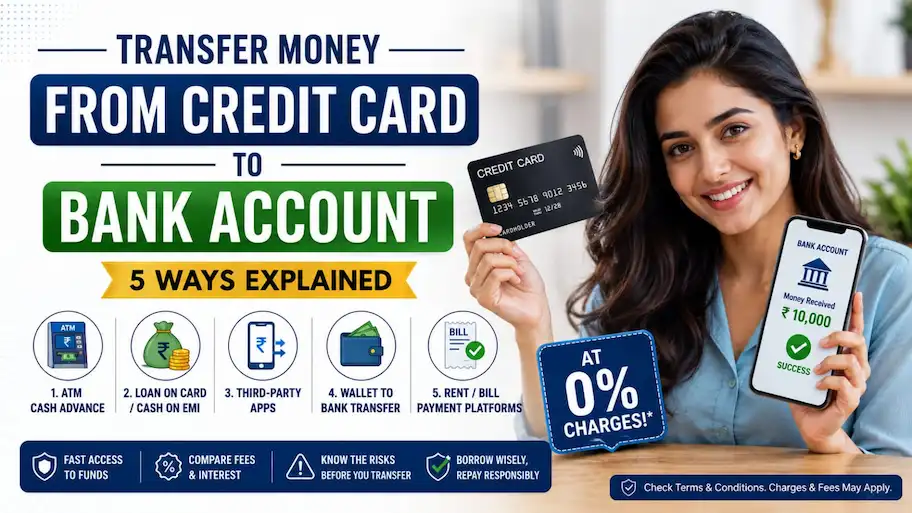
In this guide, we will look at five ways to move money from a credit card to a bank account in India. We will also compare costs, explain the risks, and show you how to avoid expensive mistakes.
In This Article
ToggleHighlight key
- Direct transfers from credit cards to bank accounts are not universally available.
- Cash advances usually involve a withdrawal fee and interest from day one.
- Banks can offer credit card holders options for the repayment period and installments to pay off loans.
- Wallets and third-party platforms may have fees and transaction restrictions.
- Zero processing fee doesn’t mean there won’t be any extra costs.
- Always check your card issuer’s latest terms before transferring money.
Can we transfer cash to the bank using a credit card if needed?
You can use up to your approved credit limit with a credit card. Unlike a debit card, which uses money from your bank account, a credit card creates a repayment obligation.
Some banks and financial service providers offer cash advances, loans against credit cards, or other eligible services. However, you generally cannot transfer money directly from every credit card to any bank account like a normal bank transfer.
Fees, interest rates, transaction limits, and eligibility requirements depend on your card issuer and the method you choose.
If you are looking for a free transfer, check the complete terms carefully. A service advertised as having zero processing fees may still involve interest, taxes, or other charges.
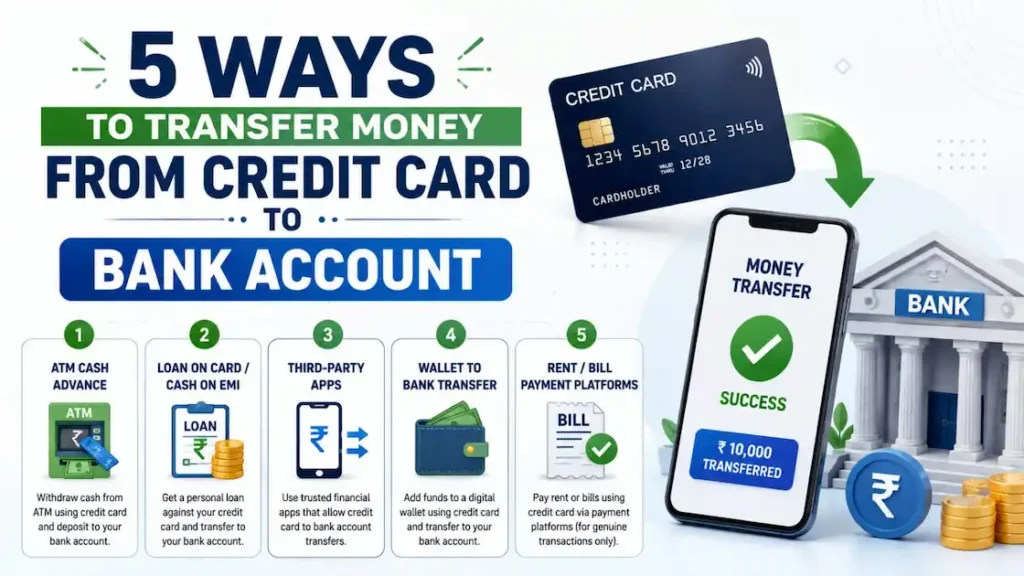
5 Ways to Transfer Money from Credit Card to Bank Account
Withdraw Cash from an ATM and Deposit It into Your Bank Account
One way to access money through a credit card is to withdraw cash from an ATM and deposit it into your bank account.
However, this method can be expensive. Credit card issuers generally charge a cash advance fee, and interest usually starts accumulating from the withdrawal date. The interest-free period available on eligible purchases generally does not apply.
The exact charges depend on your bank and card variant. Check the official HDFC Bank website or SBI Card website for applicable charges.
Example: Cost of Withdrawing ₹10,000
Suppose your card has a cash advance fee of 2.5%, subject to a minimum of ₹500, and a monthly interest rate of 3.5%.
| Particulars | Amount |
|---|---|
|
Cash withdrawn |
₹10,000 |
|
Cash advance fee |
₹500 |
|
Approximate one-month interest |
₹350 |
|
Estimated cost before GST |
₹850 |
This is an illustrative calculation, not a quote for any specific card. Actual interest depends on the issuer’s calculation method, outstanding balance, and repayment date. Applicable GST may increase the total cost.
Pros:
- Provides access to cash when needed.
- Available to eligible cardholders at supported ATMs.
Cons:
- High fees and immediate interest.
- Cash withdrawal limits apply.
- Cash advances generally do not earn regular purchase rewards.
2. Use a Loan on Your Credit Card or Cash on EMI
Some banks offer eligible customers a loan against their credit card or a facility to convert an approved amount into instalments.
Depending on the product, the money may be transferred to your registered bank account. These facilities have different interest rates, processing fees, and repayment conditions.
Before accepting an offer, check the interest rate, processing fee, monthly EMI, repayment period, and total amount payable.
You can check your bank’s official app or contact customer support to see whether a loan-on-card facility is available.
Pros:
- Structured repayment through EMIs.
- May be more suitable than a cash advance in some situations.
Cons:
- Not available to every cardholder.
- Interest and processing fees may apply.
- Missed payments can affect your credit profile.
Do not assume that a loan on your credit card is automatically cheaper than a cash advance. Compare the total repayment cost first.
3. Use a Third-Party Financial App, Where Supported
Some financial apps offer services involving credit cards and bank accounts. However, not every app allows you to transfer credit card funds directly into your own bank account.
Features, transaction limits, and fees vary between platforms. Before using an app, verify that it supports your intended transaction and check the final fee before confirming payment.
Pros:
- Some supported services may be convenient.
- Online transactions can save time.
Cons:
- Fees and restrictions vary.
- Features and policies can change.
- Unverified platforms may expose you to fraud.
Use trusted platforms and never share your OTP, card PIN, or confidential authentication details with another person.
4. Transfer Money Through a Digital Wallet, Where Permitted
Some people consider loading a digital wallet with a credit card and then transferring the wallet balance to a bank account.
However, this method does not work universally. Wallet providers may restrict withdrawals, and transfers can depend on KYC status, wallet type, transaction limits, and current terms.
Credit card wallet loads may also attract fees, and your card issuer may impose additional restrictions.
Before proceeding, check whether credit card loading and bank withdrawals are permitted, what charges apply, and whether your card issuer allows the transaction.
Pros:
- Convenient when a wallet supports the required transaction.
Cons:
- Loading and withdrawal fees may apply.
- Bank transfers may be restricted.
- Policies can change.
Never assume that money loaded into a wallet can automatically be withdrawn into your bank account.
5. Use Rent or Bill Payment Platforms for Genuine Payments
Some platforms allow eligible customers to pay rent or certain bills using a credit card. Depending on the service, the payment may be sent to a landlord or another eligible recipient.
This is not the same as transferring money to your own bank account. Use these platforms only for genuine payments that comply with their terms.
Before making a payment, check the convenience fee, applicable taxes, transaction limits, and recipient eligibility.
Pros:
- Convenient for eligible rent and bill payments.
- May help manage payment timing.
Cons:
- Convenience fees may apply.
- Not every payment is supported.
- Misuse can result in rejected transactions or account restrictions.
Comparison of the Five Methods
| Method | Potential Cost | Main Consideration |
|---|---|---|
|
ATM cash advance |
Fee, interest and applicable taxes |
Often expensive |
|
Loan on credit card |
Interest and possible processing fees |
Compare total repayment |
|
Third-party app |
Platform fees, if applicable |
Verify legitimacy |
|
Digital wallet |
Possible loading and transfer fees |
Check withdrawal restrictions |
|
Rent or bill platform |
Convenience fee and taxes |
Use for genuine payments |
The cheapest option depends on your card, eligibility, transfer amount, and repayment plan.
Credit Card to Bank Account Transfer Charges
The fee for using credit cards in India is not the same for all cards. Cash advance fees, interest rates, and limits depend on the issuer and card variant.
Before withdrawing cash or using a transfer service, check the official websites of your card issuer:
Look for the cash advance fee, monthly finance charge, applicable taxes, and transaction restrictions. Third-party websites can help with comparisons, but the issuer’s latest terms should take priority.
Can you send money with a credit card without any extra charges?
A service may advertise a zero-processing-fee offer, but that does not necessarily mean the entire transaction is free.
Before relying on such an offer, check:
- Whether it applies to your card.
- Whether the offer is temporary or limited to a specific amount.
- Whether interest or GST applies.
- Whether your bank charges a separate fee.
- Whether additional eligibility conditions apply.
For example, zero processing fees do not eliminate interest on a cash advance.
Always calculate the total cost instead of relying only on the advertised fee.
Is Credit Card Cash Transfer Safe?
Using an official bank service or a legitimate financial platform is generally safer than relying on unknown intermediaries. Follow these precautions:
- Use official bank apps and verified websites.
- Remember, sharing personal information related to banking can be risky for you.
- Avoid strangers offering cash in exchange for credit card swipes.
- Read the fees and conditions before confirming a transaction.
- Avoid unknown apps and suspicious social media offers.
Be cautious of anyone promising guaranteed, unlimited, zero-cost transfers without clear terms.
Risks of Transferring Money from a Credit Card
High borrowing costs: Cash advance fees, interest, and taxes can make borrowing expensive.
Debt problems: If you cannot repay quickly, interest and other charges can increase your outstanding balance.
Credit score impact: High credit utilisation may negatively affect your score. Missed or late payments can cause further damage.
No purchase rewards: Cash advances generally do not qualify for regular purchase rewards.
Transaction restrictions: Banks and payment platforms may reject unsupported transactions or transactions that breach their terms.
Common Mistakes to Avoid
- Assuming cash advances have an interest-free period.
- Believing zero processing fees mean zero total cost.
- Forgetting applicable taxes and other charges.
- Using your full credit limit unnecessarily.
- Trusting unknown apps or social media offers.
- Borrowing without a realistic repayment plan.
Safer Alternatives to Consider
If you need money urgently, compare other options before using a credit card cash advance.
Personal loan option: Evaluate the interest rates and other costs of different loan offers according to your eligibility.Bank overdraft: Check whether your bank offers an overdraft facility and compare its charges.
Payment extension: If you need money to pay a bill, ask the service provider whether an extension or instalment arrangement is possible.
Emergency fund: Building savings for unexpected expenses can reduce your dependence on expensive borrowing.
Choose an option based on its total cost and your ability to repay.
Conclusion
You may be able to access funds through an ATM cash advance, a loan on your credit card, or certain eligible financial services. However, the rules for transferring money are different for each service, and not all platforms offer the option to send money directly to a bank account.
Compare the total cost, verify your card issuer’s conditions, and avoid offers that promise guaranteed free transfers without clear terms.
If you regularly need extra money, consider whether a more affordable borrowing option or an emergency fund would better suit your financial situation.
Disclaimer: The information provided here is just for readers’ knowledge and should not be considered a substitute for financial advice. Fees, interest rates, eligibility requirements, and payment policies can change. Verify the latest terms with your bank or card issuer before making a financial decision.
FAQ's
Can I transfer money from a credit card to a bank account for free?
Not always. Cash advances generally involve fees and interest, while other methods may have processing charges or restrictions. Check the full terms of any zero-fee offer.
How much does it cost to transfer ₹10,000 from a credit card to a bank account?
The cost depends on the method and card issuer. In the illustrative cash advance example above, the fee and approximately one month’s interest total ₹850 before GST. Actual charges may differ.
Is there an interest-free period on credit card cash advances?
Generally, no. Interest usually starts from the withdrawal date. Check your card’s terms for the applicable rate and calculation method.
Which is cheaper: a cash advance or a loan on a credit card?
A loan on a credit card may be cheaper in some cases, but this is not guaranteed. Compare the interest rate, processing fee, repayment period, and total amount payable.
Does transferring money from a credit card affect my credit score?
It may have an indirect effect if borrowing increases your credit utilisation or leads to repayment difficulties. High utilisation and missed payments may negatively affect your score.
Can I use UPI to transfer money directly from a credit card to my bank account?
A credit card generally cannot be used like a bank account for ordinary UPI transfers to your own account. Certain supported credit card-UPI arrangements allow eligible merchant payments, but these are different from transferring cash to a bank account.

My name is Subodh Kumar, and I am a finance blogger at Financemantraa.com with a strong interest in personal finance, investing, and financial research spanning 4–5 years.
I enjoy researching financial topics and explaining complex money concepts in simple, easy-to-understand language. My areas of interest include stock market basics, IPOs, mutual funds, financial planning, insurance, saving strategies, and wealth building.
Through Financemantraa.com, I aim to help readers improve their financial knowledge, understand investment concepts, and make informed financial decisions. I focus on creating practical, beginner-friendly guides that make personal finance easier to understand and apply in everyday life.
I believe that financial education and smart money habits can help people work toward long-term financial stability. My goal is to make reliable, accessible, and informative financial content available to everyone.
Disclaimer: The information published on Financemantraa.com is for educational and informational purposes only. It should not be considered professional financial or investment advice.