
Imagine you buy some crypto, move it to your wallet, and feel safe. A week later, the balance is zero. There is no bank to call and no “forgot password” button. This can happen because of simple crypto wallet mistakes, phishing scams, or poor security habits.
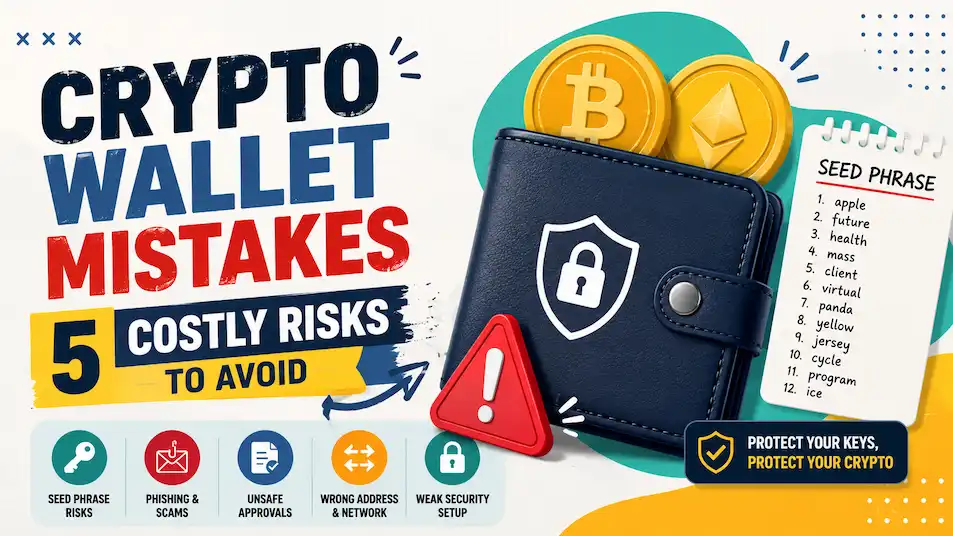
In this guide, we will look at five common crypto wallet mistakes that can cost you money. You will also learn practical crypto wallet security tips you can start using today, even as a beginner.
In This Article
ToggleHighlight key
- A crypto wallet does not store coins. It stores the keys that control them.
- Your seed phrase is the master key. Anyone who has it can access your wallet.
- Many crypto losses involve human errors, phishing, and scams.
- Fake apps, fake support agents, and risky website approvals are common traps.
- Crypto transfers are generally irreversible, so a wrong address or network can cause permanent losses.
- Spreading your funds across wallets and using extra protection can reduce your risk.
First, What Does a Crypto Wallet Actually Do?
A crypto wallet is a tool that lets you send, receive, and manage cryptocurrency. Your coins live on the blockchain. The wallet holds the secret keys that prove you control them.
Two terms matter here:
- Private key: A secret code that allows you to authorize transactions and control your crypto.
- Seed phrase (recovery phrase): A list of usually 12 or 24 words that can restore your wallet and its private keys.
Think of the seed phrase like the master key to a locker room. If someone copies it, they can access your funds, and nobody can stop them simply by resetting your password.
There are two main wallet types:
| Wallet Type | How It Works | Main Advantage | Main Disadvantage |
|---|---|---|---|
|
Hot Wallet (app or browser extension) |
Connected to the internet |
Easy and quick to use |
More exposed to online attacks |
|
Cold Wallet (hardware device) |
Keeps private keys offline |
Better protection against online threats |
Costs money and needs careful handling |
Neither is perfect. A cold wallet can reduce online risks, but you must still protect your recovery phrase and device. Now let’s look at the mistakes.
Mistake 1: Mishandling Your Seed Phrase
This is one of the biggest crypto wallet mistakes. It has two forms.
Sharing it or storing it carelessly. Some people take a screenshot of their seed phrase. Others save it in a notes app, email, or cloud storage. If their phone or account gets hacked, that phrase could be exposed. Security experts advise against storing recovery phrases digitally.
Losing it. If your phone breaks and you have no backup, you may lose access permanently. With a self-custody wallet, there is usually no company that can reset your wallet or recover your funds without the required recovery information.
How to Protect Your Private Key Security
- Write your seed phrase on paper or use a metal backup plate.
- Keep it in a safe place, away from your phone and computer.
- Consider keeping a second copy in another secure physical location.
- Never type it into a website, chat, or online form.
- Never share your recovery phrase with anyone claiming to provide technical support.
Here is a simple rule: no legitimate wallet provider or support team will ask you to share your seed phrase.
For more information, read the official Ethereum Security and Scam Prevention Guide.
Mistake 2: Falling for Phishing, Fake Apps, and Fake Support
Crypto wallet scams often look friendly and professional. Scammers do not always need to break into your wallet. They just need to trick you into handing over access.
Here are common tricks:
- Fake wallet apps: Look-alike apps or browser extensions with a similar name and logo.
- Fake support agents: You post a problem on social media, and a “helpful agent” messages you privately.
- Phishing links: Emails or texts that send you to a copy of a real website.
- Fake giveaways: “Send 1 coin and get 2 back.” Nobody gives away free money like this.
- Fake investment offers: Scammers promise guaranteed profits to convince you to connect your wallet or transfer funds.
Quick Ways to Spot a Scam
- Someone contacts you first and asks for your seed phrase or private keys.
- The message creates panic, like “your wallet will be locked in 10 minutes.”
- The website address has small spelling changes.
- The offer promises guaranteed or unusually high returns.
- Someone asks you to pay a fee to recover stolen cryptocurrency.
To stay safe, download wallet apps only from official app stores or the provider’s verified website. Bookmark the real site instead of clicking links in messages.
Also, remember that no one can honestly guarantee profits in crypto.
Read the FTC Guide to Cryptocurrency Scams to understand common fraud techniques.
Mistake 3: Connecting to Unknown Websites and Approving Everything
Many people use a hot wallet to connect to websites, such as NFT sites, trading platforms, or new apps. When you connect, the site may ask you to sign a message or approve a transaction.
The risk is that some approvals give a website or smart contract permission to move tokens from your wallet. Some platforms request unlimited token spending permissions. If you approve such a request without understanding it, you could expose your funds to unnecessary risks.
Simple Safety Habits
- Connect only to websites you trust and have checked carefully.
- Read each approval request before you confirm it.
- Be extra careful if a site rushes you or offers something that feels too good to be true.
- Use a separate wallet with a small amount for trying new apps.
- Avoid approving unlimited token spending unless you fully understand the risks.
- Regularly review and revoke unnecessary token approvals.
Remember, disconnecting your wallet from a website does not necessarily remove the token spending permissions you previously granted. You may need to revoke those permissions separately.
You can think of it like giving someone a spare key to your house. Before you do that, you should know exactly who they are and what they can do.
For detailed instructions, read Ethereum’s Guide to Revoke Smart Contract Access.
Mistake 4: Sending Crypto to the Wrong Address or Network
Crypto transfers are generally irreversible once confirmed. If you send funds to the wrong address, there is usually no central authority that can reverse the transaction.
Two common errors cause trouble:
- Wrong wallet address: A single wrong character can direct your money to another valid wallet address. Some malware can also replace a copied address with an attacker’s address.
- Wrong network: Many cryptocurrencies and tokens exist on more than one blockchain. If you send a coin using a network that the receiving wallet or platform does not support, the funds may become inaccessible.
However, not every wrong-network transfer means permanent loss. Recovery may sometimes be possible if the receiving wallet supports that network or controls the destination address. It depends on the particular blockchain and receiving platform.
Before You Hit Send
- Check the full address, not just the first and last few characters.
- Confirm that the network matches on both sides.
- Send a small test amount first, especially for large transfers.
- Avoid typing addresses by hand. Copy and paste, then carefully verify the destination.
- Check the transaction status on the relevant blockchain explorer.
This costs you a little time, but it can save you from a painful and potentially permanent mistake.
For additional guidance, read MetaMask’s Official Guide to Funds Sent on the Wrong Network.
Mistake 5: Keeping Everything in One Weakly Protected Wallet
Putting all your crypto in a single hot wallet with a weak security setup is risky. If something goes wrong, you could lose access to all the funds in that wallet at once.
Common weak spots include:
- Using the same password across many accounts.
- Skipping two-factor authentication (2FA) on exchange and email accounts that support it.
- Using public Wi-Fi without proper security precautions when managing crypto accounts.
- Not updating your phone, computer, or wallet app.
- Keeping all your cryptocurrency in a wallet used for everyday transactions.
Your email deserves special attention. Many accounts can be recovered through email, so if your email is hacked, other accounts may also become vulnerable.
How to Secure a Crypto Wallet Better
- Use strong, unique passwords and a trusted password manager.
- Turn on 2FA, preferably with an authenticator app or security key where supported.
- Keep only the amount you actively use in a hot wallet.
- Consider a hardware wallet for larger long-term holdings.
- Keep your devices and apps updated.
- Store your recovery phrase securely offline.
Remember, a hardware wallet is not magic. It protects your keys from many online threats, but you can still lose money if you reveal your seed phrase, approve a malicious transaction, or mishandle your device.
Also, remember that 2FA generally protects exchange, email, and other online accounts. It does not automatically protect every self-custody wallet transaction.
For more security advice, read Bitcoin.org’s Guide to Securing Your Wallet.
Advantages and Disadvantages of Self-Custody Wallets
When you hold your own keys, you are in full control. That has real benefits and real costs.
Advantages
- You control your funds without depending on an exchange.
- You can access your crypto using compatible wallet apps and devices.
- You reduce your dependence on a centralized platform’s security and withdrawal policies.
- You can manage your assets directly through supported blockchain applications.
Disadvantages
- You are fully responsible for security.
- Lost recovery information can mean permanently lost funds.
- Mistakes are usually irreversible, and there may be no customer service to fix them.
- You must understand basic wallet security before storing large amounts.
So the question is not “which wallet is best?” but “which setup can I manage safely?”
Quick Safety Checklist
Use this list as a simple routine:
- Back up your seed phrase offline.
- Never share it with anyone.
- Download wallets only from official sources.
- Double-check addresses and networks.
- Review every approval request.
- Revoke unnecessary token permissions.
- Turn on 2FA wherever supported.
- Split funds between everyday and long-term wallets.
- Keep your wallet software and devices updated.
Following these simple habits can help reduce the risk of losing your cryptocurrency.
Conclusion
Most crypto wallet mistakes are avoidable. Protect your seed phrase, ignore anyone who contacts you first asking for secrets, and slow down before you approve or send anything. Good crypto wallet security is mostly about careful habits, not advanced technology.
Start with one change today, like moving your seed phrase backup offline or turning on 2FA for your exchange and email accounts. Then build from there. Small steps add up to a much safer crypto journey.
Disclaimer: This article is for general educational purposes only and is not financial or investment advice. Cryptocurrency prices are volatile, and you can lose money. Wallet features, security threats, and regulations may change over time, so always check official sources before taking action.
FAQ's
What is the biggest crypto wallet mistake beginners make?
One of the biggest mistakes is mishandling the seed phrase, such as sharing it, taking screenshots, or losing it. Anyone with your recovery phrase can control your wallet, and recovery is usually impossible if the phrase is permanently lost or stolen.
Can you recover crypto sent to the wrong address?
Usually, no. Confirmed blockchain transactions are generally irreversible. However, if you sent funds to an address you control on a supported network, or to a platform that offers recovery assistance, recovery may sometimes be possible. Always contact the official platform through its verified support channel. Never pay strangers who promise guaranteed recovery.
Is a hardware wallet safer than a mobile wallet?
Generally, yes. Hardware wallets keep private keys offline, which reduces exposure to many online attacks. However, they cannot protect you if you share your seed phrase or approve a malicious transaction. Safe habits are still essential.
How can you tell if a crypto wallet app is fake?
Download only from the provider’s official website or verified app store listing. Check the developer name, review the app details carefully, and avoid links sent in unsolicited messages. A legitimate wallet provider will never ask you to share your seed phrase with its support team.
What should you do if your crypto wallet is hacked?
If you suspect your wallet is compromised, move any remaining funds to a new, secure wallet using a safe device, if possible. Revoke suspicious token approvals, change passwords on connected exchange and email accounts, and enable 2FA wherever supported. Save transaction IDs and other evidence, then report the incident to the relevant platform and local cybercrime authorities. Never trust people who promise guaranteed recovery in exchange for an upfront fee.

My name is Subodh Kumar, and I am a finance blogger at Financemantraa.com with a strong interest in personal finance, investing, and financial research spanning 4–5 years.
I enjoy researching financial topics and explaining complex money concepts in simple, easy-to-understand language. My areas of interest include stock market basics, IPOs, mutual funds, financial planning, insurance, saving strategies, and wealth building.
Through Financemantraa.com, I aim to help readers improve their financial knowledge, understand investment concepts, and make informed financial decisions. I focus on creating practical, beginner-friendly guides that make personal finance easier to understand and apply in everyday life.
I believe that financial education and smart money habits can help people work toward long-term financial stability. My goal is to make reliable, accessible, and informative financial content available to everyone.
Disclaimer: The information published on Financemantraa.com is for educational and informational purposes only. It should not be considered professional financial or investment advice.