
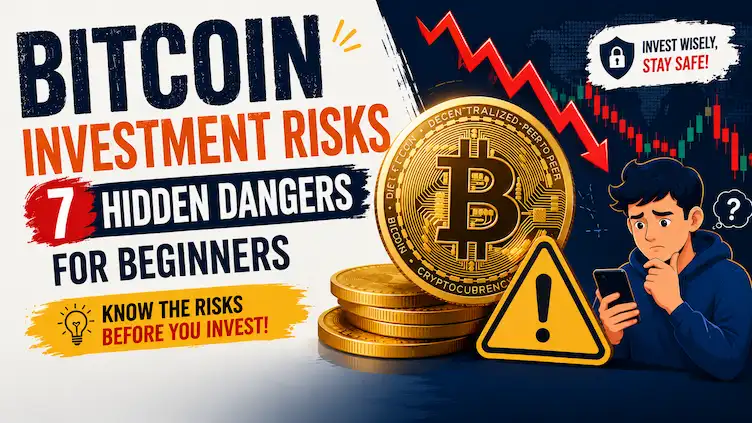
Bitcoin looks exciting from the outside. Headlines talk about record highs, and social media is full of success stories. But Bitcoin investing has another side, and that is where many beginners get hurt.
Bitcoin can offer opportunities, but it also carries serious risks. Its price can rise or fall sharply, scams are common, and investors may lose money because of hacking, lost wallet keys, or sudden market crashes.
In this guide, we will explain the 7 major Bitcoin investment risks in simple English. You will learn about price volatility, scams, security problems, Indian tax rules, and common mistakes beginners should avoid before investing in Bitcoin.
In This Article
ToggleHighlight key
- Bitcoin prices can fall sharply, even after reaching record highs.
- Bitcoin investments offer no guaranteed returns.
- Crypto scams and fake investment platforms can cause significant financial losses.
- Losing private keys or falling victim to hacking can result in permanent loss of Bitcoin.
- In India, income from transferring crypto assets is taxed at 30%, plus applicable surcharge and cess.
- A 1% TDS may apply to qualifying VDA transfers.
- Beginners should invest only money they can afford to lose.
Why Bitcoin Investment Risks Matter in 2026
Bitcoin has experienced several major price movements over the years.
According to historical market data, Bitcoin reached an all-time high of approximately $126,198 on October 6, 2025. However, by October 31, 2026, its closing price had fallen to approximately $77,301.
This represents a decline of around 39% from its record high.
Bitcoin also experienced a sharp fall on February 5, 2026, when its price dropped approximately 11% in a single day.
These movements show why understanding Bitcoin investment risks is important before putting your hard-earned money into cryptocurrency.
You can check Bitcoin historical price data here:
https://nz.finance.yahoo.com/quote/BTC-USD/history/
Let’s understand the seven major risks one by one.
7 Major Risks of Bitcoin Investment
Risk 1: Extreme Price Volatility
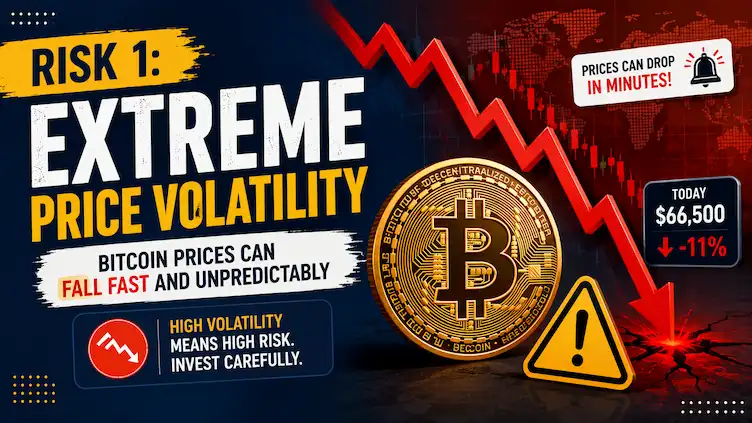
One of the biggest Bitcoin investment risks is extreme price volatility.
Volatility means how quickly and how much the price of an investment changes over a particular period.
Unlike a bank fixed deposit, Bitcoin does not offer a fixed interest rate or guaranteed return. Its price depends on market demand, investor sentiment, economic conditions, regulations, and other factors.
For example, imagine you invest ₹1,00,000 in Bitcoin.
If its price falls by 40%, your investment value becomes ₹60,000. You will have an unrealised loss of ₹40,000 if you have not sold your Bitcoin.
The price could recover later, but there is no guarantee.
Bitcoin can also rise quickly when demand increases. However, buying during a sudden price rally can be risky because prices may fall just as quickly.
How to reduce this risk:
- Avoid investing all your money at once.
- Do not buy Bitcoin simply because its price is rising.
- Understand market volatility before investing.
- Never invest your emergency savings in cryptocurrency.
Risk 2: You Can Lose Most or All of Your Money
Another major risk of Bitcoin investment is the possibility of losing a large part of your capital.
Many beginners ask, “Can you lose all your money in Bitcoin?”
The answer is yes. Although Bitcoin has recovered from several major market crashes in the past, nobody can guarantee that it will always recover.
Bitcoin is not backed by a government or a traditional financial institution. Its market value depends largely on demand and what buyers are willing to pay.
Imagine you invest ₹50,000 in Bitcoin. If its market price falls by 80%, your investment could be worth only ₹10,000.
Recovering from such a loss would require Bitcoin to increase by 400% from that reduced value.
This is why investors should never assume that a falling cryptocurrency will automatically recover.
Also, if you lose access to your wallet or send Bitcoin to the wrong address, you may lose your entire balance regardless of its market price.
How to reduce this risk:
- Avoid investing borrowed money.
- Do not put all your savings into Bitcoin.
- Maintain a diversified investment portfolio.
- Never assume that past price recoveries guarantee future performance.
Risk 3: Bitcoin Scams and Fraud
Bitcoin scams are another serious danger for beginners.
Many scammers target people who want to make quick money through cryptocurrency. They use fake websites, social media accounts, messaging groups, and investment platforms to steal money.
According to the FBI’s 2025 Internet Crime Report, Americans reported approximately $11.366 billion in losses associated with cryptocurrency-related complaints.
These figures are from the United States, not India, but they demonstrate how serious cryptocurrency-related fraud can be.
Source: FBI 2025 Internet Crime Report
https://www.fbi.gov/file-repository/2025_ic3report.pdf
Here are some common Bitcoin scams you should understand:
1. Guaranteed Profit Schemes
Some scammers promise fixed daily or monthly returns from Bitcoin trading. Remember, no genuine investment can guarantee profits from cryptocurrency trading.
2. Fake Investment Platforms
Fraudsters create websites and mobile applications that look like genuine crypto exchanges. They may show fake profits to encourage users to deposit more money.
3. WhatsApp and Telegram Scams
Unknown people may invite you to private investment groups and promise special trading signals or guaranteed returns.
4. Phishing Attacks
Scammers send fake links or emails to steal your exchange login details, passwords, and wallet information.
How to avoid Bitcoin scams:
- Never trust guaranteed-return promises.
- Avoid unknown investment groups.
- Download applications only from trusted sources.
- Never share your OTP, password, or wallet recovery phrase.
- Verify a platform before depositing money.
Risk 4: Security Risks (Hacks, Lost Keys, and Exchange Problems)
Bitcoin is a digital asset, so security is extremely important.
When you store Bitcoin in a personal wallet, you control access through private keys. A private key is a secret cryptographic credential that allows you to access and authorise transactions involving your Bitcoin.
If someone gets your private key or recovery phrase, they may be able to steal your cryptocurrency.
There are three important security risks beginners should know.
1. Hacking and Phishing
Hackers may target cryptocurrency exchanges, wallets, or individual users. Fake websites and malicious applications can also steal login information.
2. Lost Private Keys
If you lose your private keys and do not have a working backup or recovery method, you may permanently lose access to your Bitcoin.
Unlike a bank account, there is generally no customer service department that can reset a self-custody wallet’s private key.
3. Cryptocurrency Exchange Failure
Some investors keep their Bitcoin on online exchanges for convenience. However, if an exchange faces financial problems, gets hacked, or stops operating, accessing your funds may become difficult.
Even a well-known exchange cannot guarantee that your assets are completely safe.
How to protect your Bitcoin:
- Use strong and unique passwords.
- Enable two-factor authentication.
- Never share your private keys or recovery phrase.
- Keep wallet backups in a secure location.
- Be careful before clicking unknown links.
- Understand the risks of keeping assets on an exchange.
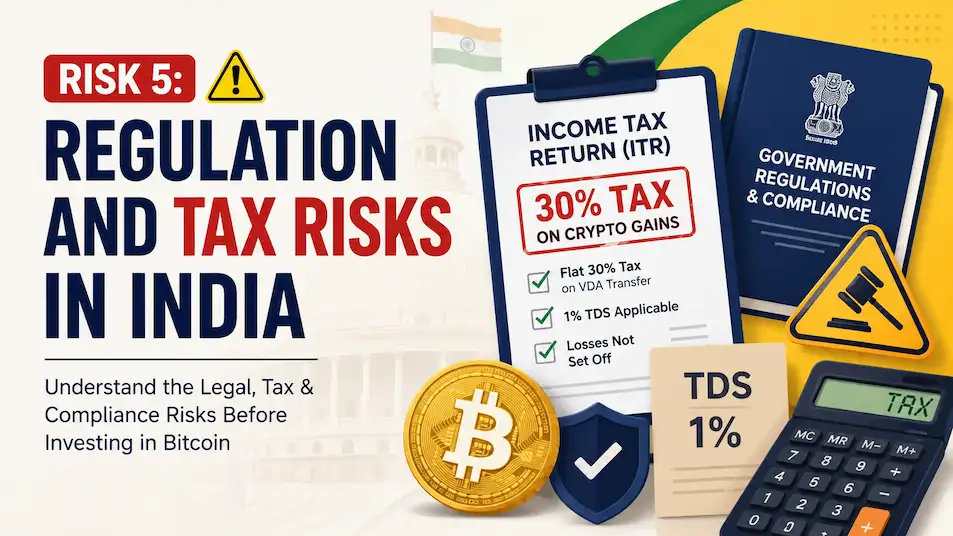
Risk 5: Regulation and Tax Risks in India
Indian investors should understand the legal and tax treatment of Bitcoin before investing.
Bitcoin is not legal tender in India and is not backed by the Indian government. However, cryptocurrency-related activities are subject to taxation and anti-money-laundering compliance requirements.
The Indian government requires relevant Virtual Digital Asset Service Providers operating in India to register with FIU-IND and follow applicable anti-money-laundering rules.
However, FIU-IND registration does not mean that an exchange is government-approved as a safe investment platform or that your crypto holdings are insured.
Source: FIU-IND Guidelines
How Is Bitcoin Taxed in India?
India imposes a special tax treatment on income from transferring Virtual Digital Assets (VDAs), including qualifying crypto assets.
Under the applicable tax provisions:
- Income from transferring VDAs is taxed at 30%, plus applicable surcharge and 4% Health and Education Cess.
- Only the cost of acquisition is generally allowed as a deduction when calculating taxable VDA income.
- VDA transfer losses cannot be set off against other income or carried forward under the special VDA tax rules.
- A 1% TDS may apply under the applicable provisions when consideration is paid to a resident for transferring a VDA, subject to prescribed thresholds.
The Income-tax Act, 2025 came into effect on April 1, 2026. Investors should check the provisions applicable to their particular tax year.
Example: Bitcoin Tax Calculation
Suppose you purchase Bitcoin for ₹1,00,000 and later sell it for ₹1,50,000.
Your calculation would look like this:
| Particulars | Amount |
|---|---|
|
Bitcoin purchase price |
₹1,00,000 |
|
Selling price |
₹1,50,000 |
|
Profit |
₹50,000 |
|
Tax at 30% |
₹15,000 |
|
4% cess on tax |
₹600 |
|
Total tax |
₹15,600 |
The above example excludes any applicable surcharge.
A 1% TDS on the ₹1,50,000 selling consideration would be ₹1,500, assuming the transaction is subject to TDS. This amount is generally available as tax credit and is not an additional final tax.
Now imagine you make a ₹50,000 loss on another cryptocurrency during the same tax year.
You cannot simply use that loss to reduce the taxable profit from your Bitcoin transaction under the VDA loss set-off restrictions.
For accurate information, check the official Income Tax Department’s VDA taxation guidance:
https://www.incometaxindia.gov.in/
Tax rules can be complicated, so consult a qualified tax professional before filing your return.
Risk 6: Leverage and Emotional Decisions
Some cryptocurrency platforms offer leveraged trading.
Leverage means using borrowed funds or margin to control a larger trading position than your available capital.
For example, with 5x leverage, an investment of ₹10,000 can control a trading position worth ₹50,000.
This can increase potential profits, but it also increases potential losses.
Even a relatively small price movement against your position can result in substantial losses or liquidation.
For beginners, leveraged cryptocurrency trading can be especially dangerous because Bitcoin prices can change very quickly.
Emotions create another problem.
Many beginners buy Bitcoin when its price is rising because they fear missing an opportunity. This behaviour is known as FOMO (Fear of Missing Out).
Later, when prices fall, they panic and sell their Bitcoin at a loss.
How to avoid these mistakes:
- Avoid leveraged trading if you are a beginner.
- Do not make investment decisions based on social media hype.
- Set a clear investment plan.
- Avoid panic buying and panic selling.
- Never invest money because someone promises quick profits.
Risk 7: No Safety Net and Unreliable Predictions
Traditional bank deposits and Bitcoin investments are very different.
In India, eligible bank deposits are insured by the Deposit Insurance and Credit Guarantee Corporation (DICGC) up to ₹5 lakh per depositor per bank, including principal and interest, subject to applicable rules.
Bitcoin does not have similar deposit insurance.
If a crypto exchange fails, your wallet gets compromised, or you send Bitcoin to the wrong address, recovering your money may be difficult or impossible.
Another problem is unreliable price predictions.
You may see analysts predicting that Bitcoin will reach $150,000, $200,000, or even higher. However, these are forecasts, not guaranteed outcomes.
Even experienced market analysts can make incorrect predictions.
Therefore, beginners should avoid making investment decisions based only on price targets or online opinions.
Source: DICGC Official FAQ
Bitcoin Investment: Advantages vs Disadvantages
Bitcoin has some potential advantages, but investors should understand its disadvantages before investing.
Possible Advantages
- Bitcoin can be purchased in small amounts.
- It can be traded 24 hours a day, seven days a week.
- Some investors consider it a high-risk alternative asset.
- Bitcoin operates on a decentralised blockchain network.
Disadvantages
- Extremely high price volatility.
- Possibility of significant financial losses.
- Cryptocurrency scams and hacking risks.
- Strict tax treatment in India.
- No guaranteed returns or bank-style deposit insurance.
- Regulatory and exchange-related uncertainty.
Bitcoin may suit investors who understand its risks, but it is not suitable for everyone.
Is Bitcoin Investment Safe for Beginners?
Bitcoin investment is not safe in the same way as an insured bank deposit.
It is a high-risk asset, and its price can change dramatically within a short period.
Beginners should first understand how Bitcoin works, how cryptocurrency wallets operate, and how market prices change.
If you decide to invest, consider starting with a small amount that you can afford to lose.
Bitcoin should not replace your emergency fund, health insurance, life insurance, or essential financial goals.
Remember, protecting your financial future is more important than chasing quick profits.
Things to Know Before Investing in Bitcoin
Before making your first Bitcoin investment, keep these important points in mind:
- Invest only what you can afford to lose. Never use money needed for household expenses or essential financial goals.
- Build an emergency fund first. Keep sufficient savings for unexpected expenses.
- Understand the exchange. Check whether the service provider follows applicable FIU-IND registration and compliance requirements.
- Enable two-factor authentication. Add an extra layer of security to your accounts.
- Protect your wallet keys. Never share your private keys or recovery phrase.
- Maintain transaction records. Keep records of purchases, sales, transfers, and applicable TDS for tax reporting.
- Avoid guaranteed-profit schemes. No genuine Bitcoin investment can promise risk-free returns.
Following these precautions cannot eliminate every risk, but they can help beginners avoid common and costly mistakes.
Conclusion
Bitcoin may attract attention because of its technology and potential for price growth, but the risks of Bitcoin investment are real.
Extreme price volatility, scams, hacking, lost private keys, leverage, and Indian tax rules can create serious problems for inexperienced investors.
This does not mean that every investor must avoid Bitcoin. However, anyone considering it should understand the risks before investing.
If you are a beginner, learn the basics, protect your money, avoid borrowing to invest, and never depend on cryptocurrency profits to meet your essential financial needs.
Is Bitcoin a good investment for beginners in 2026?
It depends on your financial goals, investment knowledge, and ability to handle losses. Bitcoin is a high-risk asset, so make decisions carefully instead of following market hype.
Disclaimer: This article is for educational and informational purposes only. It is not financial, investment, tax, or legal advice. Cryptocurrency investments involve substantial risks, including the possibility of losing your entire investment. Tax rules and regulations may change. Always consult a qualified professional before making financial decisions.
FAQ's
Is Bitcoin investment safe for beginners?
Bitcoin is a high-risk investment and does not provide guaranteed returns. Its price can rise or fall sharply. Beginners should understand the risks and invest only money they can afford to lose.
Can you lose all your money in Bitcoin?
Yes. You can lose your entire investment through extreme price declines, scams, hacking, lost private keys, or leveraged trading. Bitcoin’s past recoveries do not guarantee future performance.
Is Bitcoin a good investment for beginners in 2026?
Bitcoin may be considered by investors who understand cryptocurrency and can tolerate substantial losses. However, it is not suitable for everyone and should not replace essential savings or financial protection.
How can you avoid Bitcoin investment scams?
Use platforms that comply with applicable Indian regulations, verify websites before depositing money, enable two-factor authentication, and never share your OTP, password, or wallet recovery phrase. Avoid guaranteed-return offers.
How is Bitcoin taxed in India?
Income from transferring qualifying virtual digital assets is subject to a 30% tax plus applicable surcharge and cess. A 1% TDS may also apply to qualifying transactions. VDA losses are subject to strict set-off restrictions. Always check the latest Income Tax Department guidance for your tax year.

My name is Subodh Kumar, and I am a finance blogger at Financemantraa.com with a strong interest in personal finance, investing, and financial research spanning 4–5 years.
I enjoy researching financial topics and explaining complex money concepts in simple, easy-to-understand language. My areas of interest include stock market basics, IPOs, mutual funds, financial planning, insurance, saving strategies, and wealth building.
Through Financemantraa.com, I aim to help readers improve their financial knowledge, understand investment concepts, and make informed financial decisions. I focus on creating practical, beginner-friendly guides that make personal finance easier to understand and apply in everyday life.
I believe that financial education and smart money habits can help people work toward long-term financial stability. My goal is to make reliable, accessible, and informative financial content available to everyone.
Disclaimer: The information published on Financemantraa.com is for educational and informational purposes only. It should not be considered professional financial or investment advice.