

Gold Investment 2026: Gold has always been an important part of Indian households. People buy it for weddings, festivals, long-term savings, and financial security. But when gold prices rise sharply, one question comes to mind: Is this the right time to buy gold, or should you wait for a price drop?
Gold investment in 2026 requires careful thinking. Buying when prices are high can be risky, but waiting too long for a correction may also mean missing an opportunity.
As of October 2026, gold prices have experienced fluctuations. According to Economic Times Markets, the reported 24K gold rate in India on October 21 was approximately ₹1,46,780 per 10 grams. Actual prices vary by city, jeweller, and applicable charges.
In this guide, we will explore gold price trends, factors affecting gold prices, investment options in India, taxation, and practical tips to help beginners make informed decisions.
In This Article
ToggleHighlight key
- Nobody can predict gold prices with complete accuracy.
- Gold can help diversify a portfolio, but its price can fall.
- Investing gradually can reduce the risk of choosing a single entry point.
- Gold ETFs and gold mutual funds are convenient investment options.
- GST, making charges, expenses, and taxes can affect your final returns.
- Gold should generally complement other investments rather than replace them.
Gold Price Today: What Should Investors Know?
Gold prices change daily because of international market movements, currency fluctuations, and domestic demand.
For example, the Economic Times gold-rate tracker reported a 24K gold price of approximately ₹1,46,780 per 10 grams on October 21, 2026.
However, this is an indicative market reference, not a guaranteed price at every jewellery shop. Your actual purchase price may be higher because of GST, making charges, and the jeweller’s pricing.
Before purchasing gold, check:
- The latest price for 22K or 24K gold.
- Whether the quoted rate includes GST.
- Making charges for jewellery.
- The purity and hallmarking details.
- The resale policy and applicable deductions.
Important: A price decline does not automatically mean gold has become cheap. Consider your financial goals, investment period, and the reasons behind the price movement.
Why Are Gold Prices Rising or Falling?
Gold prices depend on several economic and market factors.
1. Interest Rates and the US Dollar
Gold does not normally pay interest or dividends. Therefore, when interest rates rise, interest-paying investments may become more attractive compared with gold.
A stronger US dollar can also put pressure on international gold prices because gold is generally priced in dollars.
However, these relationships are not automatic. Gold prices may still climb even when interest rates remain elevated.
2. Central Bank Buying
Central banks keep gold among their foreign exchange reserves. When they expand their gold holdings, their buying activity can help strengthen market demand.
However, central bank purchases are just one of several influences on gold prices and do not ensure that prices will keep climbing.
3. Wars and Economic Uncertainty
During geopolitical conflicts, financial instability, or periods of economic uncertainty, some investors turn to gold because they consider it a safe-haven asset.
But gold is not completely safe from losses. Investors may sell gold during periods of market stress, causing prices to decline.
4. Indian Rupee and Domestic Demand
Gold prices in India depend partly on international prices and the rupee’s value against the US dollar.
If the rupee weakens, imported gold can become more expensive in India, even if international prices remain relatively stable.
Weddings and festivals can also influence domestic demand.
Will Gold Prices Drop in the Coming Months?
Nobody can say with certainty whether gold prices will rise or fall over the next few months.
Prices could decline if the US dollar strengthens, interest rates remain elevated, or investors reduce their demand for safe-haven assets.
On the other hand, geopolitical tensions, strong central bank demand, or changing economic expectations could support prices.
Instead of relying entirely on gold price predictions, consider three possible scenarios:
- Prices rise: Investors who wait may have to buy at a higher price.
- Prices fall: Investors who purchase everything immediately may experience a temporary loss.
- Prices move sideways: Investors may need patience before seeing meaningful returns.
This is why predicting the exact market bottom is difficult.
Rather than making a decision based on one forecast, consider your investment horizon, risk tolerance, and the role gold should play in your portfolio.
Should You Buy Gold Now or Wait for a Price Drop?
There is no universal choice that suits everyone; your decision should be guided by the purpose behind buying gold.
Option 1: Buy Gold Now
Buying now may make sense if you have a long-term goal and gold fits your overall financial plan.
However, investing your entire amount at once exposes you to the risk of a price decline immediately after your purchase.
Option 2: Wait for Prices to Fall
Waiting can be useful if you believe current prices are too high.
The problem is that prices may not fall to your preferred level. You could end up waiting for months while prices move higher.
Option 3: Invest Gradually
For investors who are uncertain about short-term price movements, investing in smaller amounts over time can be a practical approach.
For example, instead of investing ₹30,000 in gold on one day, you could divide the amount into three purchases of ₹10,000 each.
Consider this illustrative example:
| Month | Investment | Gold Price per 10g | Approximate Gold Purchased |
|---|---|---|---|
|
Month 1 |
₹10,000 |
₹1,50,000 |
0.667 g |
|
Month 2 |
₹10,000 |
₹1,40,000 |
0.714 g |
|
Month 3 |
₹10,000 |
₹1,45,000 |
0.690 g |
|
Total |
₹30,000 |
— |
2.071 g |
In this example, the average purchase price is approximately ₹1,44,900 per 10 grams.
These figures are hypothetical and exclude taxes, fees, and other costs. The example also does not guarantee a profit.
Gradual investing can reduce dependence on a single purchase date, but it cannot eliminate market risk.
Best Ways to Invest in Gold in India
Indian investors can choose from several gold investment options.
1. Physical Gold
Physical gold includes jewellery, coins, and bars.
It is suitable for people who want to use gold for weddings, gifting, or personal ownership.
However, jewellery may involve making charges and wastage charges. Eligible gold purchases generally attract 3% GST, and storage creates additional concerns.
Check hallmarking and purity before purchasing. The Bureau of Indian Standards provides information about India’s hallmarking system.
2. Gold ETFs
Gold exchange-traded funds, or Gold ETFs, track domestic gold prices and trade on stock exchanges.
You generally need a demat and trading account to buy them.
Gold ETFs avoid the personal storage and jewellery-making costs associated with physical gold. However, they have fund expenses, brokerage or other applicable charges, and market-related risks.
3. Gold Mutual Funds
Gold mutual funds generally invest in Gold ETFs or related gold-oriented instruments.
They may suit investors who want to invest through a mutual fund account without opening a demat account.
Some funds allow systematic investment plans (SIPs). However, expense ratios and the underlying fund structure can affect returns.
4. Sovereign Gold Bonds
Sovereign Gold Bonds (SGBs) are government securities linked to the price of gold.
Earlier SGB issues offered interest of 2.5% per year, subject to the scheme’s terms, in addition to potential changes in the bond’s market value.
However, investors should check the current issuance status and available issues through the Reserve Bank of India.
If an existing bond is available on the stock exchange, its market price may differ from the value implied by the prevailing gold price. Liquidity and maturity dates also matter.
5. Digital Gold
Digital gold enables users to buy tiny quantities of gold through online platforms. It can be handy for modest investments, but buyers should check storage arrangements, fees, selling options, and associated risks.
Digital gold does not have the same regulatory framework as SEBI-regulated mutual funds and ETFs. Do not presume that all digital gold products provide equal levels of protection.
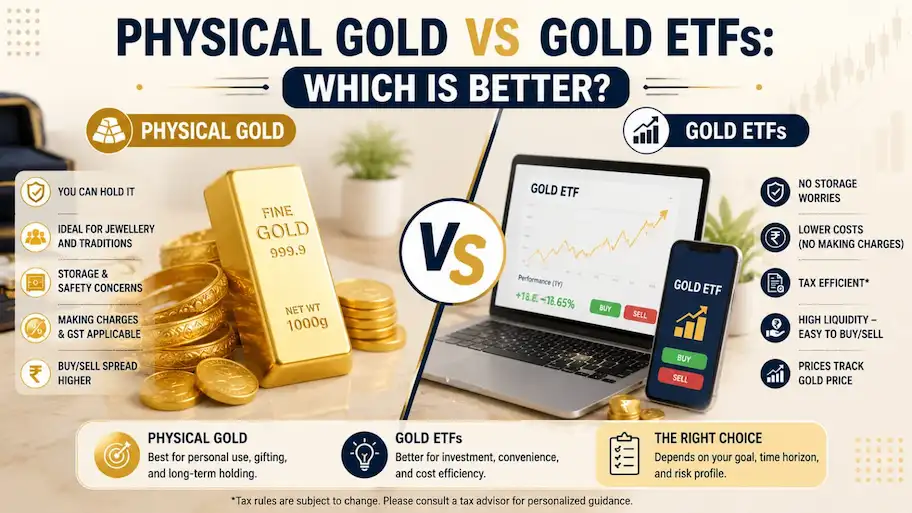
Physical Gold vs Gold ETFs: Which Is Better?
The better option depends on your objective.
| Feature | Physical Gold | Gold ETFs |
|---|---|---|
|
Main purpose |
Jewellery, gifting, ownership |
Portfolio investment |
|
Storage |
Personal storage required |
No personal storage required |
|
GST |
Generally applicable to purchases |
No GST on exchange purchase of ETF units |
|
Making charges |
Applicable to jewellery |
Not applicable |
|
Demat account |
Not required |
Generally required |
|
Market risk |
Yes |
Yes |
|
Additional costs |
Making and storage costs |
Fund expenses and transaction costs |
For long-term financial investing, Gold ETFs may be more convenient than jewellery because they avoid making charges and personal storage.
For weddings, gifting, and traditional use, physical gold may be more appropriate.
Remember that both options can lose value when gold prices decline.
Gold Investment Taxes and Costs in India
Taxation is an important part of gold investment because it affects your actual returns.
Under the capital-gains rules applicable to transfers on or after July 23, 2024, listed Gold ETF units held for more than 12 months generally qualify as long-term capital assets. Long-term capital gains are generally taxed at 12.5% without indexation, subject to applicable provisions.
Short-term gains on listed Gold ETF units held for 12 months or less are generally taxed at the investor’s applicable income-tax rates.
For example, suppose you sell eligible Gold ETF units after 14 months and make a taxable long-term capital gain of ₹20,000.
- Capital gain: ₹20,000
- Tax at 12.5%: ₹2,500
- Health and Education Cess at 4% of the tax: ₹100
- Illustrative total tax: ₹2,600
This example excludes surcharge and assumes the stated rate applies to the entire gain.
Physical gold and digital gold may have different tax considerations. The applicable treatment depends on the asset, transaction date, holding period, and current law.
For verification, consult the Income Tax Department’s official guidance on capital gains and obtain professional advice if needed.
Risks of Investing in Gold
Before investing, understand the following risks:
- Price volatility: Gold prices can fall sharply after a rally.
- No regular income: Physical gold and Gold ETFs generally do not pay interest or dividends.
- Currency risk: Rupee movements can affect domestic gold prices.
- Additional costs: GST, making charges, fund expenses, and transaction costs can reduce returns.
- Liquidity risk: Some gold products may be harder to sell at a favourable price.
- Concentration risk: Investing all your savings in gold can leave your portfolio poorly diversified.
Gold can help diversify investments, but it should not replace an emergency fund or other investments needed for your financial goals.
Gold Investment Tips for Beginners
If you are new to gold investing, follow these practical steps:
- Decide whether you are buying gold for jewellery, savings, or long-term investment.
- Keep an emergency fund before investing money you may need soon.
- Compare physical gold, Gold ETFs, and gold mutual funds.
- Consider gradual purchases instead of trying to predict the exact market bottom.
- Check all charges, taxes, and redemption conditions before investing.
- Avoid borrowing money to speculate on gold prices.
- Review your portfolio periodically instead of reacting to every daily price movement.
Choose an investment based on your financial situation, not simply because gold prices are rising or falling.
Conclusion: Is 2026 the Right Time to Invest in Gold?
Gold investment in 2026 requires patience rather than perfect timing.
Gold prices can rise further, fall sharply, or remain within a range. No analyst can guarantee which direction the market will take.
If you need gold for a long-term financial goal, a gradual investment approach may help you avoid putting all your money into the market on a single day. Gold ETFs and mutual funds offer easy investing, while physical gold suits personal use better.
Most importantly, do not invest your entire savings in gold. Maintain an emergency fund, diversify your investments, and consider your financial goals before making a decision.
The aim is not to foresee every change in gold prices. It is to make a well-informed choice that aligns with your financial goals.
Disclaimer: This article is for educational purposes only and does not constitute investment or tax advice. Gold prices fluctuate, and investments can lose value. Verify current prices, product terms, and tax rules before investing. Consider consulting a SEBI-registered investment adviser for personalised guidance.
Article Sources
- Gold prices in India: Economic Times Markets – Gold Rate
- Current gold-market news: Moneycontrol – Gold Prices on October 22, 2026
- Gold ETF taxation reference: SEBI – Consolidated Circular
- Capital-gains taxation: Income Tax Department
- Gold hallmarking: Bureau of Indian Standards
- Sovereign Gold Bonds: Reserve Bank of India
FAQ's
Is it the right time to invest in gold in 2026?
There is no guaranteed best time to buy gold. Consider your financial goals, investment period, and risk tolerance. Gradual investing may reduce the risk of choosing a single entry point.
Will gold prices fall in the coming months?
Gold prices may fall if the US dollar strengthens, interest rates remain elevated, or demand weakens. However, geopolitical uncertainty and central bank purchases may support prices. No forecast is guaranteed.
Is physical gold or a Gold ETF better for beginners?
Gold ETFs may be more convenient for investment because they avoid jewellery-making charges and personal storage. Physical gold may be preferable for weddings, gifting, and traditional use.
What happens to gold prices during a stock market crash?
Gold sometimes benefits when investors seek safer assets, but its price can also decline during market stress. Gold is not a guaranteed hedge against every market crash.
How can beginners invest in gold in India?
Beginners can compare physical gold, Gold ETFs, and gold mutual funds. Understand the costs, tax treatment, and risks before investing, and avoid committing money needed for essential expenses.

My name is Subodh Kumar, and I am a finance blogger at Financemantraa.com with a strong interest in personal finance, investing, and financial research spanning 4–5 years.
I enjoy researching financial topics and explaining complex money concepts in simple, easy-to-understand language. My areas of interest include stock market basics, IPOs, mutual funds, financial planning, insurance, saving strategies, and wealth building.
Through Financemantraa.com, I aim to help readers improve their financial knowledge, understand investment concepts, and make informed financial decisions. I focus on creating practical, beginner-friendly guides that make personal finance easier to understand and apply in everyday life.
I believe that financial education and smart money habits can help people work toward long-term financial stability. My goal is to make reliable, accessible, and informative financial content available to everyone.
Disclaimer: The information published on Financemantraa.com is for educational and informational purposes only. It should not be considered professional financial or investment advice.