

Friends, the tax season can seem scary. You open your salary slip, see the tax deduction, and think, “I wish I could do something about this.” Well, the good news is—you can. In this guide, I’m going to share some simple tax saving tips with you that actually work in 2026. No fancy stuff, no confusing rules. Just straightforward things, like I’m sitting with you over a cup of tea.
I’ve been tracking money matters for a while, and I remember my first job. My first salary slip had a tax deduction that shocked me and also made me think. Back then, I knew nothing about Section 80C or HRA. Over time, through trial and error, I learned the real tax saving strategies 2026 that helped me keep more of my hard-earned money. This is exactly what I am going to share with you all today. Don’t you want to know about these things?
Tell the truth, do you also feel that tax rules are very complicated? You are not alone in thinking this at the moment. So let’s understand it together, step by step, in the easiest way.
Highlight key
- Old regime still gives many deductions like 80C, 80D, and HRA.
- New regime has lower rates but very few deductions.
- Income up to Rs 12 lakh is tax-free under the new regime because of rebate.
- Section 80C limit is still Rs 1.5 lakh; it has not changed for years.
- Employer NPS contribution under Section 80CCD(2) works in both regimes.
- Standard deduction of Rs 75,000 is allowed under the new regime for salaried people.
- Small smart moves through the year can save you thousands of rupees.
Old tax rules or new? Find out which one will save you more.
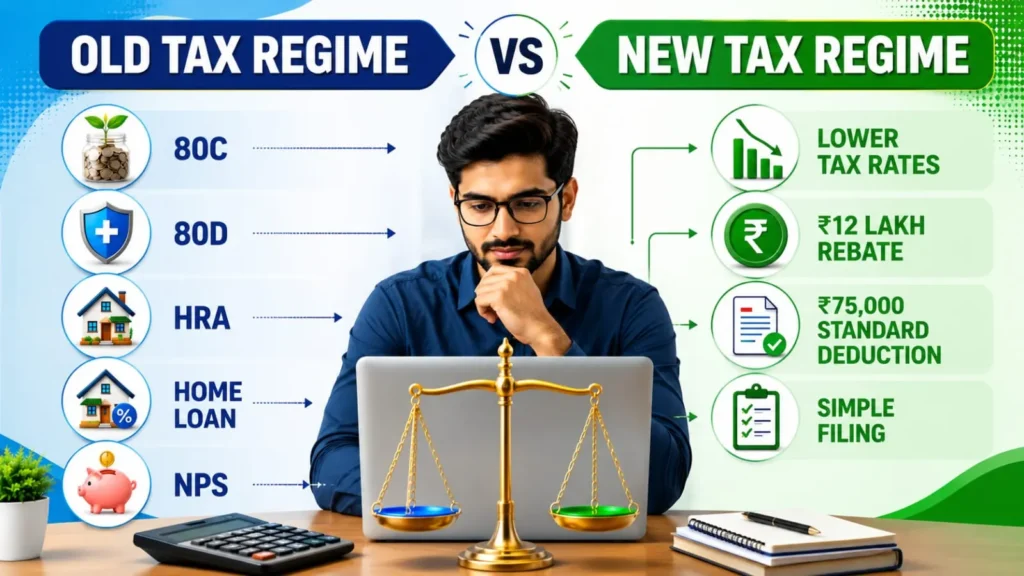
Before we jump into the list, let’s talk about something important. In 2026, you still have two choices: the old tax regime and the new tax regime. This choice affects which Tax Saving Tips will actually work for you.
The old regime lets you claim many deductions. You get to see tax deductions on stuff like 80C, 80D, HRA, and home loan interest. But the tax rates are a bit higher. The new regime, on the other hand, gives you lower tax rates but takes away most deductions. It is simple, but it also means fewer chances to save.
In my experience, if you have a home loan, insurance policies, and you invest regularly, the old regime often works better. But if you are someone who does not invest much and wants a simple tax structure, the new regime might suit you more.
Here is something worth knowing. Under the new regime, income up to Rs 12 lakh is tax-free because of the rebate under Section 87A. That is a big relief for middle-class earners. But remember, once your income crosses that limit, tax kicks in fast because deductions are limited.
So the first real tip is this. Before you pick any tax-saving product, sit down and compare both regimes. Use an online tax calculator. This one step alone can save you a lot of money and confusion.
15 Smart Tax Saving Tips for 2026
Now let’s get into the real list. These are practical Income Tax Saving Tips that you can start using today.
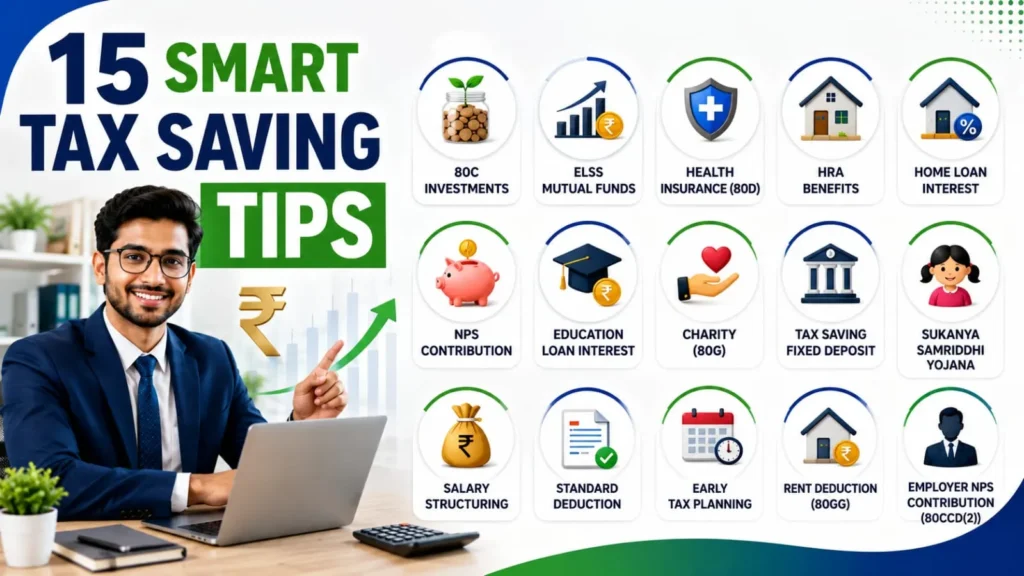
1. Max Out Your Section 80C Limit
This is the most common of all tax-saving investments. Under 80C, you can claim up to Rs 1.5 lakh in deductions. This includes PPF, ELSS mutual funds, life insurance premiums, and even your children’s tuition fees.
Friends, this limit has not changed since 2014. Many people expected it to go up in Budget 2026, but that did not happen. So make sure you are using the full Rs 1.5 lakh wisely, not just filling it with random policies.
2. Invest in ELSS Mutual Funds
If you want good returns along with tax savings, ELSS funds are worth a look. They come under 80C, and they have the shortest lock-in period among tax-saving options, just three years. In my experience, ELSS often gives better returns than traditional options like fixed deposits, though returns are not guaranteed since they depend on the market.
3. Use Section 80D for Health Insurance
Health insurance is not just about medical safety; it also saves tax. Under Section 80D, you can super easily claim a deduction on the premiums you paid for yourself, your family, and your parents. If your parents are senior citizens, the limit is even higher.
If you think as I do, health insurance should be a priority anyway. Safety is the biggest benefit; the tax exemption is just a small part of it, which is called a bonus.
4. Claim HRA If You Live on Rent
If you are a salaried employee living in a rented house, do not forget House Rent Allowance. This is one of the most useful Tax Deductions under the old regime, but it disappears completely under the new regime. So if you pay decent rent, this is a strong reason to stick with the old regime.
5. Home Loan Interest Deduction
Own a home with a loan? Section 24(b) allows you to claim a deduction on home loan interest, up to Rs 2 lakh per year for a self-occupied property. This is a solid way to reduce taxable income if you have a big loan running.
6. Additional NPS Contribution Under 80CCD(1B)
Here is a tip many people miss. Beyond the 80C limit, you can invest in the National Pension System and claim an extra deduction of up to Rs 50,000 under Section 80CCD(1B). This is separate from your 80C limit, so it is like getting an extra bucket for savings.
7. Employer NPS Contribution Under 80CCD(2)
This one works in both old and new regimes, which makes it special. If your employer contributes to your NPS account, you can claim a deduction up to 14 percent of your basic salary. This is honestly one of the best Tax Benefits left for people in the new regime.
8. Use the Standard Deduction
Every salaried person and pensioner gets a standard deduction. In 2026, this stands at Rs 75,000 under the new regime and Rs 50,000 under the old regime. You do not need to submit any proof for this; it is automatic. Small thing, but every rupee counts.
9. Claim Deduction on Education Loan Interest
If you or your child took an education loan, Section 80E allows deduction on the interest paid, with no upper limit. The benefit of this plan lasts for a full 8 years. Quite generous if you ask me.
10. Donate to Charity Under Section 80G
Donations to approved charities and relief funds can also reduce your tax. Under Section 80G, depending on the organization, you can claim either 50 percent or 100 percent of the donated amount as a deduction. Just keep your receipts safe; you will need them.
11. Rent Deduction Under Section 80GG
Not everyone gets HRA from their employer, especially self-employed folks. If that is you, Section 80GG lets you claim a deduction for rent paid, subject to certain conditions and limits. This is one of those tax-saving strategies that freelancers often forget about.
12. Tax Saving Fixed Deposits
These are simple and safe. A five-year tax-saving FD qualifies under 80C. Returns are lower compared to ELSS, but if you want zero risk, this is a decent choice. However, honestly, interest earned is taxable, so keep that in mind.
13. Invest in Sukanya Samriddhi Yojana
For parents with a daughter under 10, this government scheme is worth exploring. It offers good interest rates along with 80C benefits. It is a long-term option, but it builds a solid corpus for your daughter’s future needs.
14. Plan Salary Structuring Smartly
If you are in the new regime, talk to your HR about salary structuring. Things like meal vouchers and other allowed perks can slightly reduce your taxable income. It is not a huge saving, but every bit helps.
15. Time Your Investments Before the Financial Year Ends
Last but not least, do not wait until March to figure out your tax planning. I made this mistake in my early working years, rushing to invest in the last week and picking random products just to save tax. Start early, plan through the year, and choose investments that also match your financial goals, not just your tax bill.
Old Regime or New Regime: Which One Should You Pick
There is no one-size-fits-all answer here, buddy. Generally, if you have big deductions like home loan interest, HRA, and heavy 80C investments, the old regime saves you more. If your deductions are limited, the new regime with lower slab rates and the Rs 12 lakh rebate often works out better.
My honest suggestion: use an income tax calculator every year before deciding. Your income, investments, and life situation change, so your best regime can change too. Do not just stick to what you picked last year without checking again.
Common Mistakes to Avoid While Tax Planning
However, before you go ahead and start investing everywhere, let’s talk about mistakes people often make.
- Buying insurance policies only for tax saving, without checking if the coverage actually makes sense.
- Ignoring the lock-in period of tax saving products, then needing the money urgently.
- Not comparing old and new regime every year.
- Forgetting to collect proof of investments and donations before filing returns.
- Waiting till the last month to start tax planning.
Tell me the truth: have you made any of these mistakes before? Most of us have, and that is completely fine. The point is to learn and do better this year.
Final Thoughts on Tax Saving Tips 2026
Friends, saving on taxes is not about finding mistakes or loopholes. It’s about smartly using the legal options that the government already gives you. Whether you are a salaried employee, self-employed, or a freelancer, if you plan ahead, there’s always some way to reduce your taxable income.
In my experience, the best way is simple. Understand your tax regime, use the deductions that make sense for your life, and start early instead of rushing at the last minute. These tax-saving tips aren’t complicated; they just need a little attention and your planning.
So go ahead, sit down this week, check your numbers, and pick the options that work for you. Your future self will thank you.
Disclaimer
This article is written only for general information to help people and is not professional tax or financial advice. Tax rules can change, and everyone’s situation can be different. Please consult a qualified chartered accountant or tax advisor before making any financial decisions.
FAQ's
Q1. What are the best tax saving tips for salaried employees in 2026?
Salaried employees should use 80C, 80D, HRA, and standard deduction fully. Compare the old versus new regime yearly to pick the option with lower actual tax outgo.
Q2. How can I save income tax legally in 2026?
Use approved sections like 80C, 80D, 80CCD, and home loan interest deduction. Invest early, keep proof, and choose the tax regime that suits your income.
Q3. Is the new tax regime better than the old tax regime?
It depends on your deductions. High deduction claimers often benefit from the old regime, while others usually save more under the simpler new regime.
Q4. Can I still claim 80C deductions under the new tax regime?
No, Section 80C deductions are not allowed under the new regime. Only the old regime permits this popular tax saving deduction for investments and insurance.
Q5. What is the best tax saving investment option for beginners?
ELSS mutual funds are great for beginners since they offer tax benefits under 80C, shorter lock-in period, and potential for higher long-term returns.
Q6. How much tax can I save using Section 80CCD(1B) for NPS?
You can claim an extra deduction of up to Rs 50,000 under Section 80CCD(1B), over and above your regular Rs 1.5 lakh 80C limit.