
Friends, be honest with me: does the phrase ‘how to file income tax returns‘ make you a little nervous every year? You are not alone in facing this problem. I felt the same way when I filed my first return.
I remember sitting with my laptop, with coffee going cold beside me, thinking, ‘What if I make a mistake and the tax department sends me a notice?’ But when I actually did it, I realized that it’s not as complicated as it seems. In this article, I’ll show you, step by step and in the simplest words, how to file your income tax return online in India in 2026. No confusing terms, no jargon, just like a friend explaining it to another friend.
Whether you are a salaried employee, a freelancer, or running a small business, this guide is for you. Let’s finish it together.
Highlight key
- Learn how to file an Income Tax Return online in India step by step.
- Know the last date to file ITR for 2026
- Understand which ITR form suits you.
- Documents you need before you start
- Common mistakes people make while filing ITR
- How to check your refund status after filing
What Is Income Tax Return and Why You Should File It
Before we jump into how to file an Income Tax Return, let’s understand what it actually means. An Income Tax Return, or ITR, is basically a form where you tell the government how much money you earned in a financial year and how much tax you owe or have already paid. It sounds boring, I know, but it is one of the most important financial documents you will ever create.
In my experience, many people think filing ITR is only for rich people or big businessmen. That is simply not true. Even if your income is below the taxable limit, filing a return still has benefits. It works as income proof when you apply for a loan, a visa, or even a credit card. Banks often ask for your last two or three years of ITR before approving anything big.
Also, if extra tax was cut from your salary through TDS, filing your return is the only way to get that money back as a refund. So think of it less like a punishment and more like claiming what is rightfully yours. Now let’s talk about what you will need before starting the process.
Documents Required to File Income Tax Return
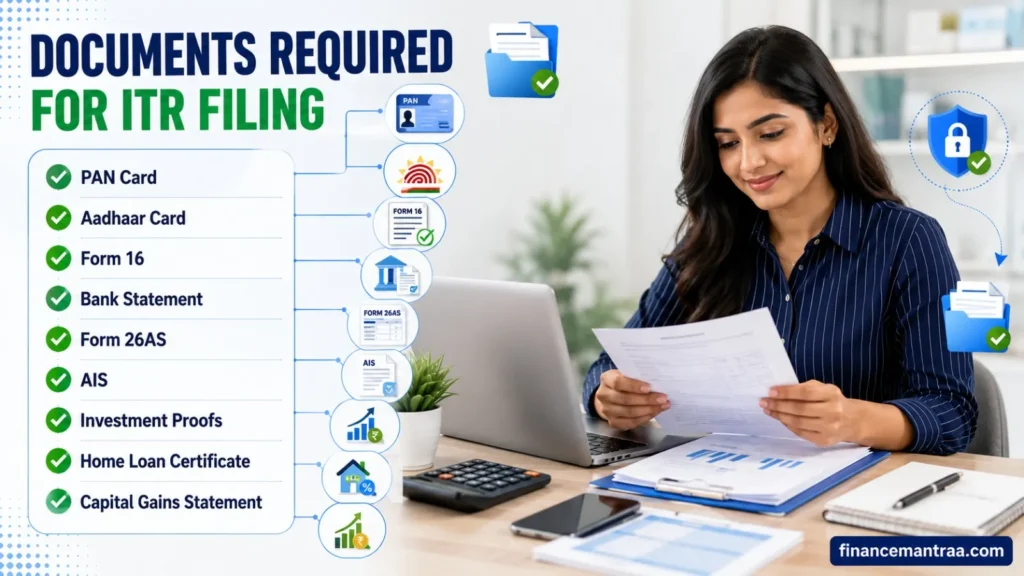
Get your documents ready in advance; otherwise, later you’ll have to deal with a lot of stress. Here is a simple list of documents required to file an Income Tax Return in 2026:
- PAN Card and Aadhaar Card
- Form 16 from your employer, if you are salaried.
- Bank account statements for the financial year
- Form 26AS and Annual Information Statement, or AIS, from the tax portal
- Investment proofs, such as insurance, PPF, or ELSS, if you claim deductions
- Home loan interest certificate, if applicable
- Capital gains statement, if you sold shares, mutual funds, or property
- Details of any other income, like interest from savings account or fixed deposits
Friends, if you don’t have Form 16 for some reason, don’t worry. You can still calculate your income using your salary slips and bank statements. Many freelancers and self-employed people don’t get a Form 16 at all, and that is completely normal. Just keep your invoices and payment records handy instead.
Which ITR Form Should You Choose in 2026
This is where a lot of people get confused, and honestly, choosing the wrong form is one of the biggest mistakes I have seen friends make. Picking the correct form matters because a wrong choice can lead to your return being marked defective by the department.
ITR-1 for Salaried Employees
ITR-1, also called Sahaj, is meant for salaried individuals with income up to fifty lakh rupees. For 2026, this form now allows you to report up to two house properties, which is a nice change from before. However, if you are a company director, or you earn agricultural income above five thousand rupees, you cannot use this form.
ITR-2, ITR-3, and ITR-4 for Others
If you have earned capital gains, own more than two houses, or are a director of a company, then ITR-2 is the form meant for you. If you run a business or profession and maintain regular books of accounts, ITR-3 applies to you. For freelancers, small business owners, or professionals under the presumptive taxation scheme with turnover within the prescribed limit, ITR-4 is usually the easiest option. If you think as I do, always double-check on the portal before submitting, because the system often suggests the right form based on your income sources.
Last Date to File Income Tax Return 2026
Now let’s talk about the dates, because missing them can be costly. For the financial year 2025-26, which is assessment year 2026-27, the last date to file an Income Tax Return is 31st July 2026 for salaried individuals filing ITR-1 or ITR-2. If you are filing ITR-3 or ITR-4 without any audit requirement, your deadline is 31st August 2026. Businesses that require an audit get until 31st October 2026.
If you miss these dates, you can still file a belated return, but you will have to pay a late fee under section 234F, and you may lose certain benefits, like carrying forward some losses. In my experience, filing early is always better. You avoid the last-minute portal rush, and you get your refund faster too. So don’t wait until the final week, friends.
How to File Income Tax Return Online, Step by Step
Alright, now comes the main part: the actual process of how to file an Income Tax Return online. I will break this into simple steps so you can follow along without any confusion.
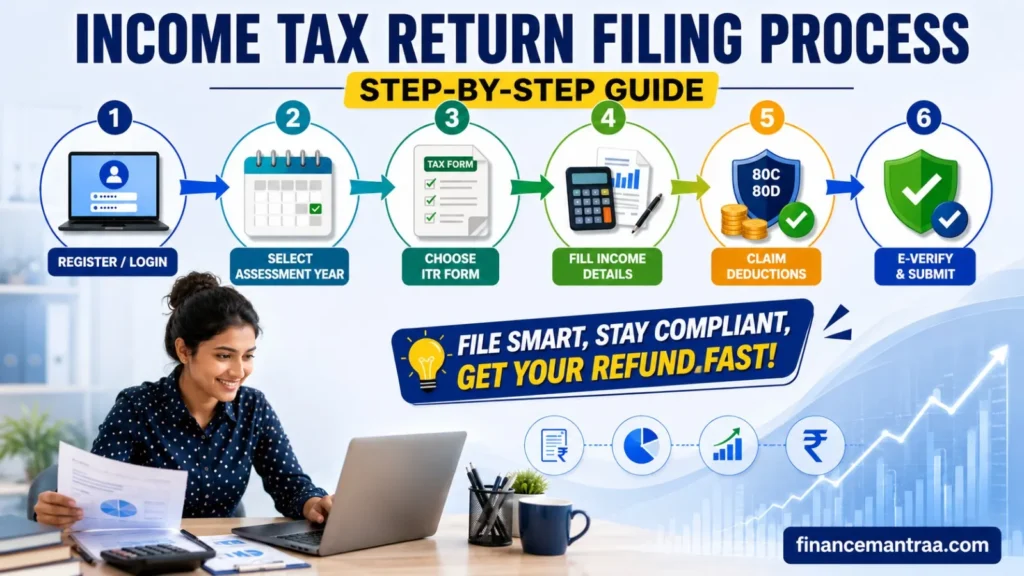
Step 1: Register or Log in on the Income Tax Portal
Go to the official Income Tax e-filing portal, incometax.gov.in. If you are filing for the first time, register using your PAN, which becomes your user ID. If you already have an account, simply log in with your PAN and password.
Step 2: Choose the Assessment Year and ITR Form
Once logged in, click on “File Income Tax Return” and select the correct assessment year, which is 2026-27 for income earned in 2025-26. The portal will ask a few questions about your income sources and suggest the ITR form that fits you best.
Step 3: Fill in Your Income Details
This is the most important step. Most of your salary, interest, and TDS details will already be pre-filled from Form 26AS and AIS. However, always cross-check every single number carefully. In my experience, pre-filled data is not always one hundred percent accurate, so take your time here.
Step 4: Claim Your Deductions
Next, enter your deductions under sections like 80C for investments, 80D for health insurance, and others that apply to you. If you have chosen the new tax regime, remember that most deductions are not available, so this step may be shorter for you.
Step 5: Verify and Submit
Once everything looks correct, submit your return. But your work is not done yet. You must verify your ITR within thirty days, either through Aadhaar OTP, net banking, or by sending a signed physical copy to the tax department. Without verification, your return is treated as if it were never filed.
How to File ITR Without a CA
Tell me the truth: many of you probably think you always need a chartered accountant to file your return. That is not true for most simple cases. If you are a salaried person with straightforward income, the online portal walks you through everything with pre-filled data, and you can easily file ITR without a CA.
I filed my own return the first time using just the portal and a bit of patience, and it worked out fine. However, if your income involves multiple properties, capital gains, foreign income, or complex business accounts, hiring a CA is genuinely worth the money. There is no shame in asking for help when the situation gets complicated.
How to File ITR for Freelancers and Self-Employed Individuals
Freelancing has grown massively in India, and if you earn through Upwork, Fiverr, YouTube, or client projects, you still need to file your Income Tax Return. Most freelancers use the presumptive taxation scheme under ITR-4, where you declare a fixed percentage of your gross receipts as profit, without maintaining detailed books.
This is honestly one of the easiest ways to file ITR for freelancers in India because it saves a lot of paperwork. Just keep a record of your total earnings through bank statements and invoices, and the rest becomes fairly simple. If your income crosses the limit for presumptive taxation, you will need to move to ITR-3 and maintain proper accounts instead.
How to Verify Income Tax Return Online
Filing your ITR is only half the job. Verification completes the process, and honestly, this step is quicker than people expect. On the portal, after submission, click on “e-Verify Return.” The easiest method is Aadhaar OTP, where a code is sent to your registered mobile number linked with Aadhaar.
You can also verify using net banking or a bank account EVC. If you skip this step, your income tax return filing process is considered incomplete, even if you submitted all the details correctly. So please, don’t forget this last but crucial step.
Common Mistakes to Avoid While Filing ITR
Over the years, I have noticed some mistakes that happen again and again. Here are the ones you should watch out for:
- Choosing the wrong ITR form according to income
- Forgetting to report interest income from savings accounts
- Not matching figures with Form 26AS and AIS.
- Skipping the e-verification step after submission
- Missing the deadline and paying unnecessary late fees
- Entering wrong bank account details, which delays your refund
If something feels off while filing, it usually is. Double-check everything before hitting submit, because correcting mistakes later takes more time and effort.
How to Check ITR Refund Status
If you paid more tax than required, the department owes you a refund. To check your ITR refund status, log in to the income tax portal, go to the “e-File” section, then “Income Tax Returns,” and click on “View Filed Returns.” You will see the current status there.
Refunds usually take a few weeks to a couple of months, depending on how quickly your return is processed. However, delays can happen if your bank account is not validated on the portal, so make sure that is done properly beforehand.
Benefits of Filing Income Tax Return
Some people still ask why they need to file. To be honest, the benefits of filing an income tax return go beyond just following the law. It helps you get a loan approved quickly, serves as valid income proof for visa applications, allows you to claim refunds, and even helps you carry forward some losses to the next year. It also creates a clean financial history, which really comes in handy when you need it the most.
Disclaimer
This article is written for general information purposes only and should not be treated as professional tax advice. Tax rules can change, so please verify the latest details on the official Income Tax portal or consult a qualified chartered accountant before making financial decisions.
FAQ's
What is the last date to file Income Tax Return for 2026?
For most salaried taxpayers filing ITR-1 or ITR-2, the last date is 31st July 2026. Business filers get slightly more time.
Can I file ITR without Form 16?
Yes, you can use salary slips and bank statements to calculate income if Form 16 is not available from your employer.
How do I choose the right ITR form?
It depends on your income type. Salaried people usually use ITR-1, while business owners and freelancers often use ITR-3 or ITR-4.
Is it necessary to verify my ITR after filing?
Yes, without e-verification within thirty days, your return is treated as not filed at all, even if submitted correctly.
Can freelancers file ITR without maintaining detailed books?
Yes, freelancers can use the presumptive taxation scheme under ITR-4, which avoids the need for detailed bookkeeping.
How long does it take to get an ITR refund?
Refunds usually take a few weeks to a couple of months, depending on processing speed and bank account validation status.