
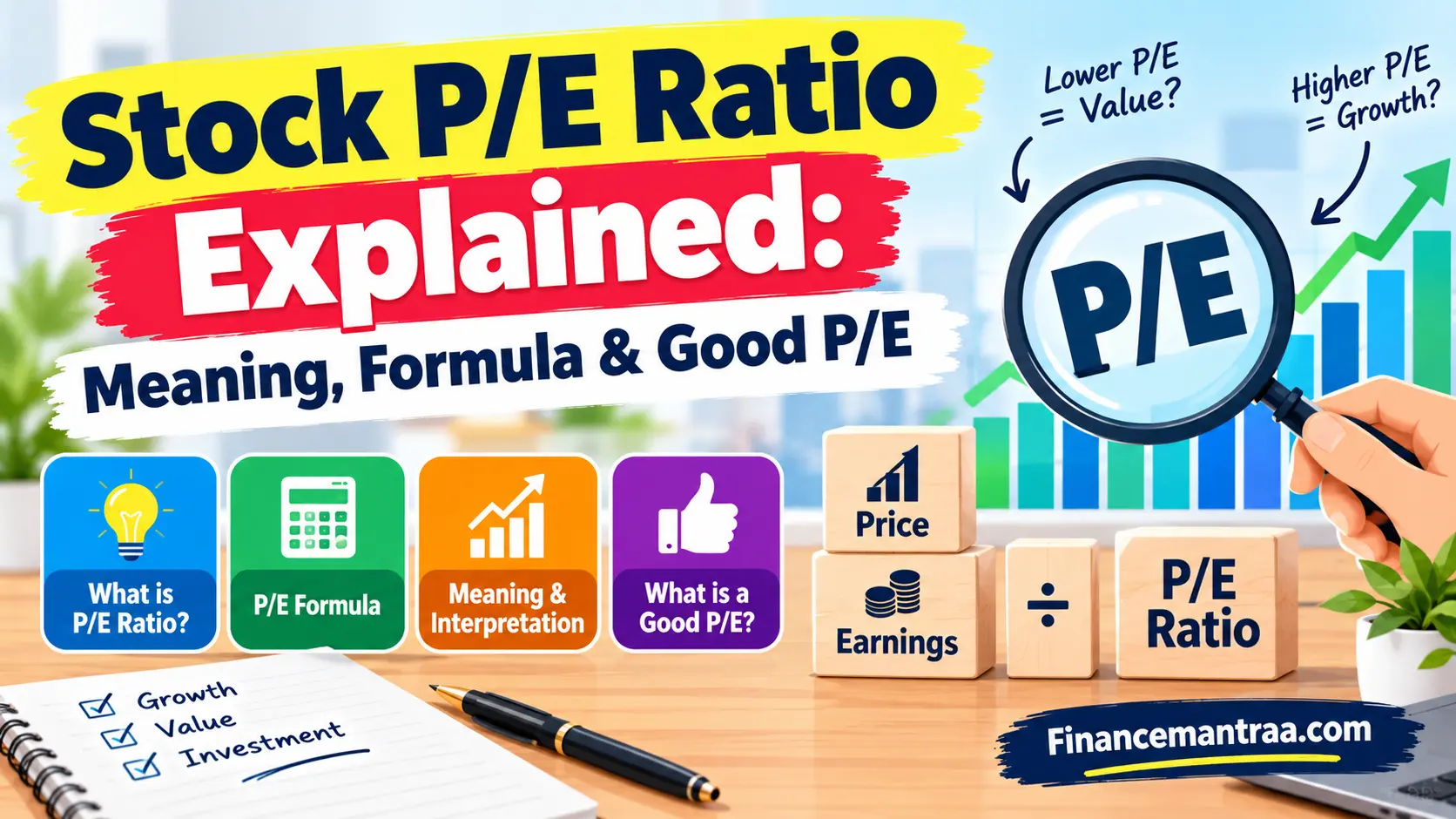
Friends, be honest with me. Have you ever bought a stock simply because its price looked cheap? I made the same mistake when I was starting out, and it cost me. That experience taught me why understanding the Stock P/E Ratio is important before investing your hard-earned money in the market.
The Stock P/E Ratio tells you how much you are paying for every rupee a company earns. It is simple, useful, and widely followed by investors. In this guide, we’ll understand what the P/E Ratio means, learn its formula, and find out how to identify a reasonable value.
We’ll also use HDFC Bank as an example because many beginners first search for HDFC Bank share and HDFC Bank stock when learning about investing. So, let’s get started.
In This Article
ToggleHighlight key
- The ratio shows how much you pay for each rupee of company profit.
- Formula: Share Price ÷ Earnings Per Share (EPS).
- A low P/E is not always cheap, and a high P/E is not always costly.
- Compare with sector peers and the company’s own past.
- HDFC Bank is used as a real-life example.
What Is the Stock P/E Ratio?
P/E stands for Price to Earnings. Imagine you are buying a small shop. If that shop earns ₹1 lakh every year and the seller is asking ₹15 lakh, you are essentially paying for 15 years of earnings. This is the basic concept behind the Stock P/E Ratio. For example, if a stock has a P/E of 20, it means you are paying ₹20 for every ₹1 the company earns in a year.
So, why do investors consider P/E Ratio useful? The biggest reason is that it provides a quick idea about a company’s valuation. Two companies can have completely different share prices, but P/E allows investors to compare their valuations on a similar scale. In some cases, a ₹2,000 stock may actually be cheaper than a ₹100 stock, and the valuation helps you understand the difference.
However, there is one important thing to remember. P/E alone cannot tell you whether you should buy or sell a stock. It mainly reflects what the market expects from the company. A high P/E may indicate that investors are expecting strong future growth, while a low P/E could point to weaker expectations or potential problems.
Therefore, investors should always look at P/E Ratio along with other financial factors before making an investment decision.
Formula With a Simple Example
The formula is very easy. You only need two things.
P/E = Market Price per Share ÷ Earnings per Share (EPS)
EPS is the yearly profit of the company divided by the total number of shares. You can find all these on Screener, NSE, BSE, or your broker app, so there’s no need to calculate by hand every time.
Let’s take a made-up example. A share trades at ₹300, and the company earned ₹15 per share last year. So 300 ÷ 15 = 20. The Stock P/E Ratio is 20.
Now, what if profit grows to ₹20 per share and the price stays ₹300? The P/E drops to 15. The stock looks cheaper, though the price did not move. That is why profit growth matters so much.
In my experience, beginners often use the wrong EPS. Always check that the profit comes from regular business. A one-time gain, like selling a building, can make the P/E look very low for a short time.
Trailing P/E vs Forward P/E
Now let’s talk about the two main types.
Trailing P/E uses the profit of the last 12 months. It is based on real numbers, so it is more reliable. Most websites show this one by default.
Forward P/E uses the profit that analysts expect in the next year. It looks ahead, which is useful, but it is only a guess. Estimates can go wrong, and I have seen many of them miss.
Here is an easy way to remember:
- Trailing P/E: facts from the past
- Forward P/E: hopes for the future.
There is also the Index P/E, like Nifty 50 P/E. It shows if the whole market is costly or cheap. When it is far above its long-term average, I become careful about adding fresh money. When it is low, I feel more comfortable.
If you think as I do, you will use both types together. Each version of the Stock P/E Ratio shows a different side of the story.
How to Find a Good Stock P/E Ratio
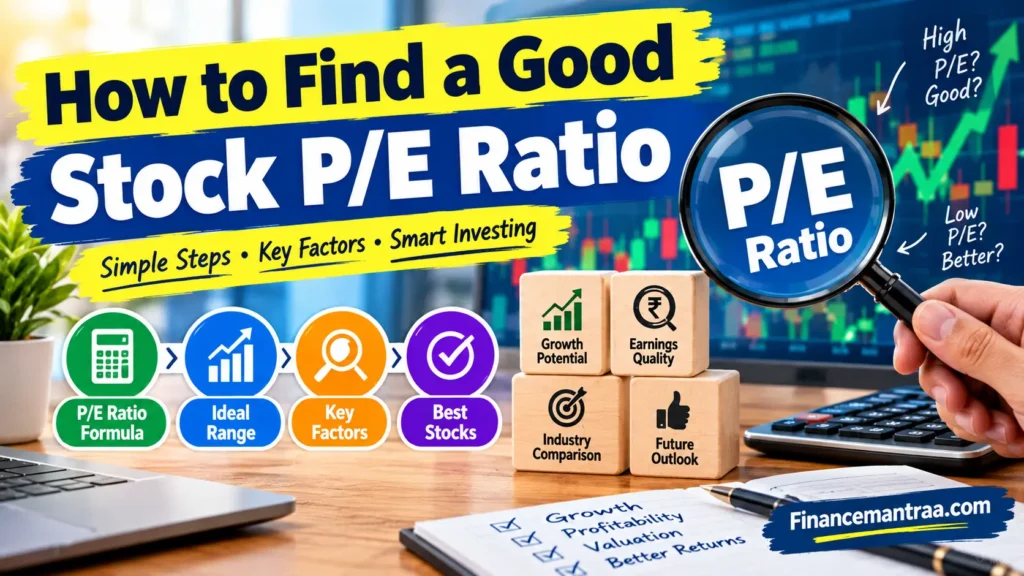
Tell me the truth, do you want one magic number? I wish it existed. Sadly, a good Stock P/E Ratio depends on the sector, the growth rate, and the risk.
Here is how I check it:
- Compare with peers. Banks should be compared with banks, not with IT or FMCG companies.
- Compare with its own history. Look at the 5- or 10-year average P/E.
- Check profit growth. A higher P/E can be fair if profit grows fast and steady.
- Look at debt and quality. A cheap stock with heavy debt can be a trap.
As a rough thumb rule, a P/E below the sector average may be attractive, and a P/E far above it needs strong reasons. Banks usually trade at lower numbers than fast-growing consumer or tech companies, because their business model is different.
Quick steps: open Screener or your broker app, note the P/E, check the sector P/E, look at the 5-year average, then read the last four quarterly results. It takes ten minutes and saves a lot of pain.
Do not chase the lowest number. I once bought a stock only because its P/E was very low. Profits fell the next year, and the price fell with it. It was a cheap lesson, but it stayed with me.
Using P/E on HDFC Bank Share: A Real Example
Many beginners search for HDFC Bank share price and latest updates before investing, so let’s use it as a real-life example. Take the current HDFC Bank stock price, divide it by the earnings per share, and you get the P/E. Then compare it with other big private banks and with HDFC Bank’s own past average. Since the merger with HDFC Ltd in 2023, the numbers look different from earlier years, so comparing only with very old data can mislead you.
Is HDFC Bank a good stock to buy? Honestly, I cannot say yes or no for you. The bank is large, well-known, and has a long record, which many long-term investors like. On the other hand, big size can slow growth, and bank profits depend on interest rates and loan quality. Before deciding, read HDFC Bank’s latest news, its financial performance and growth in results, and analyst views on the HDFC Bank share price target. Treat targets as opinions, not promises.
For HDFC Bank share investment for beginners, I suggest buying in small parts over time instead of putting all money at once.
Also, do not mix up investing in the share with using the bank. HDFC Bank offers a savings account, net banking, mobile banking, credit card, FD, personal loan, and home loan. Interest rates on HDFC Bank FD, personal loan, and home loan change from time to time, so always check the official website before you decide.
Common Mistakes and Limits of the Stock P/E Ratio
The Stock P/E Ratio is helpful, but it has limits. Let me share the common mistakes I see.
- Using only P/E. Always add ROE, debt, cash flow, and growth.
- Ignoring losses. If a company has no profit, P/E has no meaning.
- Comparing different sectors. This is the biggest error.
- Trusting one year of profit. Cyclical companies, like steel or auto, can show a very low P/E at peak profit and a very high one at the bottom.
Honestly, accounting choices can also change reported profit. So I always read the company’s results and not only the screener number.
The good part is that it is easy and fast. The bad part is that it can fool you if you use it alone. Think of it like a thermometer. It tells you there is a fever, but not the reason.
Final Thoughts on Stock P/E Ratio
So friends, the Stock P/E Ratio is a useful starting point, but it should never be considered the final answer. Understand the formula, compare it with industry peers and historical trends, and always check profit growth along with debt. Whether you are analyzing HDFC Bank or any other company, these steps can help you make a better assessment.
Now, is HDFC Bank good for long-term investment? Well, it depends on your financial goals, patience, and the price at which you buy the stock. Start small, keep learning, and never invest money that you may need in the near future.
Finally, remember that this article is meant for educational purposes only. Always do your own research or consider consulting a SEBI-registered investment advisor before making any investment decision.
FAQ's
What is a good P/E ratio for a stock?
There is no single good number. A P/E near or below the sector average, with steady profit growth and low debt, usually looks reasonable for long term investors.
How do you calculate the Stock P/E Ratio?
Divide the current share price by earnings per share. For example, a ₹300 share with ₹15 EPS gives a P/E of 20.
Is a low P/E ratio always good?
No. A low P/E can mean a bargain, but it can also show weak growth or trouble. Always check profits, debt, and the reason behind it.
What does a high P/E ratio mean?
It usually means investors expect strong future growth and will pay more today. However, it can also mean the stock is overpriced, so check growth carefully.
Which is better, trailing P/E or forward P/E?
Neither is perfect. Trailing P/E uses real past profit, while forward P/E uses estimates. Using both together gives a more balanced view of value.
Can I use the P/E ratio for banks like HDFC Bank?
Yes, but also check the price-to-book value, since banks earn from loans. Combine P/E with loan quality and growth to judge banks fairly.

My name is Subodh Kumar, and I am a finance blogger at Financemantraa.com with a strong interest in personal finance, investing, and financial research spanning 4–5 years.
I enjoy researching financial topics and explaining complex money concepts in simple, easy-to-understand language. My areas of interest include stock market basics, IPOs, mutual funds, financial planning, insurance, saving strategies, and wealth building.
Through Financemantraa.com, I aim to help readers improve their financial knowledge, understand investment concepts, and make informed financial decisions. I focus on creating practical, beginner-friendly guides that make personal finance easier to understand and apply in everyday life.
I believe that financial education and smart money habits can help people work toward long-term financial stability. My goal is to make reliable, accessible, and informative financial content available to everyone.
Disclaimer: The information published on Financemantraa.com is for educational and informational purposes only. It should not be considered professional financial or investment advice.