

Your company has extra cash. It can pay you a dividend or buy back its own shares. Both return money to shareholders, but they work very differently. Understanding share buyback vs dividend helps you read company announcements, judge payout policy, and think about your own tax.
In this guide, we’ll cover what each term means, 7 key differences, India’s current tax rules, and which suits which type of investor.
In This Article
ToggleHighlight key
- A dividend is a payment made to shareholders, usually in cash.
- A share buyback occurs when a company purchases its own shares.
- Dividends generally provide cash income without requiring shareholders to sell their shares.
- Buybacks reduce the number of outstanding shares when the company cancels the repurchased shares.
- A buyback can increase earnings per share (EPS), but it does not automatically improve business performance.
- Dividends and buybacks have different tax implications in India.
- Neither method guarantees better investment returns.
What Is a Dividend?
A dividend is a portion of a company’s distributable profits that it pays to its shareholders. Dividends are commonly paid in cash, although other forms of distribution may also be possible.
For example, suppose a company declares a dividend of ₹5 per share. If you own 200 shares, you would receive ₹1,000 before applicable taxes.
Calculation:
Dividend income = Dividend per share × Number of shares
Dividend income = ₹5 × 200 = ₹1,000
Companies may declare interim or final dividends, subject to applicable legal requirements and approvals.
Dividends can provide income to investors without requiring them to sell their shares. However, companies are not generally required to pay dividends regularly, and future payments are not guaranteed.
What Is a Share Buyback?
A share buyback occurs when a company purchases its own shares from existing shareholders or through an applicable market mechanism.
A buyback is also known as a share repurchase.
For example, suppose you own 100 shares of a company. The company announces a buyback at ₹150 per share. You may be able to offer your shares for repurchase under the terms of the offer.
If all 100 shares are accepted, you receive ₹15,000. Your actual profit depends on your acquisition cost, applicable taxes, and other relevant charges.
In a tender offer, a company invites eligible shareholders to offer their shares at a specified price. If the number of shares offered exceeds the number the company intends to repurchase, only a portion of an investor’s tendered shares may be accepted.
Repurchased shares are generally extinguished under the applicable rules, reducing the company’s outstanding share count.
For official information, see the SEBI Investor Guide to share buybacks.
Share Buyback vs Dividend: 7 Key Differences
1. How the Money Reaches You
A dividend is paid to eligible shareholders according to the company’s dividend declaration and applicable eligibility requirements.
Shareholders generally do not need to sell their shares to receive a dividend.
A buyback works differently. You usually need to participate in the offer or sell your shares through the applicable mechanism to receive the buyback consideration.
If you retain your shares and do not participate, you generally receive no direct payment from that buyback.
Key difference: Dividends provide cash to eligible shareholders, while buybacks pay shareholders whose shares are successfully repurchased.
2. Who Benefits?
Dividends distribute cash to eligible shareholders in proportion to their holdings, based on the declared dividend per share.
Buybacks directly benefit shareholders whose shares are repurchased.
Shareholders who retain their shares may benefit indirectly because their ownership percentage can increase when the company cancels repurchased shares.
However, the actual benefit depends on the buyback price, the company’s financial position, and the value of its remaining business.
Key difference: Dividends distribute cash to shareholders, whereas buybacks change the company’s share count and ownership structure.
3. Tax Treatment in India
Taxation is one of the most important differences between dividends and share buybacks.
However, the tax treatment depends on the applicable law, the transaction date, the type of investor, and the investor’s individual circumstances.
Dividend Taxation
Dividend income received by an Indian resident individual is generally taxable under the applicable income tax rules.
The tax rate depends on the investor’s applicable tax regime and income tax slab.
Tax may also be deducted at source (TDS) when the relevant statutory conditions and thresholds are met.
Investors should verify the applicable TDS threshold and rate for the relevant financial year rather than relying on an older article or a previous year’s rules.
Share Buyback Taxation
Share buyback taxation in India has changed in recent years. Therefore, investors should distinguish between the rules applicable before and after any relevant legislative amendments.
For buybacks taking place on or after 1 April 2026, investors should verify the applicable provisions of the Finance Act 2026 and the Income-tax Act before calculating their tax liability.
Where the applicable provisions tax a buyback as a capital gains transaction, the calculation generally depends on the consideration received, the acquisition cost, the nature of the shares, and the applicable capital gains rules.
The relevant tax rate may depend on factors such as:
- Whether the shares are listed or unlisted.
- The holding period.
- The applicable short-term or long-term capital gains provisions.
- The investor’s status and any special provisions that apply.
- Applicable exemptions, surcharge, and cess.
Promoters and certain other categories of shareholders may be subject to additional or different provisions.
Investors should not assume that every buyback automatically results in a lower tax liability than a dividend.
Official sources to consult:
Illustrative example
Suppose you purchase 100 shares at ₹100 each.
Your total acquisition cost is ₹10,000.
The company repurchases all 100 shares at ₹150 per share, giving you total proceeds of ₹15,000.
Your gain before applicable taxes and charges is:
Gain = ₹15,000 − ₹10,000 = ₹5,000
The actual tax liability must be calculated under the provisions applicable to your transaction. The example does not establish a particular tax rate or guarantee a specific tax outcome.
For a dividend comparison, remember that the tax treatment of dividend income may differ from that of capital gains.
Key difference: Dividends and buybacks can be taxed differently. Investors should compare their actual tax positions before deciding whether to participate in a buyback.
4. Effect on Share Count and Earnings Per Share (EPS)
A dividend does not directly reduce the number of outstanding shares.
A share buyback can reduce the outstanding share count when the company cancels the repurchased shares.
This can increase earnings per share (EPS), even if the company’s total profit remains unchanged.
The formula is:
EPS = Net Profit ÷ Number of Outstanding Shares
Consider this example:
Before the buyback:
- Net profit: ₹100 crore
- Outstanding shares: 10 crore
- EPS: ₹10
After the buyback:
- Net profit: ₹100 crore
- Outstanding shares: 9 crore
- EPS: approximately ₹11.11
The calculation assumes that net profit remains unchanged and that the number of outstanding shares falls to 9 crore.
EPS increases because the same profit is distributed across fewer shares. This does not necessarily mean that the company’s underlying business has improved.
Key difference: Dividends do not directly reduce the share count, while buybacks can increase EPS by reducing outstanding shares.
5. Effect on Stock Price
A share buyback can influence a company’s stock price in several ways.
When a company offers to repurchase shares at a premium to the prevailing market price, the announcement may attract investor interest.
A buyback can also signal that management believes the shares are undervalued.
However, neither effect is guaranteed. A company’s stock price can fall despite a buyback announcement if its financial performance weakens, market sentiment deteriorates, or investors believe the buyback price is unattractive.
Dividends can also affect stock prices.
On the ex-dividend date, a stock’s price may adjust downward to reflect the cash being distributed by the company. The actual price movement depends on market conditions and other factors.
Key difference: Buybacks may influence prices through demand, supply, and investor expectations, while dividends distribute cash from the company to eligible shareholders.
6. Flexibility and Commitment
Companies may prefer different payout methods depending on their financial position and long-term plans.
A regular dividend can create an expectation that the company will continue making similar payments. Reducing or suspending a dividend may disappoint investors who rely on that income.
Buybacks can offer more flexibility. A company may announce a buyback when it has surplus cash, but it does not necessarily have to repeat the transaction every year.
However, a buyback is not automatically a better use of capital. The company must consider its debt, investment opportunities, cash requirements, and the price it pays for its shares.
Key difference: Regular dividends can create expectations of recurring income, while buybacks can provide a more flexible way to return surplus cash.
7. Income Regularity
Dividends may suit investors seeking cash income, particularly when a company has a consistent history of dividend payments.
However, dividends are not guaranteed. A company may reduce, suspend, or stop payments depending on its financial circumstances and applicable requirements.
Buybacks are generally less suitable for investors who want predictable cash income.
To receive money from a buyback, shareholders generally need to participate in the transaction or sell their shares through the applicable mechanism.
Key difference: Dividends may provide recurring cash income, while buybacks generally provide cash only to shareholders whose shares are repurchased.
Share Buyback vs Dividend: Quick Comparison
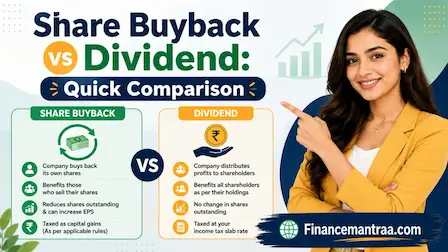
| Point | Dividend | Share Buyback |
|---|---|---|
|
Meaning |
Distribution of cash or other declared benefits to shareholders |
Company purchases its own shares |
|
Who receives money? |
Eligible shareholders |
Shareholders whose shares are repurchased |
|
Share count |
Does not directly reduce outstanding shares |
Can reduce outstanding shares |
|
EPS effect |
No direct share-count effect |
EPS can increase if outstanding shares decrease |
|
Income pattern |
May be recurring |
Generally transaction-based |
|
Shareholder action |
Usually no share sale required |
Participation or sale is generally required |
|
Tax treatment in India |
Generally taxable as dividend income |
Depends on the applicable buyback and capital gains rules |
|
Main consideration |
Income and payout sustainability |
Repurchase price and remaining shareholder value |
Advantages and Disadvantages of Dividends
Advantages of Dividends
- Potential cash income
Dividends can provide shareholders with cash without requiring them to sell their investments.
- Simple to understand
Investors can calculate their expected payment using the declared dividend per share and the number of eligible shares they own.
- Potentially useful for income planning
Companies with a consistent dividend history may appeal to investors seeking cash income, although future dividends are not guaranteed.
Disadvantages of Dividends
- Tax liability
Dividend income is generally taxable under the applicable income tax rules.
- No guaranteed payment
Companies can reduce or discontinue dividends depending on their financial circumstances and applicable requirements.
- Less cash retained by the company
Cash distributed as dividends is no longer available for other uses, such as expansion, debt repayment, or acquisitions.
Advantages and Disadvantages of Share Buybacks
Advantages of Share Buybacks
- Potential increase in EPS
A reduction in outstanding shares can increase EPS if the company’s profit remains unchanged.
- Flexible capital allocation
A company may use buybacks to return surplus cash without establishing an expectation of recurring dividend payments.
- Potential benefit to remaining shareholders
If a company repurchases shares at an attractive price, remaining shareholders may benefit from an increased ownership percentage and potentially improved per-share value.
Disadvantages of Share Buybacks
- Uncertain acceptance
In a tender offer, the company may accept only a portion of the shares offered by an investor.
- Risk of overpaying
A company can destroy shareholder value if it repurchases shares at an excessive price.
- Uneven distribution of immediate benefits
Shareholders whose shares are repurchased receive cash, while those who retain their shares do not receive a direct payment from the transaction.
Share Buyback vs Dividend for Long-Term Investors
Long-term investors should evaluate both methods in the context of the company’s fundamentals.
Dividends may appeal to investors who want cash income. Reinvesting dividends may also contribute to long-term compounding, although investment returns are never guaranteed.
Buybacks may benefit continuing shareholders when a company repurchases undervalued shares and maintains a strong financial position.
However, a higher EPS does not automatically mean that shareholder value has increased. Investors should examine the repurchase price, cash flow, debt, profitability, and future growth opportunities.
A company that pays dividends despite weakening financial health may not be a good investment. Similarly, a company that buys back shares at inflated prices may make an inefficient capital allocation decision.
Before evaluating a company’s payout policy, consider:
- Its profitability and cash flow.
- Its debt and future capital requirements.
- Whether its shares appear reasonably valued.
- The sustainability of its dividend payments.
- The price and terms of any buyback offer.
- Your investment objectives and applicable tax position.
The better choice depends on the company’s fundamentals, the price paid for shares, and the investor’s individual circumstances.
Common Mistakes to Avoid
Investors should avoid the following mistakes when comparing dividends and buybacks:
- Judging a company only by its dividend yield or buyback announcement.
- Assuming a buyback will always increase the stock price.
- Assuming a higher EPS automatically means better business performance.
- Ignoring tax rules and changes in applicable legislation.
- Forgetting that a tender offer may accept only part of the shares submitted.
- Treating a high dividend payout as safe without checking profitability and debt.
- Ignoring the opportunity cost of using company cash for buybacks instead of productive investments.
Understanding these risks can help investors evaluate shareholder payout decisions more carefully.
Conclusion
The main difference between share buyback vs dividend is how a company returns money to its shareholders.
A dividend distributes cash to eligible shareholders without requiring them to sell their shares. A buyback allows a company to repurchase its own shares, providing cash to shareholders whose shares are accepted or sold through the applicable mechanism.
Dividends may appeal to investors seeking cash income, while buybacks can reduce the outstanding share count and potentially increase EPS.
Neither method is automatically better. The outcome depends on the company’s financial strength, the price paid for shares, the sustainability of its payout policy, and the investor’s tax circumstances.
Before making an investment decision, review the company’s financial statements, payout announcement, and applicable tax rules.
Disclaimer: This article is for educational and informational purposes only. It is not investment, financial, or tax advice. Tax laws and regulations may change. Consult a qualified tax professional for advice about your individual circumstances.
FAQ's
What is the difference between a share buyback and a dividend?
A dividend is a distribution made to eligible shareholders. A share buyback occurs when a company purchases its own shares. Dividends generally provide cash without requiring shareholders to sell their shares, while buybacks pay shareholders whose shares are repurchased.
Which is better for investors, a buyback or a dividend?
Neither is always better. Dividends may suit investors seeking cash income, while buybacks may benefit continuing shareholders when shares are repurchased at attractive prices. The better option depends on the company’s financial position, valuation, and the investor’s circumstances.
3. Why do companies buy back shares instead of paying dividends?
Companies may choose buybacks because they offer flexibility in returning surplus cash. Buybacks can also reduce the outstanding share count. However, their effectiveness depends on the repurchase price, the company’s financial condition, and alternative uses of its cash.
How are buybacks and dividends taxed in India?
Dividend income is generally taxable under the applicable income tax rules. Share buyback taxation depends on the legislation applicable to the transaction and the investor’s circumstances. Investors should consult the latest official Income Tax Department guidance before calculating their tax liability.
Do buybacks create more value than dividends?
Not necessarily. A buyback may create value when a company repurchases undervalued shares. Dividends provide cash to eligible shareholders. The better approach depends on the company’s financial health, valuation, and how effectively it uses its available capital.

My name is Subodh Kumar, and I am a finance blogger at Financemantraa.com with a strong interest in personal finance, investing, and financial research spanning 4–5 years.
I enjoy researching financial topics and explaining complex money concepts in simple, easy-to-understand language. My areas of interest include stock market basics, IPOs, mutual funds, financial planning, insurance, saving strategies, and wealth building.
Through Financemantraa.com, I aim to help readers improve their financial knowledge, understand investment concepts, and make informed financial decisions. I focus on creating practical, beginner-friendly guides that make personal finance easier to understand and apply in everyday life.
I believe that financial education and smart money habits can help people work toward long-term financial stability. My goal is to make reliable, accessible, and informative financial content available to everyone.
Disclaimer: The information published on Financemantraa.com is for educational and informational purposes only. It should not be considered professional financial or investment advice.