
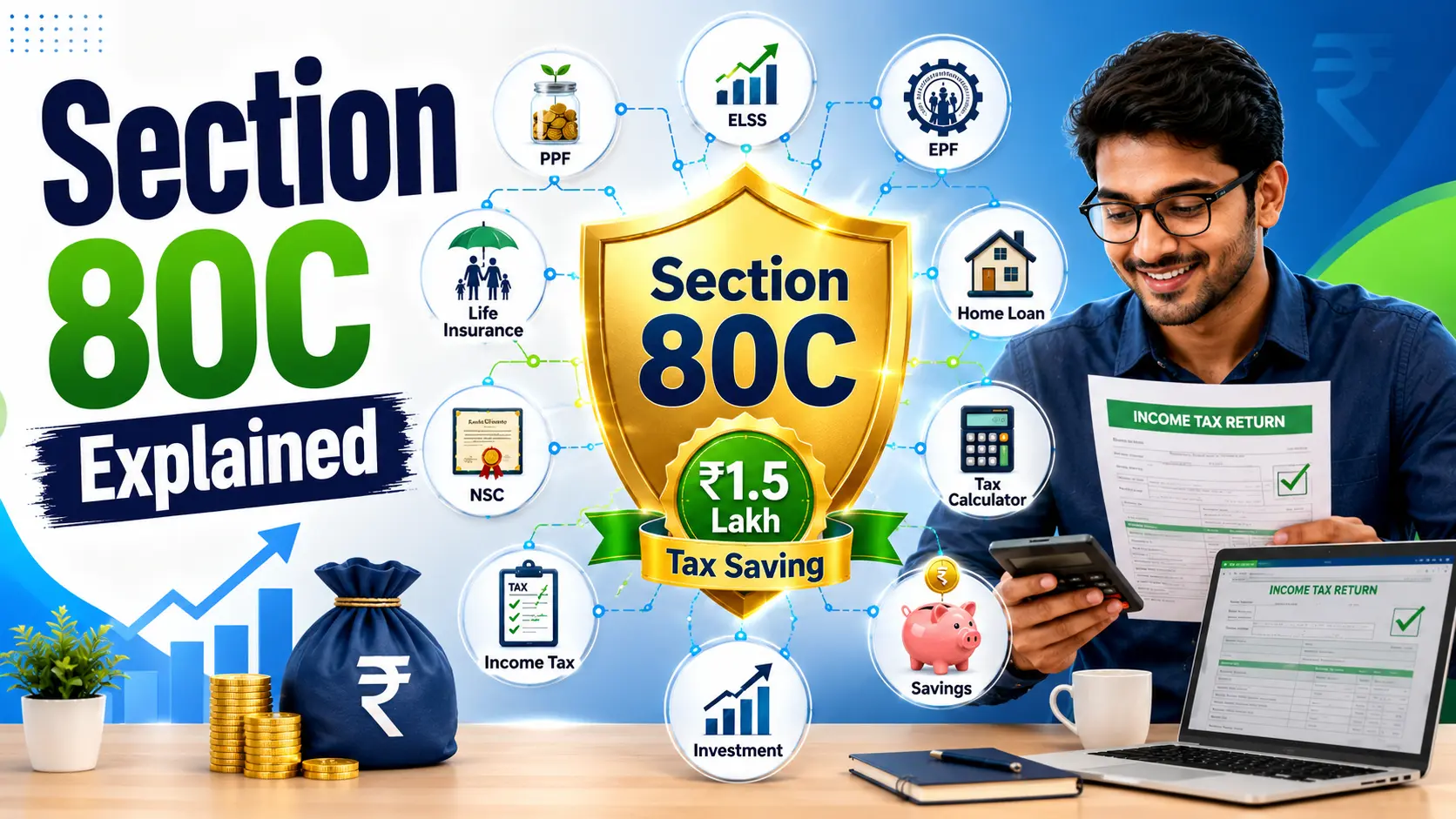
Friends, tax season comes every year, and every year the same question pops up in our minds. “Kya main apna tax kam kar sakta hoon, legally?” The answer is yes, and the easiest tool for that is Section 80C. If you have ever heard your colleague or your father talk about PPF, LIC, or ELSS while filing returns, they were talking about this very section. In this article, I will give you Section 80C Explained in the simplest way possible, so that even a complete beginner can understand it in one go.
I remember the first time I filed my own tax return. I had no clue what 80C meant. I just followed what my senior at the office told me and put money in PPF blindly. Later I realized I could have planned it much better. So today, I am sharing everything I wish someone had told me back then.
Highlight key
- Section 80C lets you reduce your taxable income by up to ₹1.5 lakh in a year.
- It is only available if you choose the old tax regime, not the new one.
- Popular options include PPF, ELSS, EPF, life insurance, NSC, and home loan principal.
- From FY 2026-27, the new Income Tax Act 2025 renames it as Section 123, but the rule stays the same.
- Before investing, always check if the old regime actually benefits you compared to the new regime.
What is Section 80C in Income Tax?
So, what is Section 80C in income tax exactly? In simple words, it is a rule under the Income Tax Act that allows you to lower your taxable income by investing or spending money in certain approved options. When your taxable income goes down, the tax you pay also goes down. That is the whole idea behind Section 80C, explained in one line.
This section has been around for a long time and is probably the most well-known tax-saving option in India. Your parents used it, your friends use it, and chances are your HR team keeps sending you reminders about it every January and February. The maximum benefit you can claim under this section is ₹1.5 lakh per financial year. This means if you invest ₹1.5 lakh in eligible options, that amount gets removed from your total income before tax is calculated.
Tell me the truth, doesn’t that sound simple? It really is. The tricky part is choosing where to invest that money so it also grows well for your future, not just saves tax for one year.
How Does Section 80C Work in India?
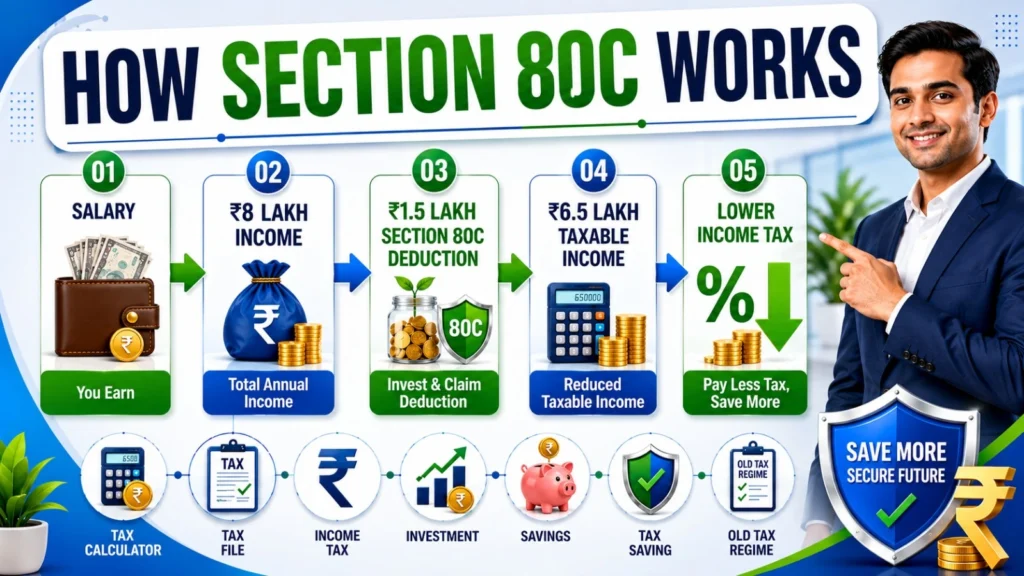
Now let’s talk about how this actually works in practice. Suppose your annual income is ₹8 lakh. Without any deduction, you would pay tax on the full ₹8 lakh as per the applicable slab. But if you invest ₹1.5 lakh under Section 80C, your taxable income becomes ₹6.5 lakh. Your tax is then calculated on this lower amount.
In my experience, this is where many salaried employees get confused. They think 80C directly reduces their tax by ₹1.5 lakh. That is not correct. It reduces your taxable income by that amount, and your actual tax saving depends on your income slab. So someone in the 30 percent slab saves more money than someone in the 5 percent slab, even though both invest the same ₹1.5 lakh.
One more important point, this benefit is available only if you pick the old tax regime while filing your return. The new tax regime, which is now the default option for most taxpayers, does not allow you to claim Section 80C. So before you rush to invest, check which regime actually suits your income level.
Section 80C Deduction Limit for FY 2026-27
The Section 80C deduction limit for FY 2026-27 remains ₹1.5 lakh, just like earlier years. There is no fresh hike announced, so do not expect a bigger number this year. If you were hoping for a higher limit, buddy, I am sorry to disappoint you, but ₹1.5 lakh is still the ceiling.
However, there is a structural change worth knowing. Starting 1st April 2026, the new Income Tax Act 2025 has combined Section 80C along with 80CCC under a fresh section called Section 123. The name has changed and the section number is different, but the main tax benefit and the ₹1.5 lakh deduction limit are still exactly the same. So if you are filing your return for income earned between April 2025 and March 2026, you will still refer to the old Section 80C rules, since that income falls under the earlier law.
Also remember, this deduction is only available under the old tax regime. The new regime, which most people are shifting to because of its wider slabs and higher rebate under Section 87A, does not give you this benefit at all. So the real question is not just about the limit, but about which regime works better for your salary structure.
List of Investments Eligible Under Section 80C
Here is the list of investments eligible under Section 80C that most Indians use every year.
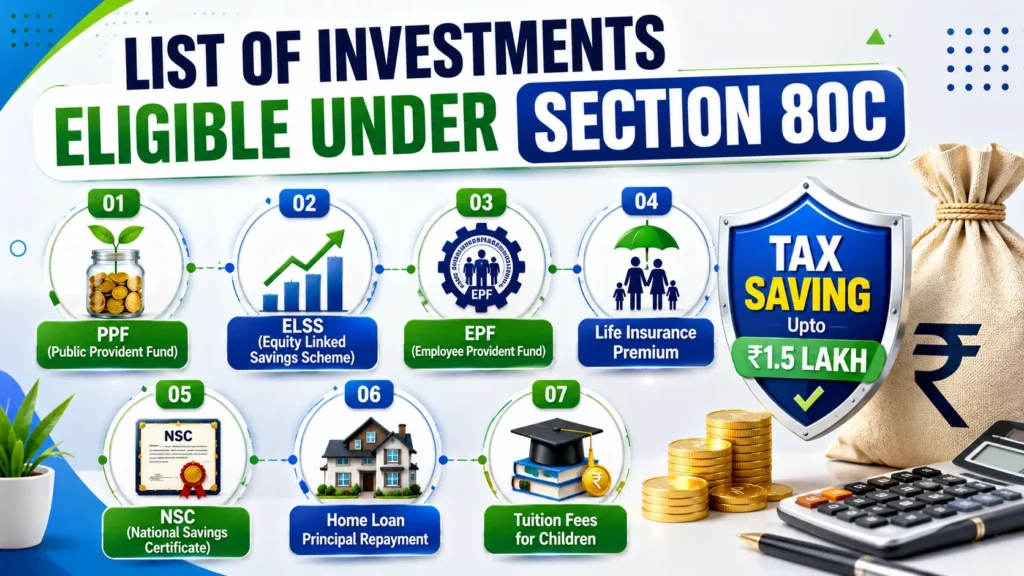
PPF (Public Provident Fund)
PPF is one of the safest options under 80C. It offers government backed returns and complete tax free interest. The lock-in period is 15 years, so it works best for long-term goals like retirement or your child’s future. If you want safety over speed, PPF is a solid choice.
ELSS (Equity Linked Savings Scheme)
ELSS is a mutual fund that invests in the stock market. It has the shortest lock-in period among all 80C options, just 3 years. The returns can be higher than PPF, but they come with market risk. If you can handle some ups and downs, ELSS is worth considering.
EPF (Employee Provident Fund)
If you are a salaried employee, a part of your salary already goes into EPF every month. This contribution counts under Section 80C automatically. Many people forget this and end up investing extra without checking how much EPF already covers.
Life Insurance Premium
Premiums paid for life insurance policies, for yourself, your spouse, or your children, also qualify under this section. However, keep in mind that pure insurance term plans give better protection value compared to old-style endowment policies that mix insurance with investment.
National Savings Certificate
National Savings Certificate, or NSC, is another safe government backed option. It comes with a fixed interest rate and a 5 year lock in. It suits conservative investors who do not want to touch the stock market.
Home Loan Principal Repayment
If you are repaying a home loan, the principal portion of your EMI, not the interest part, is eligible under 80C. This is a big relief for people who already have heavy EMIs, since they do not need to invest extra separately.
Tuition Fees for Children
Tuition fees paid for up to two children, for full-time education in India, also count under this section. So if you are already paying school fees, part of your 80C limit might already be used without you realizing it.
PPF vs ELSS Under Section 80C: Which is Better?
This is probably the most common confusion I see. PPF vs ELSS under Section 80C really depends on your goal and your comfort with risk.
- If you want guaranteed, safe returns with zero market risk, PPF wins.
- If you want higher growth potential and don’t mind short-term ups and downs, ELSS wins.
- PPF locks your money for 15 years, ELSS only for 3 years.
- PPF interest is fixed by the government, ELSS returns depend on stock market performance.
If you think like I do, a mix of both works well. Keep some money safe in PPF for long-term security, and put some in ELSS for growth. Do not put your entire ₹1.5 lakh in just one option.
Section 80C: Old Regime vs New Regime
This point deserves its own section because it changes everything. The new tax regime is now the default choice for most taxpayers in India. It offers wider tax slabs and a higher rebate under Section 87A, meaning people earning up to ₹12 lakh may pay zero tax without claiming any deductions at all.
However, the new regime does not allow Section 80C, 80D, or most other Chapter VI-A deductions. So if you have very few deductions to claim, the new regime often works out cheaper. But if you have a home loan, insurance premiums, and other investments that easily add up to a large deduction amount, the old regime combined with Section 80C might still save you more.
My honest advice, do not invest in 80C just out of habit. Calculate both regimes first using an online tax calculator, then decide where to put your money. This single step can save you thousands of rupees every year.
How to Save Tax Under Section 80C: Step by Step
If you have decided the old regime suits you, here is a simple way to save tax using Section 80C.
- Check how much you already contribute through EPF and tuition fees.
- Subtract that from ₹1.5 lakh to know your remaining limit.
- Decide your risk appetite, safe options like PPF and NSC, or growth options like ELSS.
- Spread your investment across two or three options instead of just one.
- Invest early in the financial year instead of waiting for March, so your money grows longer.
Now let’s talk about timing. Many people rush in the last week of March to invest their full ₹1.5 lakh. This is not ideal because your money gets less time to grow, especially for market-linked options like ELSS. Starting early, even with small monthly amounts, works much better in the long run.
Common Mistakes to Avoid
- Choosing insurance policies just for tax saving without checking actual coverage needs.
- Ignoring EPF contribution while calculating remaining 80C limit.
- Investing the full ₹1.5 lakh in the last week of the financial year.
- Not comparing old regime versus new regime before investing.
- Putting everything in one single option instead of diversifying.
Friends, these small mistakes cost people real money every year. A little planning at the start of the year saves a lot of stress in March.
Disclaimer
This article is for general information and learning purposes only. Tax rules can change with new budgets and government notifications. Please consult a qualified tax advisor or chartered accountant before making any investment or tax filing decision based on this content.
FAQ's
What is Section 80C in income tax?
Section 80C lets you reduce taxable income by up to ₹1.5 lakh yearly through approved investments like PPF, ELSS, and insurance, but only under the old tax regime.
What is the Section 80C deduction limit for FY 2026-27?
The limit stays at ₹1.5 lakh for FY 2026-27, the same as previous years, with no increase announced by the government so far.
Can I claim Section 80C under the new tax regime?
No, Section 80C deductions are available only under the old tax regime. The new regime does not allow this deduction at all.
PPF vs ELSS under Section 80C, which is better for beginners?
PPF suits safety seekers with a 15-year lock-in, while ELSS suits growth seekers who can handle risk with just a 3 year lock in.
Does EPF count towards the Section 80C limit?
Yes, your monthly EPF contribution automatically counts under Section 80C, reducing the extra amount you need to invest separately.
Is home loan principal repayment eligible under Section 80C?
Yes, you can claim a tax deduction on the principal amount of your home loan EMI under Section 80C. The interest amount is also eligible for a tax benefit, but it is claimed under a different section of the Income Tax Act.