
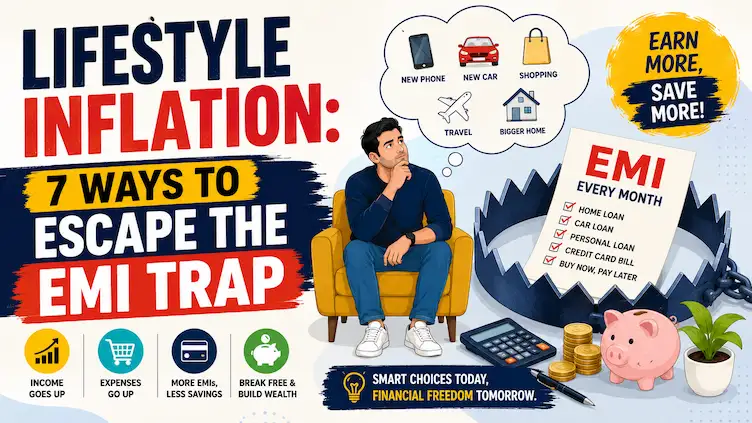
Your salary goes up. A few months later, your savings look the same. Sound familiar? This is lifestyle inflation, and it quietly affects many working people in India. A bigger phone, a costlier car, or a new gadget on EMI feels harmless on its own. Together, they can eat up every raise you get.
In this guide, we will look at what lifestyle inflation is, why it leads to the EMI trap, and 7 practical ways to get out of it.
In This Article
ToggleHighlight key
- Lifestyle inflation means your spending rises as your income rises.
- Too many EMIs lock up your future salary before you even earn it.
- A simple budget and a savings-first habit can protect your salary increases.
- You do not need to give up all comforts. You need a proper financial plan.
What Is Lifestyle Inflation?
Lifestyle inflation, also called lifestyle creep, happens when your spending grows every time your income increases. You earn more, so you upgrade your phone, home, car, dining habits, and holidays.
Here is a simple example. Suppose your monthly salary increases by ₹10,000. If you save ₹8,000 of that increase, you are building wealth. But if you spend the entire ₹10,000 on lifestyle upgrades, your savings remain exactly where they were.
Over time, this habit can prevent you from building wealth, even when your income continues to grow.
Lifestyle Inflation in India
In India, easy access to credit can make this problem worse. “No-cost EMI” offers, instant personal loans, and credit card limits make big purchases feel affordable. You often notice the small monthly payment instead of looking at the total purchase price.
However, some no-cost EMI offers may involve processing fees, other charges, or a discount that you could have received by paying upfront. Always compare the total amount payable before choosing an EMI.
That is how lifestyle inflation in India can gradually turn into the EMI trap.
What Is the EMI Trap?
An EMI (Equated Monthly Instalment) is a set amount that a borrower pays each month to gradually repay a loan. The EMI trap happens when too many loan payments take up a large share of your monthly salary. As a result, you have less money left to save, invest, or handle emergencies.
Here is a simple formula to check your EMI burden:
EMI Ratio = (Total Monthly EMIs ÷ Monthly Take-Home Salary) × 100
For example, if your monthly take-home salary is ₹50,000 and your total EMIs are ₹20,000, your EMI ratio is 40%.
This means 40% of your take-home salary goes towards loan repayments, leaving ₹30,000 for household expenses, savings, investments, and other financial needs.
There is no single EMI ratio that is suitable for everyone. Your income, family size, essential expenses, and financial responsibilities all matter. As a general precaution, avoid taking on repayment obligations that leave too little room for essential expenses and savings.
The Reserve Bank of India’s financial inclusion strategy also highlights the importance of sustainable borrowing and guarding against excessive repayment obligations.
Source: Reserve Bank of India – National Strategy for Financial Inclusion 2025–30
Why Lifestyle Inflation Reduces Savings
Each EMI represents a financial obligation to pay a set amount over several months or even years. When your income grows, and you add a new EMI each time, your fixed monthly expenses keep increasing.
Then a job change, an unexpected medical bill, or a delayed salary can create real financial stress.
Also, money spent on loan interest does not directly build your wealth. It is a borrowing cost that reduces the money available for your financial goals.
7 Ways to Escape the EMI Trap
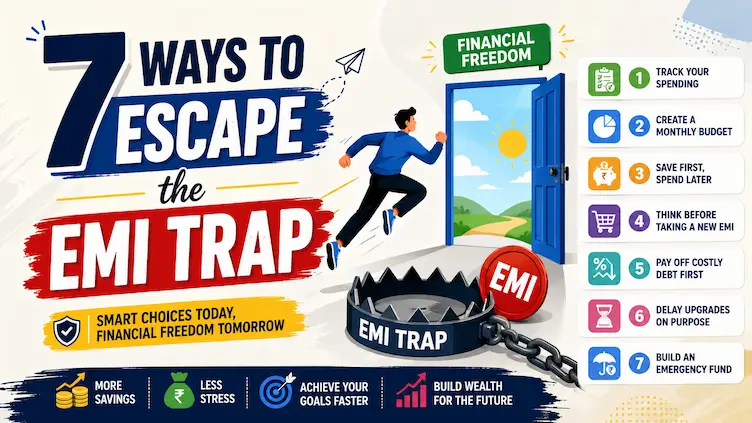
1. Track Your Spending for One Month
You cannot fix what you cannot see. Record all your expenses for 30 days using a notebook, spreadsheet, or mobile banking app.
Many people find that small, repeated expenses, such as food delivery, online shopping, and unused subscriptions, add up quickly.
Divide your spending into three categories:
- Needs: Rent, groceries, electricity, and essential bills.
- Wants: Shopping, entertainment, and dining out.
- Savings: Emergency funds, investments, and financial goals.
This is the first step towards better spending habits and smarter money management.
For more guidance, read SEBI’s guide to managing income and expenses.
2. Build a Simple Monthly Budget
Effective monthly budgeting can be simple and hassle-free. Try the popular 50/30/20 budgeting method:
- 50% for needs (rent, groceries, essential bills, and necessary loan payments).
- 30% for wants (shopping, entertainment, and dining out).
- 20% for savings and investments.
For example, if your monthly take-home salary is ₹50,000:
- ₹25,000 for needs.
- ₹15,000 for wants.
- ₹10,000 for savings and investments.
This is only a budgeting guideline, not a fixed rule. If your rent, family responsibilities, or existing EMIs are higher, you can adjust the percentages to match your financial situation.
The main goal is to control unnecessary spending while making regular savings a priority.
Source: NISM – Budgeting
3. Save First, Spend Later
When your salary increases, move a part of that increase into savings before you get used to having extra money.
For example, if your salary increases by ₹5,000, you could save ₹3,000 and use the remaining ₹2,000 for lifestyle improvements, provided your essential expenses are covered.
Automatically move a portion of your salary into your savings account as soon as payday arrives. You can also allocate money towards your emergency fund and long-term financial goals.
This is one of the easiest ways to save money when your salary increases.
Remember, saving regularly is more important than waiting until the end of the month to see what is left.
Source: SEBI – Why Save?
4. Think Before Taking a New EMI
Before buying anything on EMI, ask yourself:
- Do I really need this, or do I just want it?
- Can I save money and purchase it later without borrowing?
- What is the total cost, including interest, processing fees, and other charges?
- Will this EMI affect my monthly savings?
A “no-cost EMI” may still involve processing fees or a lost upfront discount. Therefore, compare the total amount payable with the cash purchase price before making a decision.
Avoid taking a loan simply because the monthly instalment looks small. Always consider your existing financial responsibilities.
This habit helps you avoid unnecessary EMIs and loans.
5. Pay Off the Costliest Debt First
If you already have several loans, list them along with their outstanding balances, interest rates, and monthly payments.
Pay extra towards the debt with the highest interest rate first, while continuing to make at least the minimum required payments on all your other debts.
This approach is commonly known as the debt avalanche method.
Credit card outstanding balances and personal loans often carry higher interest rates than home loans, but actual rates depend on your lender and loan terms. Check your loan documents before deciding which debt to repay first.
Once you clear an expensive loan, you can use the money previously spent on its EMI to repay your next debt or increase your savings.
This is an important part of learning how to manage your salary and monthly EMIs.
6. Delay Upgrades on Purpose
You do not have to say no to every lifestyle upgrade. You just need to make thoughtful spending decisions.
Try a “30-day wait” rule for non-essential purchases. If you want a new smartphone, television, or expensive gadget, wait for 30 days before buying it.
If you still want the item after 30 days and it fits your budget, you can consider purchasing it.
Often, the urge to buy something fades after a few days.
This simple habit helps control impulse buying and prevents unnecessary spending.
7. Build an Emergency Fund
An emergency fund is money kept aside for unexpected financial needs, such as medical bills, job loss, or urgent household expenses.
Many financial experts suggest keeping an emergency fund equal to 3 to 6 months of essential living expenses. However, people with irregular income, dependents, or higher financial responsibilities may need a larger reserve.
For example, if your essential monthly expenses are ₹25,000, a 3-to-6-month emergency fund would be ₹75,000 to ₹1,50,000.
Keep this money somewhere safe and easily accessible. The main purpose of an emergency fund is financial protection, not earning high returns.
With this financial cushion, you are less likely to depend on credit cards or personal loans when unexpected expenses arise.
Source: NISM – Save for Emergencies
Advantages and Disadvantages of Controlling Lifestyle Inflation
Advantages
- More savings and less financial stress.
- Faster progress towards financial freedom.
- Better ability to handle unexpected expenses.
- Less dependence on loans and credit cards.
- More money available for long-term financial goals.
Disadvantages
- You may need to say no to some purchases.
- Friends and family may spend more, which can sometimes feel uncomfortable.
- Financial progress can feel slow at first.
- You may need to delay certain lifestyle upgrades.
Being honest about this trade-off matters. Controlling lifestyle inflation does not mean living a dull life. It means choosing what is worth your money and spending according to your priorities.
Common Mistakes to Avoid
- Taking an EMI because the monthly payment looks small.
- Counting your yearly bonus as regular monthly income.
- Ignoring small daily expenses.
- Spending on status instead of actual needs.
- Skipping savings until “next month”.
- Increasing expenses every time your salary increases.
- Using credit cards without planning how to repay the outstanding balance.
Avoiding these mistakes can help you maintain better financial discipline.
Conclusion
Lifestyle inflation is easy to miss because it grows slowly. The good news is that you can control it with small, consistent habits.
Track your spending, plan your budget, save before you spend, and think carefully before taking every new EMI.
You do not need to stop enjoying life or avoid every purchase. You simply need to make sure your expenses do not increase as quickly as your income.
These simple steps support smart money management, reduce unnecessary debt, and help you build wealth without increasing your expenses every time your salary rises.
Remember: A higher salary does not automatically make you wealthy. What you save and invest from that salary matters just as much.
Disclaimer: This article is for general educational purposes only and is not financial advice. Financial needs, loan terms, and interest rates can vary from person to person. Always check the terms and conditions with your bank or lender and consult a qualified financial advisor before making important financial decisions.
FAQ's
What is lifestyle inflation in simple words?
Lifestyle inflation means your spending increases whenever your income increases. Instead of saving the extra money, you spend it on bigger upgrades, so your savings and net worth may not grow as expected.
How can I avoid lifestyle inflation?
Set a monthly budget, save a part of every salary increase automatically, and wait before making non-essential purchases. Tracking your expenses also helps you identify where your extra money is disappearing each month.
How many EMIs are too many?
There is no fixed number of EMIs that is safe for everyone. What matters is the total amount you pay towards loan repayments compared with your take-home income and essential expenses. Too many EMIs can leave you with very little money for savings and emergencies.
Is lifestyle inflation always bad?
No. Small lifestyle upgrades after a salary increase are perfectly reasonable if you can still save, invest, and meet your financial responsibilities. It becomes a problem when spending grows faster than savings and pushes you towards unnecessary debt.
How can I stop unnecessary spending?
Track your expenses, cancel unused subscriptions, and use a 30-day waiting rule for non-essential purchases. Automating your savings on salary day can also help reduce impulse spending.

My name is Subodh Kumar, and I am a finance blogger at Financemantraa.com with a strong interest in personal finance, investing, and financial research spanning 4–5 years.
I enjoy researching financial topics and explaining complex money concepts in simple, easy-to-understand language. My areas of interest include stock market basics, IPOs, mutual funds, financial planning, insurance, saving strategies, and wealth building.
Through Financemantraa.com, I aim to help readers improve their financial knowledge, understand investment concepts, and make informed financial decisions. I focus on creating practical, beginner-friendly guides that make personal finance easier to understand and apply in everyday life.
I believe that financial education and smart money habits can help people work toward long-term financial stability. My goal is to make reliable, accessible, and informative financial content available to everyone.
Disclaimer: The information published on Financemantraa.com is for educational and informational purposes only. It should not be considered professional financial or investment advice.