

Your CIBIL score determines how easily you can get a loan and what interest rate you may have to pay. If you are stuck at 650, you probably want to know how to increase your CIBIL score quickly.
Here is the honest answer: a 90-day plan can help improve your score, but reaching 800+ in 90 days is not guaranteed. Your results depend on your credit history, repayment behaviour, outstanding debt, and credit report.
In this guide, we will cover what you can fix quickly, what takes longer, and a step-by-step plan to improve your CIBIL score.
In This Article
ToggleHighlight key
- CIBIL scores range from 300 to 900. Many lenders consider a score of 750 or above strong.
- Payment history and credit utilization are important factors affecting your CIBIL score.
- Late payments and errors in your credit report can hold your score down.
- No one can promise an exact score improvement in 90 days. Results depend on your credit profile.
- You do not necessarily need an 800 score to get a loan. A score of 750 or above can improve your chances of getting better offers, subject to lender policies.
What Is a Good CIBIL Score in India?
A CIBIL score is a three-digit number that shows how reliably you have managed credit and repaid your loans. It ranges from 300 to 900. Generally, the higher your score, the greater your chances of obtaining a loan or credit card.
A score of 750 or above is often considered strong, although approval still depends on each lender’s eligibility rules.
Here is an illustrative CIBIL score range:
| Score Range | General Meaning |
|---|---|
|
300 to 549 |
Poor |
|
550 to 649 |
Low |
|
650 to 749 |
Fair to Good |
|
750 to 900 |
Strong to Excellent |
These categories are only general guidelines, not official fixed CIBIL classifications. Different lenders may use different eligibility criteria.
You can check the official TransUnion CIBIL website to understand your credit score and report.
Can You Really Increase CIBIL Score from 650 to 800 in 90 Days?
It depends on why your score is currently at 650. Let’s look at two cases.
Case 1: Your score is low because of fixable issues.
These may include high credit card utilization, recent missed payments, or incorrect information in your credit report. If these issues are corrected, you may see an improvement within a few months.
Case 2: Your score is low because of a long credit history of missed payments.
Defaults, settled loans, and repeated missed payments can take much longer to overcome. Even after clearing outstanding dues, negative payment history may continue to affect your credit profile.
So, improving your score from 650 to 750 may be possible in some cases. Reaching 800+ in 90 days is uncommon and cannot be guaranteed.
Any website or agent promising an exact score increase in a fixed period should be treated with caution.
Why Is My CIBIL Score Stuck at 650?
Your CIBIL score may remain stuck at 650 for several reasons.
Common reasons include:
- Credit card usage close to your available limit.
- Missed or late EMIs and credit card payments.
- Too many loan or credit card applications within a short period.
- Errors or incorrect information in your credit report.
- A short credit history with limited repayment records.
Your first job is to identify the reason behind your low score. That brings us to Step 1.
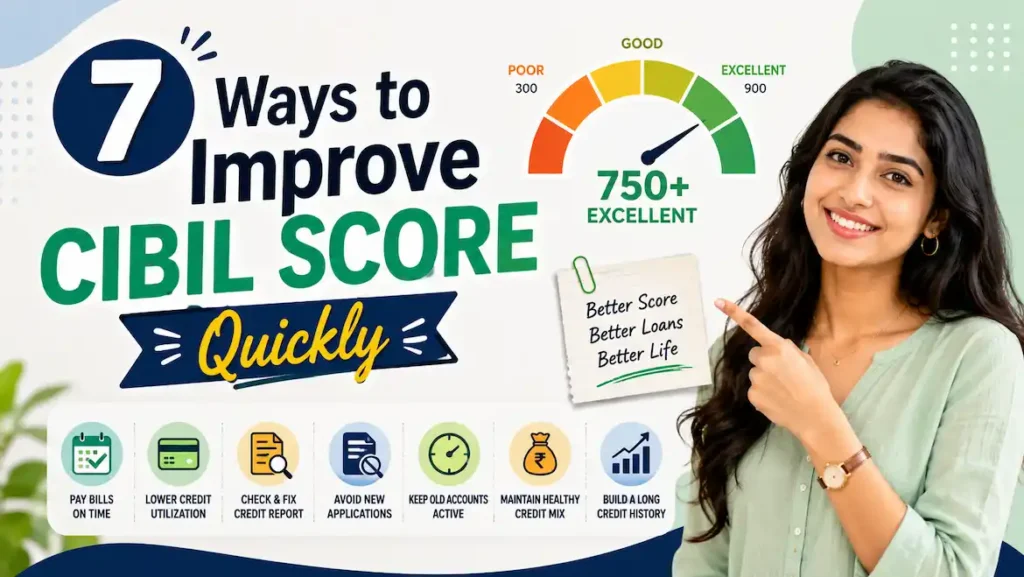
7 Ways to Improve CIBIL Score Quickly
Step 1: Check Your Credit Report
The first step is to check your credit report and understand why your score is low.
You can get your credit report from the official TransUnion CIBIL website. Under the applicable rules, consumers can access one free CIBIL Score and Report every calendar year.
Look for:
- Late or missed payment records.
- Loan accounts you do not recognize.
- Incorrect outstanding balances.
- Closed loans incorrectly shown as active.
- Duplicate loan accounts.
- Wrong personal information.
Checking your credit report regularly helps you identify mistakes and possible fraudulent accounts.
You can get your free report here: CIBIL Free Credit Score and Report.
Step 2: Fix Errors and Raise a Dispute
If you find a mistake in your credit report, contact your lender first and request a correction.
You can also raise a dispute through the CIBIL website.
Remember, CIBIL cannot independently change or delete accurate information reported by banks and financial institutions. It coordinates with the concerned lender to verify and correct inaccurate information.
Keep supporting documents such as payment receipts, loan closure certificates, and bank statements ready.
According to CIBIL, dispute resolution may take approximately 30 days, depending on the response from the concerned credit institution.
You can raise a dispute here: CIBIL Dispute Resolution.
Step 3: Pay Every Bill and EMI on Time
Your payment history is one of the most important factors affecting your CIBIL score.
Even one missed EMI or delayed credit card payment can negatively affect your credit profile.
Here are a few simple habits:
- Pay your loan EMIs before the due date.
- Pay your credit card bills on time.
- Set up auto-debit reminders for regular payments.
- Keep enough money in your bank account for scheduled payments.
- Avoid missing even small outstanding payments.
For credit cards, always try to pay the full statement balance before the due date.
Paying only the minimum amount due may help you avoid being reported as late when paid on time, but the remaining balance can attract interest and increase your debt burden.
A consistent repayment habit can help build a healthier credit history over time.
Step 4: Reduce Credit Card Utilization
Credit utilization means how much of your available credit limit you are using.
For example, if your credit card limit is ₹1,00,000 and your outstanding balance is ₹60,000, your credit utilization is 60%.
A common financial guideline is to keep your credit utilization below 30%. However, this is not a guaranteed CIBIL scoring threshold. Generally, lower utilization is better for maintaining a healthy credit profile.
Formula:
Credit Utilization = (Outstanding Credit Card Balance ÷ Total Credit Limit) × 100
Example (for illustration only):
- Total credit limit: ₹1,00,000
- Outstanding balance: ₹60,000
- Current utilization: 60%
- After reducing the balance to ₹30,000: 30% utilization
Reducing your outstanding credit card balance can help improve your credit profile.
You can also request a credit limit increase from your bank, but only if you can manage your spending responsibly. Do not increase your spending just because your credit limit has increased.
Step 5: Avoid New Loan and Credit Card Applications
Every time you apply for a new loan or credit card, the lender may check your credit report. This can create a hard inquiry.
A single hard inquiry may have a small impact on your score, but multiple applications within a short period can make you appear more dependent on credit.
During your 90-day improvement plan:
- Avoid unnecessary personal loan applications.
- Do not apply for multiple credit cards together.
- Compare loan offers before submitting applications.
- Apply for new credit only when you genuinely need it.
Reducing unnecessary applications can help you maintain a healthier credit profile.
Step 6: Do Not Close Old Credit Cards Without Thinking
Closing an old credit card may affect your credit profile, depending on your overall credit history and available credit limit.
For example, closing an old card may reduce your total available credit limit. If your spending remains the same, your overall credit utilization ratio may increase.
Before closing an old credit card, consider:
- Whether it has an annual maintenance fee.
- Whether you still need the available credit limit.
- Whether closing it will increase your overall credit utilization.
- Whether you can manage the card responsibly.
If the card has no annual fee and you can manage it safely, keeping it open may be reasonable.
However, do not keep an expensive or unnecessary card only for the purpose of improving your CIBIL score.
Step 7: Keep a Healthy Credit Mix and Be Patient
A healthy credit profile may include different types of credit, such as secured loans and unsecured credit cards.
For example:
- Secured loans include home loans and vehicle loans.
- Unsecured credit includes personal loans and credit cards.
A balanced credit mix can contribute positively to your credit profile. However, it is not necessary to take a new loan just to improve your CIBIL score.
Taking unnecessary debt can create financial pressure and increase your repayment burden.
Focus on responsible borrowing, timely payments, and maintaining a low credit utilization ratio.
Most importantly, be patient. Building a strong credit history takes time.
90-Day Action Plan to Improve Your CIBIL Score
If your current CIBIL score is 650, follow this simple 90-day action plan.
| Days | What to Do |
|---|---|
|
1 to 7 |
Download your credit report, identify problems, and start disputes for incorrect information. |
|
8 to 30 |
Clear overdue amounts, set up auto-pay reminders, and reduce credit card balances. |
|
31 to 60 |
Maintain low credit utilization, avoid unnecessary new applications, and follow up on disputes. |
|
61 to 90 |
Recheck your credit report and confirm whether corrections and payment updates are reflected. |
Remember, this plan focuses on improving your credit behaviour and correcting problems. Your actual CIBIL score improvement may take more or less than 90 days.
How Often Does CIBIL Score Update?
Your CIBIL score changes when credit bureaus receive and process updated information from lenders.
The Reserve Bank of India (RBI) has introduced more frequent credit information reporting requirements.
Under the updated reporting directions applicable to commercial banks from July 1, 2026, banks must submit credit information as of the 9th, 16th, 23rd, and the last day of each month. The updated information must be submitted within the prescribed timelines.
However, this does not mean your CIBIL score will automatically change on each of these dates. The actual update depends on when your lender submits the information and when the credit bureau processes it.
You can read the official rules here: RBI – Credit Information Reporting Directions, 2025.
How to Improve CIBIL Score Without a Credit Card
You do not need a credit card to build a good credit history.
If you already have a personal loan, vehicle loan, or home loan, make sure you repay every EMI on time.
If you have no credit history, you may consider a suitable secured credit product, such as a credit card against a fixed deposit, if it fits your financial needs.
Before choosing one, check the interest rates, fees, terms, and repayment conditions.
Remember, you should never take unnecessary debt just to create a credit history.
How to Improve CIBIL Score After Loan Default
Improving your CIBIL score after a loan default usually takes more time.
If you have missed loan payments in the past, follow these steps:
- Check your credit report to understand the outstanding amount.
- Contact your lender and discuss repayment options.
- Clear the overdue amount or follow an agreed repayment plan.
- Ask the lender to update your account status correctly.
- Keep written proof of payments and loan closure.
- Make all future payments on time.
If you settle a loan for less than the full outstanding amount, the account may be reported as “Settled” rather than “Closed”. This status can still affect future loan decisions.
Negative payment history does not disappear immediately after repayment. Continue following good financial habits and give your credit profile time to improve.
Benefits of a High CIBIL Score
Maintaining a high CIBIL score can offer several advantages.
- Better Chance of Loan Approval
A strong CIBIL score can improve your chances of getting a loan, although lenders also consider your income, existing debt, and repayment capacity.
- Better Chances of Lower Interest Rates
Some lenders may offer more competitive interest rates to applicants with stronger credit profiles. However, the final rate depends on lender policies and other eligibility factors.
- Easier Credit Card Approval
A good credit score may improve your chances of getting approved for premium credit cards and other credit facilities.
- Quicker Processing at Some Lenders
A healthy credit profile may help lenders assess your application more easily, although processing times vary.
Important Limitation: Even with an 800 CIBIL score, a lender can reject your application based on your income, employment stability, existing debt, or internal eligibility rules.
Your credit score is one important factor, not a guarantee of approval.
Common Mistakes to Avoid While Improving Your CIBIL Score
Many people unknowingly make mistakes that can damage their credit profile.
Avoid these common mistakes:
- Paying only the minimum due for months instead of clearing the full credit card balance.
- Applying for multiple loans or credit cards at the same time.
- Ignoring small unpaid bills and overdue amounts.
- Believing credit repair agents who promise an 800+ score quickly.
- Closing old credit cards without checking the possible impact.
- Ignoring errors in your credit report.
- Taking unnecessary loans just to improve your credit mix.
- Checking your credit report only after a loan rejection.
Avoiding these mistakes can help you build a stronger credit profile over time.
Conclusion
To increase your CIBIL score, start with the basics: pay your EMIs and credit card bills on time, reduce credit card utilization, fix errors in your credit report, and avoid unnecessary new credit applications.
A consistent 90-day effort can bring visible improvements, especially if your score is being held back by fixable issues.
Still, reaching 800+ in 90 days is not something anyone can promise. Aim for 750 first, stay consistent, and let your credit score grow steadily.
Remember, a good CIBIL score is not built overnight. It comes from responsible borrowing and regular repayment habits.
Disclaimer: This article is for general educational and informational purposes only and should not be treated as financial advice. Credit score ranges, lender policies, and reporting practices may change. Always check your latest credit report and refer to the official CIBIL and RBI websites for updated information.
FAQ's
How many points can CIBIL score increase in 90 days?
It varies from person to person. Clearing overdue dues, reducing credit card utilization, and correcting errors in your credit report can help improve your score. However, no fixed increase is guaranteed. Serious issues such as defaults may take much longer to overcome.
Does paying credit card bills increase CIBIL score?
Yes, paying your credit card bills on time helps build a positive payment history. Paying the full statement balance also helps prevent interest from accumulating and keeps your outstanding debt under control. Late payments can negatively affect your CIBIL score.
Does closing a loan improve CIBIL score?
Not always. Repaying a loan on time and having it correctly reported as closed can contribute to a positive credit history. However, your score may change depending on your overall credit profile, especially if the loan was your only active credit account.
How often does CIBIL score update?
CIBIL updates your credit information when lenders submit new data. Under RBI’s updated directions applicable to commercial banks from July 1, 2026, credit information is submitted based on reference dates falling on the 9th, 16th, 23rd, and last day of each month. However, the exact time your score changes depends on lender reporting and credit bureau processing.
What is a good CIBIL score in India?
CIBIL scores range from 300 to 900. Many lenders consider a score of 750 or above strong. However, loan approval also depends on your income, existing loans, repayment capacity, and the lender’s eligibility requirements.

My name is Subodh Kumar, and I am a finance blogger at Financemantraa.com with a strong interest in personal finance, investing, and financial research spanning 4–5 years.
I enjoy researching financial topics and explaining complex money concepts in simple, easy-to-understand language. My areas of interest include stock market basics, IPOs, mutual funds, financial planning, insurance, saving strategies, and wealth building.
Through Financemantraa.com, I aim to help readers improve their financial knowledge, understand investment concepts, and make informed financial decisions. I focus on creating practical, beginner-friendly guides that make personal finance easier to understand and apply in everyday life.
I believe that financial education and smart money habits can help people work toward long-term financial stability. My goal is to make reliable, accessible, and informative financial content available to everyone.
Disclaimer: The information published on Financemantraa.com is for educational and informational purposes only. It should not be considered professional financial or investment advice.