

You open a finance website before an IPO and notice a number next to the company name. It says something like “GMP +₹40.” At first glance, it may look like a free preview of the stock’s listing price. But can you really trust that number?
The IPO grey market is an unofficial market where IPO shares or applications may be traded before a company lists its shares on a stock exchange. Investors often watch the Grey Market Premium (GMP) to understand market sentiment, but relying on it without understanding the risks can lead to poor investment decisions.
In this guide, we explain the grey market, how IPO GMP works, how to estimate a listing price, and the seven risks every investor should understand before trusting grey market figures.
In This Article
ToggleHighlight key
- The IPO grey market operates outside the regular stock exchange trading system.
- Grey Market Premium (GMP) is an unofficial indication of the premium quoted over an IPO’s issue price.
- GMP may reflect short-term market sentiment, but it does not guarantee the listing price.
- Unofficial deals may carry risks related to payments, delivery, and disputes.
- GMP figures published online may differ between sources and change quickly.
- Beginners should examine a company’s fundamentals and official offer documents rather than depending solely on GMP.
What Is Grey Market in IPO?
The grey market in an IPO is an informal market where traders make arrangements involving IPO shares or applications before the shares are officially listed on a stock exchange.
Unlike regular stock market transactions, these arrangements take place outside the normal exchange-based trading and settlement system. Participants may deal through private contacts or intermediaries, and the terms of a transaction may depend on the agreement between the parties.
This is the basic grey market meaning: an unofficial market operating outside the regular exchange-trading framework.
Investors often discuss the grey market because they want to estimate whether an IPO might list above or below its issue price. However, grey market rates are unofficial and should not be viewed as dependable predictions of exchange prices.
How Does the IPO Grey Market Work?
The IPO grey market generally attracts attention before a company’s shares begin trading on a stock exchange.
Here is a simplified explanation of how it may work:
- A company introduces its IPO and discloses the price band along with key issue information.
- Market dealers or traders start indicating unofficial IPO premiums or expected listing prices.
- Interested parties discuss and negotiate terms through private, informal agreements.
- The quoted premium can fluctuate as investor sentiment, subscription data, and new market updates emerge.
- After the shares are listed, participants evaluate their positions based on the agreements they previously entered into.
These informal dealings do not operate under the same exchange-regulated trading and settlement framework used for standard stock market transactions.
You may also come across the term Kostak rate. It usually means a pre-agreed amount for selling or transferring an IPO application, whether or not the applicant receives any share allotment. The exact conditions depend on the terms agreed upon by the parties involved.
Keep in mind that these practices belong to the informal market and are not officially included in the IPO application or share allotment procedure.
What Is Grey Market Premium (GMP) in IPO?
Grey Market Premium, commonly called GMP, is the unofficial premium quoted for an IPO share before its stock exchange listing.
For example, if an IPO has an issue price of ₹100 and its quoted GMP is ₹20, the implied grey market price would be ₹120.
GMP is often used by investors as an informal indicator of expected listing sentiment. However, it is not an official price published by SEBI or a stock exchange.
Here is what different GMP figures may indicate:
- Positive GMP: Some grey market participants are willing to pay a premium over the issue price.
- Zero GMP: The quoted premium is approximately zero.
- Negative GMP: The unofficial quote indicates a price below the issue price.
These numbers show unofficial market trends, not a certain result. A positive GMP does not ensure a profitable listing, and a negative GMP does not guarantee a loss.
How Is IPO GMP Calculated?
The basic calculation is straightforward:
GMP = Unofficial Grey Market Price − IPO Issue Price
For example:
- IPO issue price: ₹100 per share
- Unofficial grey market price: ₹120 per share
- GMP: ₹120 − ₹100 = ₹20
Therefore, the quoted GMP is ₹20 per share.
In practice, websites may report GMP directly rather than provide a separate grey market price. The terminology and reference price used should be checked before comparing figures across sources.
Keep in mind that this figure reflects an unofficial quote. It neither determines the company’s true value nor forecasts its actual listing price.
How to Calculate IPO Listing Price Using GMP
Investors sometimes add the quoted GMP to the IPO issue price to estimate a possible listing price.
Consider this hypothetical example:
- IPO issue price: ₹100
- Quoted GMP: ₹20
- Estimated listing price based on GMP: ₹100 + ₹20 = ₹120
The implied listing gain would be:
Estimated Gain (%) = (GMP ÷ IPO Issue Price) × 100
Using the example:
(₹20 ÷ ₹100) × 100 = 20%
This means the GMP implies a possible listing price of ₹120, or 20% above the issue price.
However, this is only a mathematical estimate based on an unofficial quotation. The actual listing price could be ₹120, lower than ₹120, or even below the IPO issue price.
The calculation also does not account for transaction costs, taxes, or other factors that may affect an investor’s actual return.
Important: Never assume that a quoted GMP represents a guaranteed profit or an official listing-price forecast.
How to Check IPO Grey Market Premium
Many finance websites publish IPO GMP figures for upcoming or recently closed public issues. These figures may help readers understand the sentiment being reported in the informal market, but they need careful interpretation.
Follow these steps when checking IPO GMP:
- Compare multiple sources: Different websites may report different figures. Comparing them can reveal inconsistencies, although it cannot establish an official GMP.
- Check the date and time: Unofficial quotations can change quickly, so an older figure may no longer reflect current sentiment.
- Understand the source: Check whether the website explains where its numbers come from and how frequently they are updated.
- Avoid guaranteed-profit claims: Treat claims of certain listing gains with caution.
- Read official IPO documents: Check the company’s Red Herring Prospectus (RHP), financial statements, risk factors, and issue details.
You can find official offer documents through the NSE Offer Documents page.
Remember, official exchange websites provide IPO information and offer documents, not an official GMP figure.
Is Grey Market Trading Legal in India?
This is an important question, but the answer should not be oversimplified.
The IPO grey market is an unofficial market outside the regular exchange-trading system. Grey market quotations are not official prices published by SEBI or stock exchanges, and informal transactions do not receive the same exchange-based settlement and grievance mechanisms as regular listed-share trades.
However, it would be inaccurate to conclude that every transaction described as grey market activity is automatically legal or illegal. The legal position may depend on the specific arrangement, the parties involved, and the applicable laws and regulations.
Investors should not interpret the absence of an official exchange mechanism as permission to participate in every type of informal transaction.
If you are considering participating in such an arrangement, obtain appropriate legal advice and verify the current regulatory position. For ordinary investors, the more straightforward approach is to use regulated channels and make IPO decisions based on official disclosures.
Grey Market vs Stock Market: Key Differences
The grey market and the regular stock market differ in several important ways.
| Point | IPO Grey Market | Regular Stock Market |
|---|---|---|
|
Trading framework |
Informal arrangements |
Regulated exchange framework |
|
Price information |
Unofficial quotations |
Public exchange-traded prices |
|
Transaction process |
Depends on the arrangement |
Exchange and clearing-system procedures |
|
Settlement |
May involve counterparty risk |
Established clearing and settlement mechanisms |
|
Investor protection |
No equivalent exchange-based protections for informal deals |
Applicable regulatory and investor grievance mechanisms |
|
Price transparency |
Limited and inconsistent |
Public trading information is available |
|
Main purpose |
Informal speculation before listing |
Buying and selling listed securities |
This comparison explains why investors should be cautious when interpreting grey market prices. A number quoted informally does not carry the same status as an exchange-traded price.
7 Risks of the IPO Grey Market Every Investor Must Know
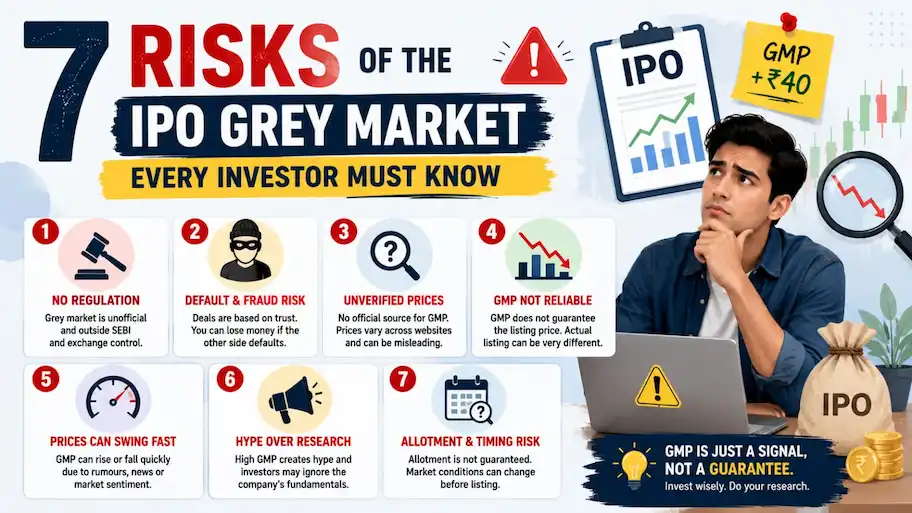
1. Limited Investor Protection
Grey market arrangements take place outside the regular stock exchange trading and settlement system.
If a dispute occurs, you may not have access to the same exchange-based complaint and settlement mechanisms available for regular trades. The legal options available will depend on the circumstances and applicable law.
This is one reason beginners should be particularly careful about entering informal financial arrangements.
2. Default and Fraud Risk
Informal transactions may depend on trust between the parties. If someone fails to pay, refuses to honour an agreement, or misrepresents the terms, recovering the money can be difficult.
Before participating in any financial arrangement, understand who the other party is, what the agreement requires, and what recourse may be available if something goes wrong.
A promised premium or expected listing gain is not worth ignoring the possibility of fraud or default.
3. Unverified and Inconsistent Prices
There is no official exchange-published GMP figure against which every website’s quotation can be checked.
One website may show a premium of ₹20, while another may report ₹25 or provide no figure at all. Differences can arise from timing, information sources, or the informal nature of the market.
Do not automatically assume that the highest reported GMP is the most accurate one. Treat online figures as unverified information unless their reliability can be independently established.
4. GMP Cannot Reliably Predict the Listing Price
Does grey market premium predict IPO listing price? It may sometimes move in the same direction as the eventual listing, but it is not a dependable guarantee.
The actual listing price is determined by trading in the stock exchange market after listing. It can be affected by market conditions, investor demand, company valuation, broader market movements, and other factors.
Even a high GMP can be followed by a disappointing listing. Similarly, a low or negative GMP does not establish exactly how the stock will perform.
Use GMP, if you choose to monitor it, only as an unofficial sentiment indicator rather than a substitute for research.
5. Prices Can Change Quickly
Grey market quotations may change as news, subscription data, market sentiment, or expectations change.
A premium reported in the morning may be different later in the day. A figure published several days before listing may also become less relevant as new information emerges.
This makes it risky to base a financial decision on a single GMP update. Even a recently published figure may not represent a reliable or executable transaction price.
6. Hype Can Replace Proper Research
A high GMP can make an IPO look attractive, particularly to beginners who are hoping for quick listing gains.
However, the premium alone does not explain whether the company has a sustainable business, manageable debt, consistent profits, or an attractive valuation.
Before applying, review the company’s business model, revenue, profitability, debt, competitive position, use of IPO proceeds, and risk factors.
A company can attract strong short-term interest and still face long-term business challenges. Do not confuse market excitement with business quality.
7. Allotment and Timing Uncertainty
Submitting an IPO application doesn’t ensure share allotment. It is determined by the relevant allocation rules and the level of investor demand for shares in the offering.
Informal arrangements involving applications or expected allotment can create additional uncertainty. The terms may not work out as a participant expected, particularly if the transaction depends on a particular allotment outcome.
There is also a short period between the IPO closing and listing during which expectations can change. In India, SEBI rules require applicable public issues to be listed within three working days after the issue closing date.
You can verify the official framework in SEBI’s circular on the T+3 listing timeline.
The key takeaway is that neither receiving an allotment nor earning listing gains is ever guaranteed.
Advantages and Disadvantages of Watching GMP
Possible Advantages
- It can provide an informal indication of sentiment among some market participants.
- Changes in reported GMP may encourage investors to investigate why expectations are changing.
- It can help readers understand the discussion surrounding an upcoming IPO, provided they recognise its limitations.
Disadvantages
- GMP is unofficial and may be inaccurate.
- Reported figures can vary between sources.
- Short-term hype may influence expectations.
- It cannot establish the company’s fair value.
- It may encourage emotional decisions or unrealistic profit expectations.
Watching GMP is a personal choice, but participating in informal transactions is not necessary to apply for an IPO through the official process.
Common Mistakes Beginners Make
New investors may make several avoidable mistakes when evaluating IPO grey market information.
- Treating a high GMP as a guarantee of listing profit.
- Applying for an IPO only because its reported premium looks attractive.
- Ignoring the company’s financial statements and valuation.
- Trusting a single website without checking the source or update time.
- Confusing an unofficial quotation with an official stock exchange price.
- Assuming every IPO applicant will receive an allotment.
- Participating in informal deals without understanding counterparty and legal risks.
Avoiding these mistakes can help you make more informed decisions.
Smarter Ways to Evaluate an IPO
Instead of relying only on GMP, consider the following steps before applying for an IPO.
1. Read the Red Herring Prospectus
Review the company’s business, financial statements, risk factors, and details of the public issue.
2. Examine Revenue, Profits, and Debt
Look at financial performance over several years, where information is available. Check whether growth is supported by sustainable business performance.
3. Evaluate the Valuation
Compare the company’s valuation with relevant listed competitors, while considering differences in business models, profitability, and growth prospects.
4. Understand the Use of IPO Proceeds
Check whether the money will support business expansion, repay debt, or provide an exit for existing shareholders.
5. Review Official Subscription Information
Use exchange-published information to understand demand in different investor categories. Subscription figures are useful context, but they do not guarantee listing gains.
6. Consider Your Risk Tolerance
Decide how much risk you can afford before applying. Never invest money you may need for essential expenses simply because an IPO appears popular.
Official offer documents and disclosures are more appropriate foundations for investment decisions than unofficial market quotations.
Conclusion
The IPO grey market can attract attention because investors want to estimate how a new stock might perform after listing. However, Grey Market Premium (GMP) is an unofficial indicator, not an assured listing price or a promise of profit.
Its limitations include inconsistent quotations, rapidly changing sentiment, counterparty risks, and the possibility of misleading expectations. The legal position of any informal transaction also depends on its specific circumstances and applicable regulations.
So, should beginners trust the IPO grey market premium? The sensible approach is to treat GMP cautiously, if you monitor it at all, and base your investment decision on the company’s financial position, valuation, official disclosures, and your own risk tolerance.
Disclaimer: This article is for educational purposes only and is not investment advice. Market practices and regulations may change. Read the official IPO documents and consult a SEBI-registered investment adviser if you need personalised investment guidance.
Article Source
- SEBI — IPO Listing Timeline (T+3): SEBI Circular on T+3 Listing
- NSE — IPO Offer Documents: NSE Offer Documents
- NSE — IPO Listing Process: NSE Listing Process
FAQ's
What is the grey market in an IPO?
The IPO grey market is an unofficial market where participants make arrangements involving IPO shares or applications before listing. It operates outside the regular exchange-trading system.
What does GMP mean in an IPO?
GMP stands for Grey Market Premium. It is the unofficial premium quoted over an IPO’s issue price and may indicate sentiment among some market participants.
Is grey market premium accurate for predicting the listing price?
No. GMP is not a reliable guarantee of the listing price. Actual trading after listing can produce a price that differs significantly from the estimate implied by GMP.
Is grey market trading legal in India?
Its legal position should not be reduced to a simple yes-or-no answer for every transaction. The circumstances and applicable laws matter. Informal transactions do not provide the same exchange-based protections as regular stock market trades.
Should beginners rely on IPO GMP today?
No. Beginners should not rely on GMP alone. They should review official offer documents, financial performance, valuation, business risks, and their own investment objectives before making a decision.

My name is Subodh Kumar, and I am a finance blogger at Financemantraa.com with a strong interest in personal finance, investing, and financial research spanning 4–5 years.
I enjoy researching financial topics and explaining complex money concepts in simple, easy-to-understand language. My areas of interest include stock market basics, IPOs, mutual funds, financial planning, insurance, saving strategies, and wealth building.
Through Financemantraa.com, I aim to help readers improve their financial knowledge, understand investment concepts, and make informed financial decisions. I focus on creating practical, beginner-friendly guides that make personal finance easier to understand and apply in everyday life.
I believe that financial education and smart money habits can help people work toward long-term financial stability. My goal is to make reliable, accessible, and informative financial content available to everyone.
Disclaimer: The information published on Financemantraa.com is for educational and informational purposes only. It should not be considered professional financial or investment advice.