

Friends, let’s be honest about what I’m about to talk about. Every year when March comes, most of us start getting anxious about taxes. We quickly buy some random insurance policy or put money into a scheme to save on taxes, without knowing whether this scheme is right for us or not. I’ve made this mistake too, so trust me, I know how it feels.
That’s exactly why I decided to write this complete Tax Planning Guide 2026 for you. In this guide, I’ll explain in the simplest words how you can save more taxes legally, without any confusion and without any tricky English terms.
This is not a boring textbook article. Think of it as if I’m sitting with you over coffee, explaining how taxes work and how you can plan them smartly. So grab your cup, relax, and let’s move forward step by step honestly.
Highlight key
- What tax planning really means and why 2026 is an important year for it
- New tax regime vs old tax regime, explained in easy language.
- Best tax saving investments under Section 80C (now Section 123)
- Health insurance benefits under Section 80D (now Section 126)
- Simple tax planning tips for salaried people and self-employed professionals
- A ready checklist before the financial year ends
- Common mistakes people make while doing tax planning
Complete guide to tax planning: Understand its important role in 2026.
Tax planning simply means arranging your income, investments, and expenses in such a way that you pay the lowest tax possible, in a fully legal way. It is not tax evasion. It is not hiding money. It is just being smart with the rules the government has already given us.
In my experience, most people confuse tax planning with tax saving. Tax saving is just one small part of tax planning. Real tax planning looks at your full financial picture, your goals, your family needs, and then decides the best route.
Now why does this Tax Planning Guide 2026 matter this year, especially? Because India has moved to a brand new Income Tax Act, 2025, which is applicable from April 1, 2026. Many old section numbers you knew, like 80C and 80D, have changed. Section 80C is now called Section 123, and Section 80D is now called Section 126.
The good news, buddy, is that the benefits and limits are mostly the same. Only the numbers changed, not the actual savings. So a proper Tax Planning Guide 2026 has to explain both the old and new names, so you are not confused when you see your Form 16 or file your return.
New tax system vs old tax system: Find out which one is right for you
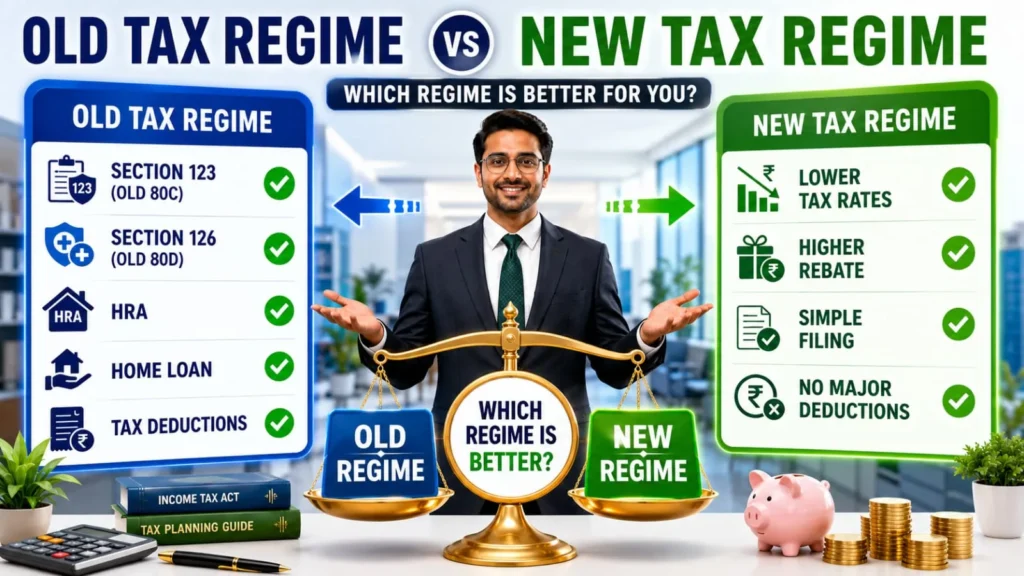
This is the biggest question in any Tax Planning Guide 2026, and honestly, there is no one answer for everyone. It depends on your income and how much you invest.
New Tax Regime Slabs
The new regime is now the default option, which means if you do not choose anything, this is what applies to you automatically. Here are the slabs:
- Up to Rs 4 lakh: No tax
- Rs 4 lakh to Rs 8 lakh: 5%
- 10% tax on income from ₹8 lakh to ₹12 lakh.
- Rs 12 lakh to Rs 16 lakh: 15%
- Rs 16 lakh to Rs 20 lakh: 20%
- ₹20 lakh to ₹24 lakh: Will have to pay 25% tax in this slab.
- Above Rs 24 lakh: 30%
The best part: tell me the truth, wouldn’t you love this? If your taxable income is up to Rs 12 lakh, you pay zero tax because of a rebate. For salaried people, after the standard deduction of Rs 75,000, income up to around Rs 12.75 lakh becomes tax-free.
But here is the catch: the new regime does not allow most deductions like 80C or HRA.
Old Tax Regime Slabs and Deductions
The old regime still exists if you want to choose it. The slabs are Rs 2.5 lakh nil, then 5%, 20%, and 30% at higher levels. It looks higher on paper, but if you have many deductions like home loan interest, insurance, PPF, and rent, this regime can actually save you more money.
So which one is better in this Tax Planning Guide 2026? If your investments and deductions cross around Rs 4 to 4.5 lakh in a year, the old regime usually wins. The new rule is being considered more beneficial than before for those who invest less.
Best Tax Saving Investments Under Section 123 (Old Section 80C)
If you choose the old regime, this section is your best friend. You can reduce your taxable income by up to Rs 1.5 lakh every year by investing in specific options. In my experience, people just buy whatever their agent tells them, without comparing. Please don’t do that.
Here are some solid choices:
- PPF (Public Provident Fund): Safe, government-backed, and tax-free returns. Good for the long term.
- ELSS Mutual Funds: Shortest lock-in of just 3 years among all 80C options, and better growth potential since it is market-linked.
- Life Insurance Premium: Useful, but only buy pure term insurance for protection, not those mixed investment-cum-insurance plans. Those give low returns, and I say this honestly, they are not great.
- Sukanya Samriddhi Yojana: Great if you have a daughter, decent interest rate and fully tax-free.
- 5 Year Tax Saving FD: Safe but returns are lower, and interest is taxable, so use it only if you want zero risk.
- NPS (National Pension System): This section provides an additional tax deduction of up to 50,000 rupees over the 1.5 lakh rupees limit, which helps in building a retirement fund.
If you think as I do, an ELSS and PPF combination works well for most middle-class families because one gives growth and the other gives safety.
Health Insurance and Section 126 (Old Section 80D) Benefits
Friends, this one is very close to my heart. A few years back, my father had a medical emergency, and because we had a good health insurance policy, we did not have to break our savings. That day I understood why health insurance is not optional; it is necessary.
Under this section, you get a deduction for health insurance premiums:
- Up to Rs 25,000 for yourself, spouse, and children
- Additional Rs 25,000 for parents, or Rs 50,000 if they are senior citizens
So a full family, including senior citizen parents, can claim up to Rs 75,000 in deductions. This is available only in the old regime. Beyond tax saving, health insurance protects your family from huge hospital bills, so treat it as protection first, tax benefit second.
Tax Planning for Salaried Employees
If you are a salaried employee, your Tax Planning Guide 2026 strategy should start early in the financial year, not in the last month. Here is what actually helps:
- Check your salary structure. Ask HR if you can restructure it to include HRA, LTA, and meal coupons; these reduce taxable income.
- Submit investment proofs on time so extra TDS is not cut from your salary.
- Compare both regimes using an online calculator before choosing; don’t just follow your colleague’s choice.
- If you have a home loan, the old regime with interest deduction may benefit you more.
However, if your salary is simple with no big deductions, the new regime with lower slabs and higher rebate limit is usually the easier and better path.
Tax Planning for Self-Employed Professionals
Now let’s talk about freelancers, consultants, and business owners. Your Tax Planning Guide 2026 looks a bit different from a salaried person’s plan.
- Keep proper books of accounts and bills; this helps claim genuine business expenses.
- Use the presumptive taxation scheme if your turnover qualifies; it reduces paperwork a lot.
- Pay advance tax on time to avoid interest penalty; many self-employed people forget this.
- Invest in NPS and health insurance, since you don’t get employer benefits like a salaried person.
Self-employed income can be unpredictable, so plan tax quarterly instead of waiting for year-end. This one habit alone saves a lot of stress.
Smart Tax Planning Ideas for Higher Savings

Here are a few extra tricks that people often miss in their Tax Planning Guide 2026 planning:
- Claim home loan interest deduction separately; it is not part of the 1.5 lakh limit.
- Donate to registered charities for deduction, but always keep the receipt.
- If married, and both partners earn, split investments smartly between both to use both exemption limits.
- Start tax planning in April, not February. Trust me, rushed decisions in the last month rarely turn out well.
Tax Planning Checklist Before the Financial Year Ends
Before the year closes, quickly go through this:
- Compare old vs new regime with actual numbers.
- Complete your Section 123 (80C) investments.
- Buy or renew health insurance under Section 126 (80D)
- Collect rent receipts if claiming HRA.
- Pay any pending advance tax.
- Keep all proofs organized in one folder.
Tax Planning vs Tax Saving: What's the Difference
Many people search this, so let me clear it in simple words. If your goal is to save tax, small but important steps like investing up to ₹1.5 lakh in an ELSS fund can help. Tax planning is the bigger picture; it includes your regime choice, retirement goals, insurance needs, and long-term wealth building, all combined together with tax efficiency in mind. Good tax planning naturally includes tax saving, but tax saving alone is not full tax planning.
Common Mistakes to Avoid in Tax Planning
Proper tax planning is not just for saving taxes, but also important for future financial security. In this 2026 guide, I will show you how to stay away from common mistakes.
- Waiting till March: This is the biggest mistake. Rushed investments in the last month are rarely the best choice, and you often end up buying something just to save tax, not because it is good.
- Not comparing both regimes: Many people stick to the old regime out of habit, or jump to the new regime just because it sounds simple. Always run the numbers first.
- Buying wrong insurance: Mixing insurance and investment in one plan usually gives poor returns on both sides. Keep them separate, buddy.
- Ignoring Form 26AS and AIS: These documents show your actual income and TDS details. Not checking them can lead to mismatch notices later.
- Missing advance tax deadlines: If you have income other than salary, missing advance tax payments adds interest charges that were fully avoidable.
Avoiding these small mistakes can make your entire tax planning smoother and more effective, without much extra effort.
Final Thoughts
Friends, this Tax Planning Guide 2026 isn’t about hassles or finding some lost luggage. It’s about how we can smartly and honestly make use of the rules already set by the government. Don’t rush into anything this March. Start now, compare both systems with real numbers, choose the right insurance and investments, and by the end of this year, you’ll legally have more money than before.
Disclaimer
Friends, this article has been written just for general information and educational purposes for my brother and friends. It is not professional tax or investment advice for anyone. In the future, the government may make changes to tax-related rules, tax slabs, and various sections.
Before making any financial decisions, check the latest updates on the Income Tax Department’s official website, or else be sure to consult a qualified tax expert. I have tried my best to keep this Tax Planning Guide 2026 accurate and updated, but I will not be responsible at all for any losses arising from decisions made solely based on this article. All the best, guys.
FAQ's
What is the new tax regime slab for 2026?
Income up to Rs 4 lakh is tax-free, then rates rise in steps from 5% to 30%, with income up to Rs 12 lakh effectively tax-free due to the rebate.
Is Section 80C still available in 2026?
Yes, but it is now called Section 123 under the new Income Tax Act. The Rs 1.5 lakh deduction limit and eligible investments remain the same.
Which is better, old or new tax regime?
If your deductions cross around Rs 4 lakh yearly, the old regime helps more. Otherwise, the new regime with lower rates is simpler and better.
Can I claim both 80C and 80D deductions?
Yes, but only under the old tax regime. Both sections (now 123 and 126) work together to lower your taxable income significantly.
When should I start tax planning for the year?
Start in April, right at the beginning of the financial year. Early planning avoids rushed, wrong decisions and gives better investment returns.
Is ELSS better than PPF for tax saving?
ELSS offers higher growth with market risk and shorter lock-in, while PPF is safer with fixed returns. A mix of both works well for most people.