
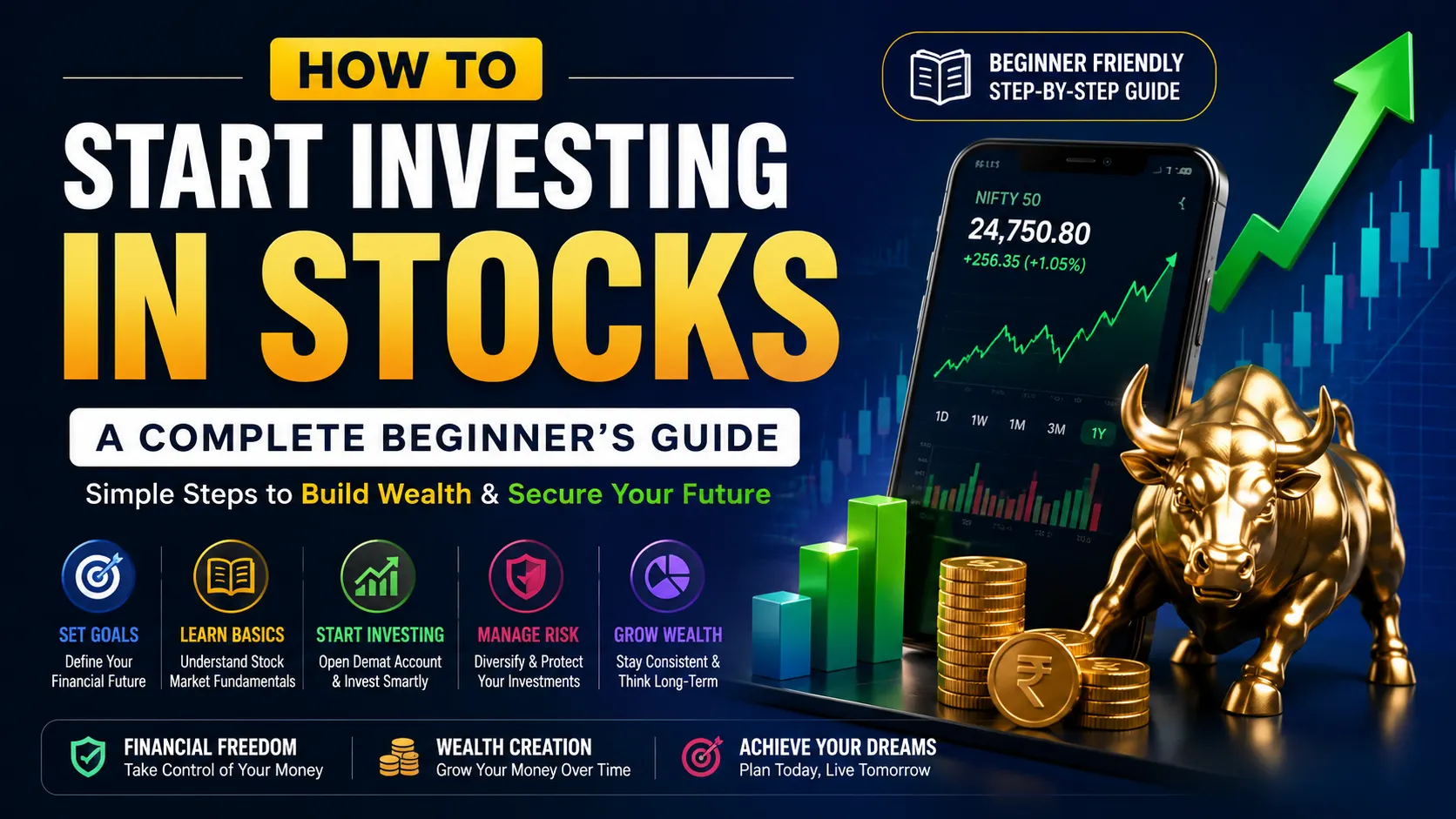
These days, it seems like everyone is talking about the stock market. You hear about it in office conversations, in family WhatsApp groups, and even in Instagram reels. But to be honest, most people don’t know how to start investing in stocks. I was exactly like that in the beginning – completely confused. It seemed like only rich people or experts could do it. But when I eventually started, I realized it is not as complicated as everyone thinks.
In this article, I will explain everything from scratch to a solid plan in simple language. We will cover each step with real-life examples. This guide is especially for middle-class people who want to take important steps to secure their future.
Why You Should Learn How to Start Investing in Stocks Right Now
Inflation is rising like crazy. Everything is getting more expensive. If you keep your money in a bank fixed deposit, you might earn 6-7%, but inflation is running at around the same rate or higher. That means your money is actually losing value over time. This is exactly why understanding how to start investing in stocks has become so important.
I’ve seen people who started consistent investing 10-12 years ago, and their lives look very different today. My friend Rohan, for instance, began putting in ₹3,000 every month in a SIP-style approach back in 2015. Today, his portfolio is worth over 18 lakhs. Meanwhile, I started in 2017 and I’m still learning every day.
When you invest in stocks, you become a part-owner of a company. If the company does well, its stock price usually goes up and you make money. Sometimes you even get dividends. For the average person, this is one of the most powerful ways to create long-term wealth.
Understanding the Basics of the Stock Market
Before you learn how to start investing in stocks, it’s important to understand what a stock actually is. In simple terms, a stock is a small piece of a company. If you buy shares of Tata Motors, you become a tiny part-owner of that company.
In India, there are two major stock exchanges: the National Stock Exchange (NSE) and the Bombay Stock Exchange (BSE). Thousands of companies are listed here, but we only need to focus on the solid ones.
You might have heard terms like blue-chip stocks, mid-cap, and small-cap. Blue-chip companies are large and stable, like Reliance, HDFC Bank, or ITC. They usually come with lower risk. Small-cap stocks can give higher returns but also carry more risk.
Step-by-Step Guide: How to Start Investing in Stocks
Now let’s get into the practical part. Here’s a clear roadmap for how to start investing in stocks.
1. Set Clear Financial Goals First
The very first step in starting to invest in stocks is to define your goals. Don’t just say, ‘I want to make money..” Ask yourself better questions:
- Do you need a new car in five years?
- Are you saving for your children’s higher education?
- Or are you planning for retirement in 15 years?
Once your goals are clear, deciding how much risk you can take becomes easier. If you’re young, between 25 and 35, you can afford a slightly aggressive approach. If you have family responsibilities, stick to safer options like blue-chip stocks and index funds.
2. Build Your Knowledge with Free Resources
Never jump into how to start investing in stocks without proper knowledge. Here are some excellent free resources I personally recommend:
- Zerodha Varsity – completely free and very well-structured
- Groww Academy
- YouTube channels like CA Rachana Ranade and Pranjal Kamra
- Books such as “The Psychology of Money” by Morgan Housel and “Coffee Can Investing”
I started with Zerodha Varsity. I used to read for 30-40 minutes every day. Within two to three months, I felt much more confident.
3. Open a Demat and Trading Account
This process is surprisingly easy these days. The best platforms for beginners are:
- Groww – super simple app, perfect for new investors
- Zerodha – low charges and professional features
- Upstox and Angel One are also good options
You’ll need your Aadhaar, PAN card, bank details, and a quick selfie. Video KYC gets done in about 10 minutes. My first account was on Groww because the interface felt very beginner-friendly.
4. Learn How to Research Stocks
This is probably the most crucial part of how to start investing in stocks. Before putting money into any company, check these things:
- Do you understand the company’s business model?
- How has its profit grown over the last 5-10 years?
- Is the debt level manageable?
- Where does it stand in its industry?
I personally follow only 4-5 sectors that I understand well—banking, IT, consumer goods, pharma, and renewables. I avoid investing blindly in sectors I don’t know.
Take 2020 as an example. During the lockdown, everyone was scared. I invested a small amount in HDFC Bank and Reliance. Those decisions have given me solid returns over time.
5. Start Small and Stay Consistent
A big mistake beginners make is thinking they need ₹50,000 or ₹1 lakh to begin. That’s not true. You can start with just ₹2,000 to ₹5,000. My very first investment was only ₹6,200. I faced a small loss, but it taught me valuable lessons.
You can also invest in a SIP style in stocks—putting a fixed amount on a specific date every month, whether the market is up or down.
Different Ways to Invest in the Stock Market
There are several approaches when learning how to start investing in stocks:
Direct Stocks: Research and buy individual company shares yourself. This can give high returns but needs time and knowledge.
Mutual Funds: Professional managers handle your money. Equity mutual funds invest in stocks and are quite safe for beginners.
Index Funds: In my opinion, this is the best starting point. Nifty 50 or Sensex index funds give you exposure to the top 50 companies. They have low costs and have historically delivered 12-15% average returns over long periods.
ETFs: Exchange Traded Funds are another good option.
Even today, I keep about 60% of my portfolio in index funds and mutual funds. The rest goes into carefully chosen direct stocks.
Risk Management – Never Ignore This
The stock market always comes with risk, and you should never forget that. When figuring out how to start investing in stocks, keep these rules in mind:
- Diversify your portfolio across 10-15 different stocks or funds
- Only invest money you won’t need for the next 5-7 years
- Learn to use stop-loss orders
- Control your emotions—both greed and fear can be dangerous
Remember the 2022 market crash? Many people sold everything in panic. Those who stayed calm saw good recovery in 2023 and 2024.
Common Mistakes Beginners Often Make
I’ve made most of these mistakes myself, so let me share them honestly:
- Buying because of FOMO when prices are already very high
- Following tips from YouTube or friends without doing your own research
- Adding more money to a losing stock without proper analysis
- Checking your portfolio every single day (this will stress you out)
- Trying short-term trading without enough experience
Once, I invested ₹15,000 based on a random tip. I lost nearly 40%. That day I made a strict rule: only invest based on my own research.
How to Build a Strong Portfolio Over Time
In the beginning, keep 70% in safer investments like index funds and large-cap stocks, and 30% in mid and small-caps. As you gain experience, you can adjust the mix.
Review your portfolio every six months. Check company quarterly results. If the fundamentals are weakening, consider exiting.
Also, understand taxes. Long-term capital gains (after holding for more than one year) are taxed at 12.5% now.
Real-Life Success Stories from India
While Rakesh Jhunjhunwala was a legend, there are many inspiring stories of regular people too. A school teacher from my hometown in Lucknow started investing ₹4,000 every month in index funds since 2016. Today his portfolio is worth more than 35 lakhs. If someone with a regular salary can do it, so can you.
Advanced Tips Once You’ve Gained Some Experience
After one or two years, you can explore:
- Deeper sector research
- Reading annual reports
- Basic technical analysis like candlestick patterns
- Proper asset allocation between stocks, gold, and fixed income
But remember, simplicity usually works best. Don’t overcomplicate things.
Final Thoughts on How to Start Investing in Stocks
Learning how to start investing in stocks can really completely change your life if it is done in the right way or patiently. Open a demat account today. Start your first investment with a small amount. You will make mistakes, but those same mistakes will teach you a lot in the future.
My personal suggestion is to start with 50% in index funds. Then, as you learn, gradually invest directly in stocks as well. Be patient. After 8-10 years, you will thank yourself for starting at the right time.
If you have any questions or any issues related to this article, you can mention them in the comments. I will do my best to answer your question. And remember, this is not personal financial advice. Always start by keeping your situation in mind and consulting a SEBI-registered advisor if necessary.
There is a lot of risk in the stock market. Only invest as much as you are ready to keep invested for a long time. Be happy while investing!
FAQ's
1. How much money do I need to start investing in stocks?
You don’t need a lot. You can start with as little as ₹2,000 to ₹5,000. The most important thing is to begin and stay consistent rather than waiting for a big amount.
2. Is stock market investing safe for beginners?
Yes, it is safe if you follow the right approach. Start with index funds or Nifty 50 funds, invest only money you won’t need for 5-7 years, and diversify. Remember, there is always some risk, but long-term investing reduces it significantly.
3. Which is better for beginners: Direct stocks or Index Funds?
For beginners, Index Funds are much better and safer. They give you exposure to top companies without the stress of picking individual stocks. Once you gain experience (after 1-2 years), you can slowly add direct stocks.
4. How long should I stay invested in the stock market?
Minimum 5-7 years, ideally 8-10 years or more. Stock market is a long-term game. Short-term trading is risky and not recommended for new investors.
5. Can I lose all my money in stocks?
It is very unlikely if you invest in good companies or index funds and stay invested for the long term. However, the market can go down temporarily, so only invest money you can afford to keep locked in. Never invest money you need in the near future.