
Friends, have you heard the big news? India economy has now reached $3.92 trillion. Yes, you read that right. This number is not small; it puts our India among the world’s top economies. But what does this actually mean for people like you and me? Does a big GDP mean better jobs, more money in our pockets, or cheaper goods in the local market? Let’s talk about this today in the simplest way, just like I explain to my family at home over tea.
I still remember when I was in school, my economics teacher used to say that it would take decades for India’s GDP to reach big numbers. Today, seeing India economy cross $3.92 trillion, I truly feel proud of this. But friends, it’s also important to be honest. A big GDP number doesn’t always mean that everyone’s situation is good. So let’s understand this step by step, both the good parts and the difficult parts, as this article is written with complete honesty.
Highlight key
- India’s nominal GDP stood at $3.92 trillion for the year 2025-26, as per IMF data.
- This makes India the sixth-largest economy in the world.
- India recorded around 7.8% growth in one recent quarter, which is strong.
- The government is focusing on manufacturing, agriculture, and MSMEs to push growth further.
- India had briefly moved up to fourth position before slipping to sixth due to currency and ranking changes.
What Is India's GDP Right Now? (Current State of Indian Economy)
Let’s start simple. GDP means Gross Domestic Product. In simple words, it is the total value of all goods and services a country makes in one year. Think of it like the total income of a big family business, except this business has 1.4 billion people working in it.
As per the IMF’s April 2026 report, the India economy GDP was recorded at $3.92 trillion for the financial year 2025-26. This was shared by the government itself in Parliament, so it is not just some random number floating around online. This makes India the sixth-largest economy on the planet right now.
Now here’s an interesting twist. Just a few months back, at the end of 2025, India had actually crossed Japan to become the fourth-largest economy, with GDP near $4.18 trillion. But by April 2026, the ranking moved to sixth. Why? Because currency movements, exchange rate changes, and how other economies performed also affect this ranking. It is not only about India growing slowly or fast, but other countries’ numbers shift the table too.
Tell me the truth, did you know GDP rankings could change so quickly just because of currency swings? I didn’t fully understand this until I read about it properly. It taught me that GDP size alone doesn’t tell the full story of an economy’s health.
Indian Economy Growth Rate in 2026?
Now let’s talk numbers that actually excite people: the growth rate. India recorded around 7.8% year-on-year growth in the January to March quarter, driven mainly by strong domestic demand and continued investment. Friends, this is a solid number when you compare it with most developed nations that are struggling to even hit 2-3% growth.
The Indian economy growth story is largely driven by three things:
- Rising domestic consumption, meaning we Indians are spending more
- Growing infrastructure investment, roads, ports, railways getting built faster
- Expansion in both services and manufacturing sectors together
In my experience tracking business news for years, this combination of consumption plus infrastructure is exactly what keeps an economy moving even when the global situation is shaky.
Main Sectors Driving the Indian Economy
If you want to understand Indian economy sectors, think of it like a three-legged stool.
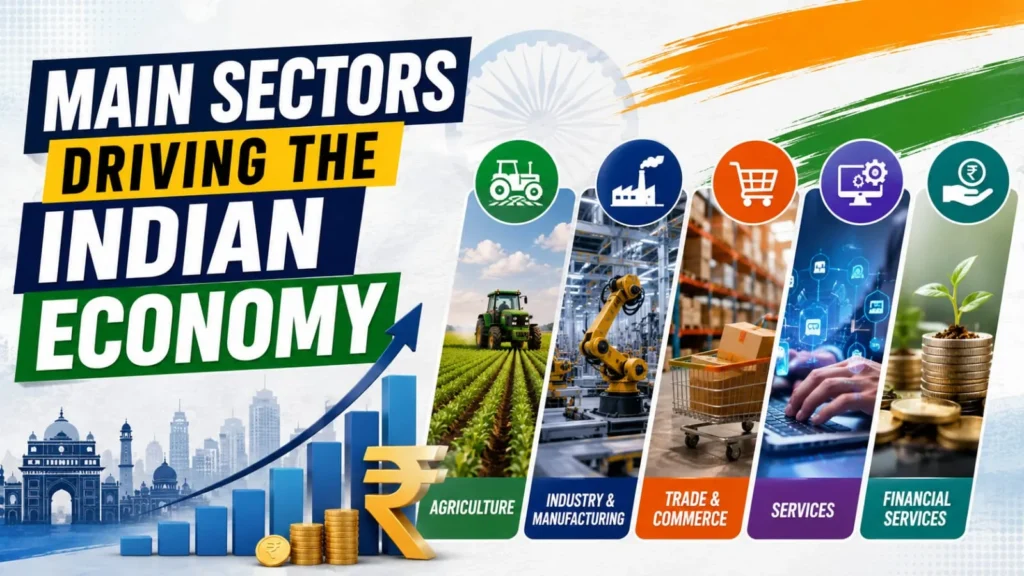
Agriculture
Agriculture still employs a huge chunk of our population, even though its share in GDP has come down over the years compared to manufacturing and services. It remains the backbone for rural India and food security.
Manufacturing
This is where the government has been pushing hard through schemes like Production Linked Incentives and relaxed Quality Control Orders. The goal is simple: make more products inside India instead of importing everything.
Services
The services sector, including IT, banking, tourism, and more, continues to be the biggest contributor to India GDP. If you think as I do, this sector is what really keeps our economy resilient during global slowdowns, since Indian IT and service exports are in demand worldwide.
Agriculture
Agriculture still employs a huge chunk of our population, even though its share in GDP has come down over the years compared to manufacturing and services. It remains the backbone for rural India and food security.
India Economy Strengths
Let’s be honest and fair here, because a good article should not just praise everything blindly.
- Large domestic market: With over 1.4 billion people, India doesn’t need to depend only on exports to grow
- Strong banking sector: Non-performing assets of public sector banks have dropped from 3.47% in 2024 to just 1.93% in 2026, showing banks are healthier now
- Foreign investment interest: A bigger economy naturally attracts more global investors
- Young population: Most of our workforce is young, which means more working hands for years to come
- Digital push: UPI, internet banking, and digital tools have made transactions faster across the country
India Economy Challenges
Now the part where I won’t sugarcoat anything, because if something is bad, it needs to be said clearly.
- Per capita income is still low: Even though total GDP looks big, when divided among 1.4 billion people, individual income remains modest compared to smaller developed nations.
- Employment concerns: Job creation hasn’t always matched the pace of economic growth
- Public debt: Government spending remains high compared to revenue collected
- Productivity gaps: Many sectors still need better technology and skill development to compete globally
Friends, this is exactly why the size of GDP alone should never be the only measure we celebrate. A country can have a huge GDP but still face real struggles at the ground level for common families.
Government's View and Policy Push
The government’s stance, as shared by Minister of State for Finance Pankaj Chaudhary in Parliament, is that India is following a broad-based strategy to boost growth potential. Now let’s talk about what this strategy actually includes.
The focus areas are:
- Boosting agricultural productivity through better tools and support
- Promoting manufacturing through PLI schemes and easier compliance rules
- Strengthening MSMEs, since small businesses create most of the jobs in India
- Expanding infrastructure across roads, railways, and digital networks
However, the government has also been careful in tone, choosing restraint over loud claims. This shows a more mature approach where growth numbers are shared with facts, not just hype.
Indian Economy vs Other Major Economies
Right now, India sits at sixth place in nominal GDP terms, behind the United States, China, Germany, Japan, and the United Kingdom. But here’s something many people miss: in Purchasing Power Parity terms, which adjust for cost-of-living differences, India actually ranks much higher, close to third position globally.
This difference matters because nominal GDP is measured directly in US dollars, so currency strength plays a big role. A weaker rupee against the dollar can push India’s ranking down even if actual economic activity inside the country is growing steadily. So when people ask why India economy ranking dropped from fourth to sixth so fast, currency movement is a big part of that answer, not a sudden slowdown.
Future of Indian Economy
Now let’s talk about what’s ahead. Fitch Ratings recently kept India’s sovereign rating stable, pointing towards strong growth along with the structural challenges we discussed earlier. Most economists still expect India to remain one of the fastest-growing major economies over the next few years.
Growth projections suggest India GDP could reach around $4.15 to $4.2 trillion by the end of 2026, with continued expansion expected into 2027 and beyond. If manufacturing push and infrastructure spending continue at this pace, the India economy should keep climbing steadily.
Now let’s talk about what this means practically for you. A growing economy generally means more job opportunities over time, better infrastructure in your city, and improved access to services. But it takes time for these big numbers to actually reach the common man’s pocket. Patience and smart personal financial planning still matter, no matter how big the country’s GDP becomes.
Final Thoughts
So friends, to sum it up, the India economy at $3.92 trillion is genuinely a big achievement, making us the sixth-largest economy globally. The story of this growth is supported by real figures like 7.8% quarterly growth, better health of banks, and the government’s strong focus on construction and infrastructure.
But we should also stay grounded in reality. Challenges like low per capita income and employment gaps are very real, and ignoring them would be dishonest for all of us. If you think like me, the right way is to celebrate progress while also understanding what still needs to be improved by all of us and the government. This is the real picture of India economic growth journey for today.
FAQ's
Q1. What is India's current GDP in 2026?
India’s nominal GDP stood at $3.92 trillion for 2025-26 as per IMF data, making it the sixth-largest economy in the world currently.
Q2. Why did India's GDP ranking fall from fourth to sixth place?
Ranking changes mainly due to currency movements and exchange rate shifts, not because India’s actual economic growth slowed down significantly.
Q3. What is India's GDP growth rate right now?
India recorded around 7.8% year-on-year growth in a recent quarter, driven by strong domestic demand, consumption, and continued investment activity.
Q4. Which sectors contribute most to the Indian economy?
The services sector contributes the most, followed by industry and manufacturing, while agriculture remains vital for employment and rural livelihoods across India.
Q5. What are the biggest challenges facing the Indian economy today?
Low per capita income, employment gaps, high public debt, and productivity issues remain key challenges despite India’s strong overall GDP growth numbers.
Q6. Will India's economy keep growing in the coming years?
Yes, most economists expect India to remain among the fastest-growing major economies, with GDP projected to cross $4 trillion soon.