
Friends, let’s talk about money today. Not in a boring way, but in a way that actually makes sense. If you have ever wondered how some people turn small savings into big money over time, the answer is simple: Compound Interest. Compound Interest Explained in plain words, means your money earns interest, and then that interest also starts earning interest. Sounds small, right? But trust me, over the years, this small idea can change your whole financial life.
I remember when I opened my first savings account. I was in college, and I put in a small amount every month, just because my father told me to. I didn’t understand the math. I just saw numbers going up slowly. Years later, when I checked the account again, I was shocked. The amount was way more than what I had actually deposited. That was my first real lesson in how compound interest works, and honestly, it felt like magic.
Now, if you are someone who is just starting your money journey, this article is written exactly for you. We will keep the language simple, avoid boring financial jargon, and explain everything with real examples. By the end, you will not only understand what compound interest is, but you will also know how to use it to grow your own savings.
Highlight key
- Compound Interest means earning interest on your interest, not just on your original amount.
- It works best when you give it time, so starting early really matters.
- The compound interest formula helps you calculate the exact growth of your money.
- Compound Interest vs Simple Interest shows a huge difference over long periods.
- A Compound Interest Calculator makes planning easy for beginners.
- Small, regular investments can grow into a large amount because of compounding.
What is Compound Interest?
So, what is compound interest with an example? Let’s keep it simple. Imagine you put ₹10,000 in a fixed deposit that gives 10% interest every year. In the first year, you earn ₹1,000 as interest. Now, in the second year, you don’t just earn interest on ₹10,000. You earn interest on ₹11,000 because your interest from last year has joined your original amount. This cycle keeps repeating, and your money keeps growing faster and faster.
This is very different from simple interest, where you always earn interest only on your original amount, year after year. That is why understanding compound interest for beginners is so important. Once you understand this idea, you start looking at savings and investments in a completely different way. You realize that in investing, it is not enough to simply put in money; dedicating the right amount of time and maintaining patience is equally important.
In my experience, most people ignore this concept when they are young, thinking they will start later. But friends, that is exactly the mistake you should avoid. The sooner you begin investing, the longer your money has to benefit from the power of compounding.
Now let’s talk numbers, but don’t worry, I will keep it simple. The Compound Interest Formula is:
A = P (1 + r/n)^(nt)
Here:
- A is the final amount.
- P is your principal, or the money you started with
- r is the annual interest rate
- n is how many times interest is added in a year
- t is the total number of years
I know this looks a bit technical, but you don’t need to solve it by hand every time. You can use any Compound Interest Calculator online; just enter your amount, rate, and time, and it will show you the future value instantly. This is one of the easiest ways to plan your savings and see how to calculate compound interest step by step without doing manual maths.
Here is a simple example. If you invest ₹50,000 at an 8% interest rate for 10 years, compounded yearly, your money can grow to almost ₹1,08,000. That means your money almost doubled, just by sitting there and compounding quietly in the background.
Compound Interest vs Simple Interest: What's the Real Difference?
Tell me the truth, have you ever compared these two properly? Most people just know the words but never see the actual difference in numbers.
In simple interest, the interest is calculated based on the initial principal amount every time. So if you invest ₹1,00,000 at 10% for 5 years, you get ₹10,000 every year, making it ₹50,000 total interest.
However, with compound interest, the interest earned is added to the principal, causing the investment amount to grow continuously over time. Over this five-year period, the benefit of compounding can result in total interest exceeding ₹50,000, because you earn additional interest not only on the principal but also on the interest previously earned.
This difference becomes huge over longer periods, like 15, 20, or 30 years. This is exactly why long-term investments benefit so much from compounding. If you think as I do, this comparison alone should be enough reason to choose compound interest investment options over simple interest ones whenever possible.
Benefits of Compound Interest You Should Know
Let’s talk about why compound interest is genuinely useful, and where it is not so magical.
The good side:
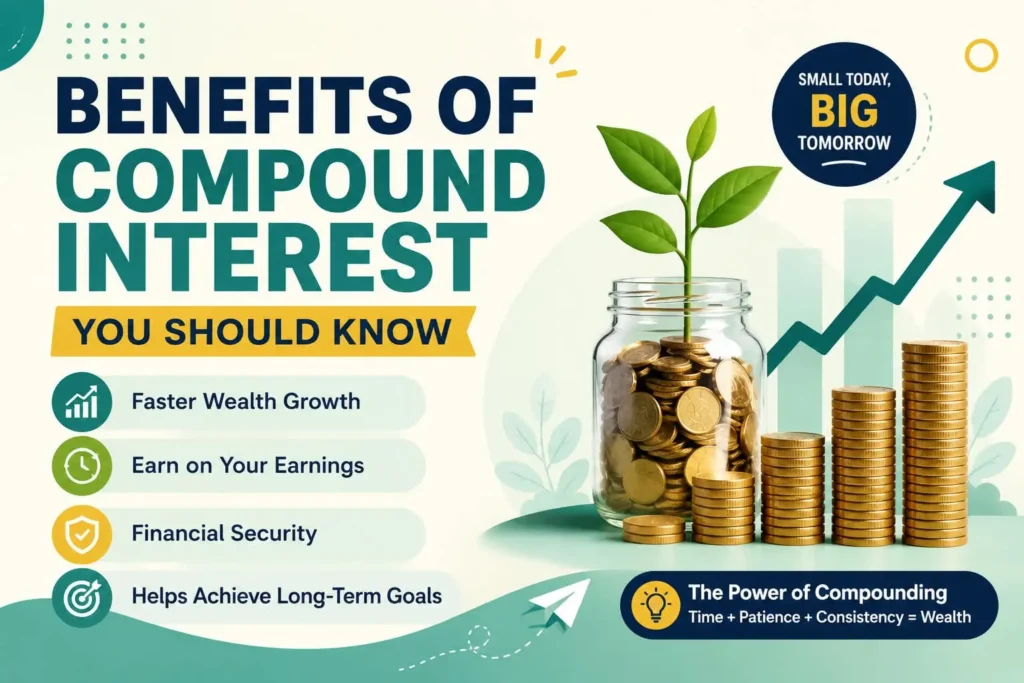
- It helps your money grow faster without extra effort from your side.
- It rewards patience and long-term thinking.
- Small monthly investments can turn into a big amount over time.
- It works well with mutual funds, fixed deposits, PPF, and other Compound Interest Savings options.
- It teaches good financial habits like consistency and discipline.
The honest downside:
- It works both ways. If you have loans or credit card debt, compound interest can also work against you, increasing your debt quickly.
- It needs time. If you expect fast results in just 1 or 2 years, you might feel disappointed.
- Choosing the wrong Compound Interest Rate or platform can reduce your actual returns.
So friends, compounding is powerful, but only when it is used the right way, and with realistic expectations.
How Monthly Investment Benefits from Compound Interest
Now let’s talk about something practical. Many people ask how monthly investment benefits from compound interest, especially through SIPs or recurring deposits.
When you invest a fixed amount every month, each instalment starts earning its own interest from the day it is added. Over years, this creates a snowball effect. Your earlier instalments grow the most because they get more time to compound, while your recent ones are just starting their journey.
This is why financial experts always say, start small, but start early. Even ₹2,000 or ₹3,000 per month, invested consistently for 15 to 20 years, can turn into a large amount purely because of compounding, not because you suddenly invested a huge sum.
Compound Interest Examples in Real Life
Let’s look at a few real examples to make this clearer.
- A fixed deposit of ₹1,00,000 at 7% for 10 years can grow to nearly ₹1,96,715
- A mutual fund SIP of ₹5,000 per month at an average 12% return for 20 years can grow to more than ₹45 lakhs, even though your total investment is only around ₹12 lakhs.
- A PPF account with regular yearly deposits, compounded annually, can create a strong retirement fund over 15 years.
These compound interest examples show one common thing: time is your biggest friend here. The longer you stay invested, the more powerful the compounding effect becomes.
Now, here is something I always tell my friends and family. Don’t just look at the final number and get excited. Look at how slow the growth feels in the first few years. This is the part where most people give up. In the beginning, the interest amount looks small, and it feels like nothing is happening. But once you cross the halfway mark of your investment period, the growth speeds up in a way that genuinely surprises you. This is the real power of compounding, and patience is the price you pay for it.
I have also seen people make a common mistake here. They start an investment, see slow growth in year two or three, and pull out their money thinking it is not working. Friends, this is exactly the wrong move. Every time you withdraw early, you reset the clock on compounding. The real reward comes only when you let your money sit undisturbed for a longer duration.
Best Investments for Compound Interest Growth
If you are wondering where to actually apply this concept, here are some common options people use in India:
- Fixed Deposits, for safe and steady compounding
- Public Provident Fund (PPF, for long-term, tax-friendly growth
- Mutual Funds through SIP, for potentially higher growth over time
- Recurring Deposits, for disciplined monthly saving with compounding benefits
Each option has its own Compound Interest Rate and risk level, so it is smart to choose based on your goals, whether that is buying a house, planning retirement, or building an emergency fund.
How to Build Wealth Using Compound Interest
Building wealth with compounding is not about luck; it is about strategy. Here is a simple compound interest investment strategy for beginners:
- Start as early as possible, even with a small amount.
- Stay consistent; don’t skip your monthly investment.
- Avoid withdrawing early, because that breaks the compounding cycle.
- Reinvest your returns instead of spending them immediately.
- Review your investments once a year, but don’t panic over short-term ups and downs.
Friends, this is not a get-rich-quick method. It is a slow, steady, and reliable way to grow your money, and honestly, that is what makes it trustworthy.
Final Thoughts
So, to sum up everything, Compound Interest Explained in simple words means your money works harder for you as time passes. It rewards patience, consistency, and early action. Whether you choose fixed deposits, PPF, or mutual funds, the core idea remains the same: let your interest earn its own interest.
If you think like I do, you will agree that understanding compound interest for beginners is one of the most valuable financial lessons anyone can learn. Start today, even with a small amount, and let compounding do the rest of the work over the years.
Friends, money habits are built slowly, not overnight. You don’t need a huge salary or a lump sum to begin. You just need a small, steady amount and the discipline to stick with it. Even if you feel your current investment is too small to matter, remember that every rupee you put in today gets many more years to grow than the rupee you plan to invest next year. That single decision, to start now instead of later, is often the biggest factor separating people who build real wealth from those who keep waiting for the perfect moment.
FAQ's
How does compound interest work for beginners?
Compound interest adds your earned interest back to your principal, so future interest is calculated on a growing amount, helping your money increase faster over time naturally.
What is compound interest with example?
If you invest ₹10,000 at 10% yearly, you earn interest on ₹10,000 first, then on ₹11,000 next year, since previous interest joins the principal amount.
How to calculate compound interest step by step?
Use the formula A equals P times one plus r divided by n, raised to nt, or simply use an online compound interest calculator for instant results.
Compound interest vs. simple interest, what's the main difference?
Simple interest is calculated only on the original amount every year, while compound interest is calculated on the principal plus previously earned interest, making it grow faster.
How much money can compound interest generate over 10 years?
It depends on your amount and rate, but even moderate investments can nearly double or triple over 10 years, thanks to consistent compounding growth.
How to use a compound interest calculator effectively?
Simply enter your principal, interest rate, time period, and compounding frequency, and the calculator instantly shows your future value, making planning much easier for beginners.