
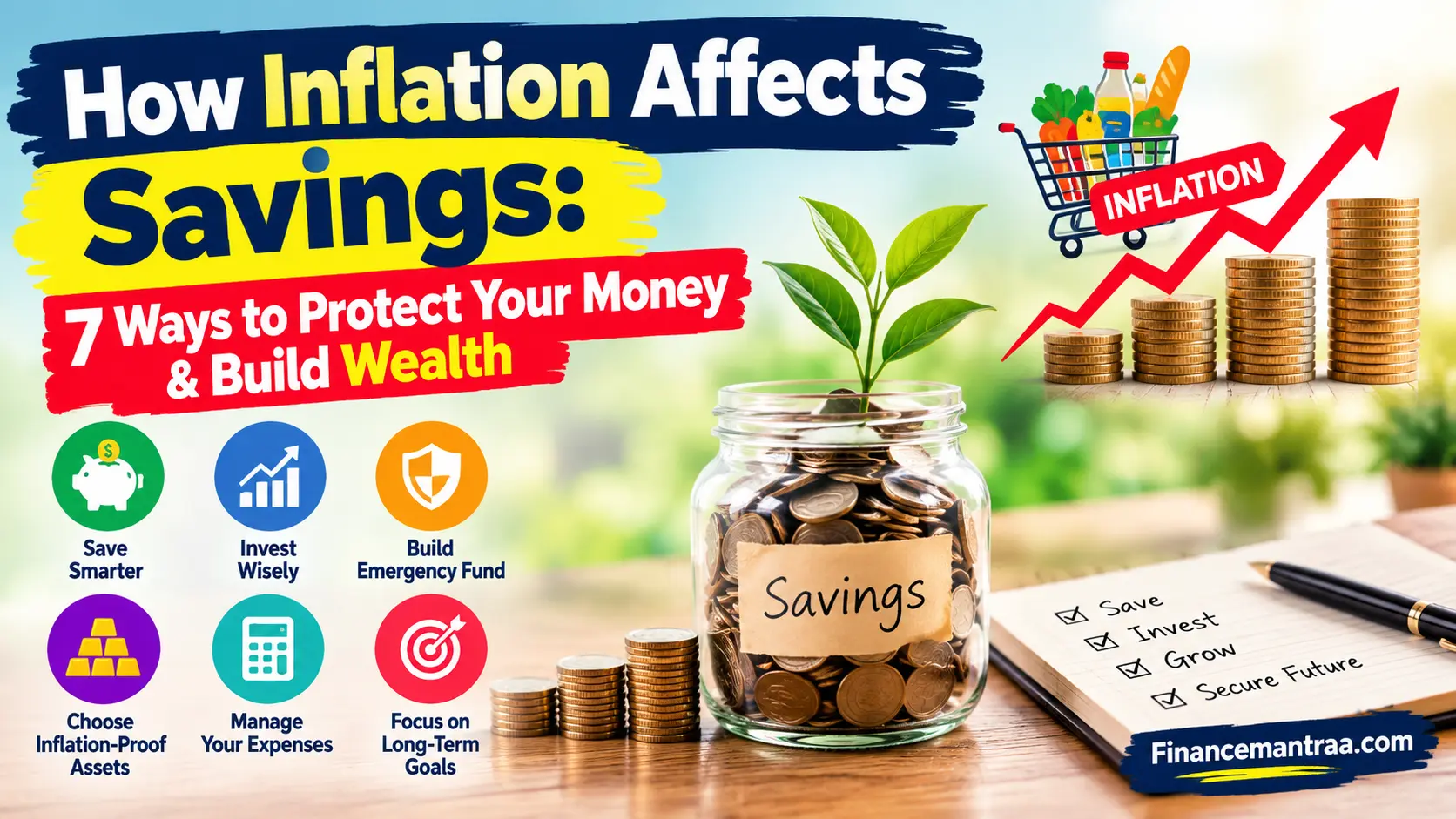
Friends, let’s talk about something that quietly eats your money every single day. I am talking about inflation. Most of us keep our hard-earned cash safe in a bank account and feel happy about it. But here is the truth: how inflation affects savings is something everyone must understand, because the money sitting in your account today will not buy the same things tomorrow.
I remember a few years back, I had saved up a decent amount for a new laptop. I waited for almost a year, thinking I would save a little more and get a better model. When I finally went to buy it, the price had gone up so much that my “extra” savings barely covered the difference. That day I truly understood how inflation affects savings in real life, not just in textbooks.
In this article, we will break down exactly how inflation affects savings, why your money loses value over time, and I will share 7 simple ways to protect your money and even build real wealth. Let’s get into it.
Highlight key
- Inflation reduces the real value of the money you save, even if the number in your account stays the same.
- Fixed deposits and regular savings accounts often fail to beat inflation.
- Diversifying into stocks, mutual funds, and gold can help protect your wealth.
- Understanding real return (return minus inflation) is key to smart financial planning.
- Small daily habits, like tracking expenses and investing early, make a huge difference over the long term.
What Is Inflation and Why Should You Care?
In simple words, inflation means prices go up over time. The same packet of rice, the same litre of petrol, the same haircut- all of these cost more this year than they did five years ago. Now, here is the connection to your wallet: when prices rise, the value of your money falls. This is exactly how inflation affects savings, quietly and steadily.
Tell me the truth: have you ever felt like your salary increases every year, but somehow you still feel short on money? That is inflation working in the background. If your income grows by 5% but prices grow by 7%, you are actually losing purchasing power, even though your bank balance looks bigger.
In my experience, most people ignore inflation because it does not feel urgent. It is not like a big loss that hits you in one day. It is slow, almost invisible, like a slow leak in a tyre. You do not notice it until one day your tyre is flat, or in this case, until your savings cannot buy what they used to.
This is why understanding how inflation affects savings is not just some finance lesson. It is something that touches every single goal you have, your child’s education, your retirement, your dream home, and even your next vacation.
How Inflation Affects Savings Directly
Let’s get specific now. How inflation affects savings comes down to one simple idea: real return. Real return is what you actually earn after subtracting inflation from your interest rate.
Say your savings account gives you 3.5% interest per year. Sounds fine, right? But if inflation is running at 6%, your real return is actually negative 2.5%. That means your money, in terms of what it can buy, is shrinking every year, even though the number on your bank statement is going up.
Here are a few common ways inflation affects savings in everyday life:
- Money kept in a regular savings account loses value because bank interest rates are usually lower than inflation.
- Fixed deposits (FDs) may look safe, but after tax and inflation, the actual gain is often very small or even negative.
- Cash kept at home loses value the fastest since it earns zero interest at all.
- Long-term goals, like retirement, get pushed further away because the target amount needed keeps increasing.
If you think as I do, this should feel a little uncomfortable. And it should, because comfort with old habits is exactly what allows inflation to quietly damage our wealth. However, the good part is that once you see this pattern clearly, you can start making small corrections that add up over time, and that is exactly what we will cover next.
Inflation and Fixed Deposits: A Closer Look
Many Indian families trust fixed deposits like a religion. And honestly, FDs are not bad; they give safety and guaranteed returns. However, when we talk about inflation and fixed deposits, the numbers often fall short of expectations.
Let’s say you put money in an FD earning 6.5% per year. After tax deduction (say you are in the 20% slab), your actual return drops to around 5.2%. Now if inflation is at 6%, your real return becomes negative. In simple words, your money grew in numbers, but shrank in actual value.
This does not mean you should avoid FDs completely. They are useful for short-term goals and emergency funds, and they still have a place in a balanced portfolio. But relying only on FDs for long-term wealth building is a mistake many people make, and it directly connects to how inflation affects savings over decades.
I have seen this happen with my own relatives. My uncle kept almost his entire retirement fund in FDs for over fifteen years. On paper, the amount doubled. But when he actually went to use that money for a family wedding, he was shocked at how little it actually covered compared to what he had originally planned for. The number grew, but the buying power did not grow nearly as much. This is a perfect real-life lesson in inflation and bank savings, and why FDs alone are rarely enough.
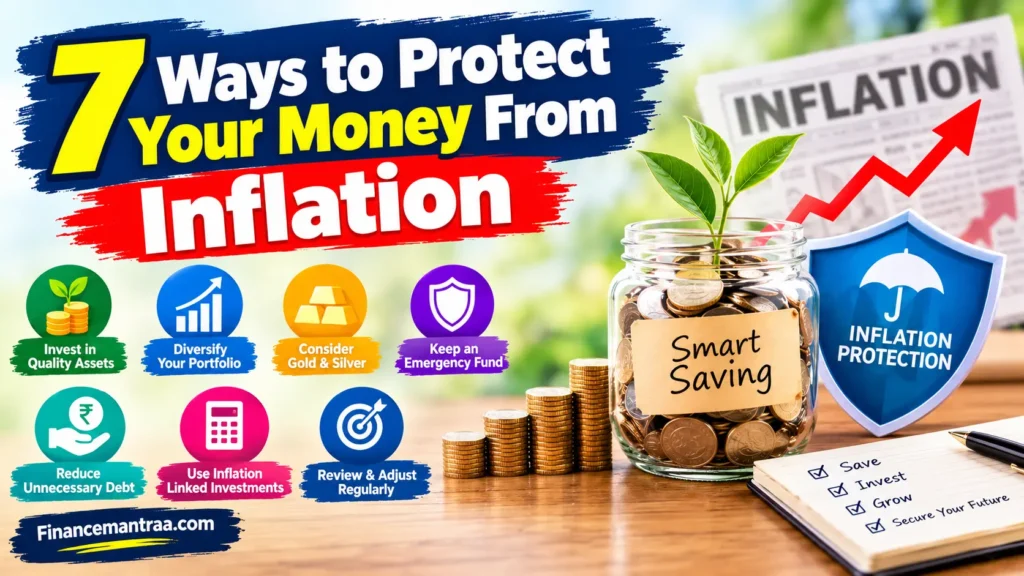
7 Ways to Protect Your Money From Inflation
Now, let’s talk about solutions. Here are 7 practical ways to protect your money and beat how inflation affects savings.
1. Invest in Equity Mutual Funds
Historically, equity markets have given returns that beat inflation over the long term. A simple SIP (Systematic Investment Plan) in a good mutual fund, started early, can grow much faster than inflation eats into your savings. However, remember, equity comes with market risk, so this works best for long-term goals of 5 years or more.
2. Diversify Into Gold
Gold has always been seen as a hedge against inflation in India. When prices rise, gold often holds or increases its value. You do not need to buy physical gold only; options like Sovereign Gold Bonds or Gold ETFs are safer and more convenient.
3. Consider Real Estate Carefully
Real estate can protect against inflation because property prices and rents generally rise along with the cost of living. However, this needs a large investment and is not very liquid, so only consider it if you have surplus funds and a long time horizon.
4. Use the Power of Compounding Early
Now let’s talk about time, your biggest friend. The earlier you start investing, the more compounding works in your favour. Even small monthly amounts, if started early, can grow into a big number that comfortably beats inflation.
5. Track and Reduce Unnecessary Expenses
This one is simple but powerful. If you save more each month, you have more money working for you. Cut down on subscriptions you don’t use, impulse purchases, and unnecessary loans. Every rupee saved and invested wisely fights back against how inflation affects savings.
6. Avoid Keeping Too Much Cash Idle
Keeping a large amount of cash at home or in a zero-interest account is one of the worst habits. Keep only what you need for emergencies (usually 3 to 6 months of expenses), and put the rest to work in better options.
7. Review and Rebalance Your Portfolio Yearly
Inflation rates change, interest rates change, and your life goals change too. Therefore, review your investments at least once a year. Move money between equity, debt, and gold based on your current needs and the inflation trend.
Inflation and Personal Finance: Building the Right Mindset
Understanding how inflation affects savings is only half the battle. The other half is building the right mindset around money and personal finance in general. In my experience, people who succeed financially are not always the ones who earn the most; they are the ones who understand where their money goes and make it work harder for them.
If something is good, I will say it clearly, SIPs in equity mutual funds are genuinely one of the best tools for regular people to beat inflation over time. If something is bad, I will say that too, keeping all your savings in a regular bank account for 10, 15, or 20 years, with no other investment, is simply not a smart move in today’s economy.
Now let’s talk about goals for a moment. Whether it is your child’s higher education, a comfortable retirement, or even a simple family vacation, every financial goal has a future cost that is higher than its present cost, purely because of rising prices. This is why long-term wealth building always has to factor in inflation, not just the amount you think you need today. If you calculate your retirement number based on today’s expenses without adjusting for inflation, you will likely fall short by a huge margin twenty or thirty years down the line.
Friends, financial planning is not about being perfect. It is about being consistent and aware. Once you understand how inflation affects savings, you naturally start making better choices, small changes that add up to big results over the years. Even simple steps, like automating your investments so you never miss a month, can make a noticeable difference over a decade or two.
Final Thoughts
So, to wrap it up, inflation is not some scary economic term reserved for news channels. It is a real force that touches your daily life, your savings account, your fixed deposits, and your long-term goals. We have seen exactly how inflation affects savings, through reduced purchasing power, low real returns, and the slow shrinking of idle cash.
But the good news is, you now have 7 practical tools in your hands, equity investments, gold, real estate, early compounding, expense tracking, avoiding idle cash, and yearly portfolio reviews. Use them wisely, stay consistent, and your money will not just survive inflation; it will grow ahead of it.
Tell me the truth: how many of these steps are you already following, and how many can you start this month? You do not need to fix everything overnight. Just pick one habit from this list and start today. Over the years, that one small decision can protect your savings and quietly build the kind of wealth that inflation can never take away from you.
FAQ's
How does inflation affect savings accounts specifically?
Inflation reduces the real value of money in savings accounts because bank interest rates are usually lower than inflation, so your purchasing power slowly decreases over time despite growing balances.
Can fixed deposits protect my money from inflation?
Fixed deposits offer safety but often fail to beat inflation after tax deductions, meaning your real return can turn negative, so they work best for short-term goals only.
What is the best way to beat inflation with investments?
Equity mutual funds, gold, and real estate historically outperform inflation over the long term, especially when combined with early investing and consistent yearly portfolio rebalancing habits.
How much money should I keep as cash during high inflation?
Keep only 3 to 6 months of expenses as an emergency fund, and invest the remaining surplus in inflation-beating options like mutual funds or gold instruments.
Why does my salary increase but I still feel financially behind?
This happens because inflation often rises faster than salary increments, silently reducing your real purchasing power even though your income number looks bigger each year.
How can beginners start protecting savings from inflation today?
Start small with SIPs in mutual funds, track monthly expenses, avoid idle cash, and gradually diversify into gold or equity for steady inflation-beating growth.