
Buddy, if you have been tracking the forex market or you are an NRI who was planning to park some dollars in an Indian bank, I have some news that will matter to you. The RBI FCNR(B) Closure has caught almost everyone off guard, and honestly, it caught me a little off guard too.
Just about a week before this happened, RBI Governor Sanjay Malhotra himself said there was no plan to shut the window early. Then, out of nowhere, the RBI announced it was closing the swap facility one full month ahead of schedule. Tell me the truth, doesn’t that sound a bit confusing at first?
In my experience covering RBI announcements for a while now, I have learned that when the central bank changes its stance this fast, there is always a real number-driven reason behind it. So in this article, we will break down the RBI FCNR(B) Closure in the simplest way possible, what Governor Malhotra actually said, why he called it “policy calibration,” and what it means for you.
In This Article
ToggleQuick Highlights
- RBI closed the FCNR(B) Swap Window on August 31, 2026, a full month before the original September 30, 2026 deadline
- Banks can still complete swaps with RBI until September 11, 2026 for deposits already booked.
- Total inflows crossed $56.85 billion as of August 13, with $52.3 billion coming from FCNR(B) deposits alone.
- Governor Sanjay Malhotra had ruled out early closure just 9 days earlier, on August 5
- India’s forex reserves crossed the $700 billion mark, helped directly by this scheme.
- The ECB and OFCB part of the scheme continues as before, till December 31, 2026
What Is FCNR(B) and Why Did RBI Open This Window in the First Place?
Let’s start from the basics, because not everyone tracks banking jargon daily, and that is completely fine.
FCNR(B) stands for Foreign Currency Non-Resident (Bank) deposit. It is basically a fixed deposit that NRIs can open in foreign currency, like US dollars, in Indian banks. The good part for depositors is that this deposit does not carry exchange rate risk, since it stays in foreign currency itself.
Back in June 2026, the RBI opened a special concessional swap window under the RBI FCNR(B) Scheme. In simple words, RBI told banks, “Bring in fresh FCNR(B) dollar deposits, and we will swap those dollars with you at a cheap, RBI-subsidised cost.” This allowed banks to offer NRIs attractive interest rates without banks bearing the full hedging cost themselves.
Why did RBI do this? Because the rupee needed support. When more dollars come into the country, the rupee gets stronger, and forex reserves go up. This is not a new trick either. RBI used something similar back in 2013 during the taper tantrum crisis, and that time it collected around $34 billion in three months.
This time, the numbers went way beyond that old record, and that is exactly where our story on the RBI FCNR(B) Closure begins.
Timeline: How the RBI FCNR(B) Closure Actually Happened
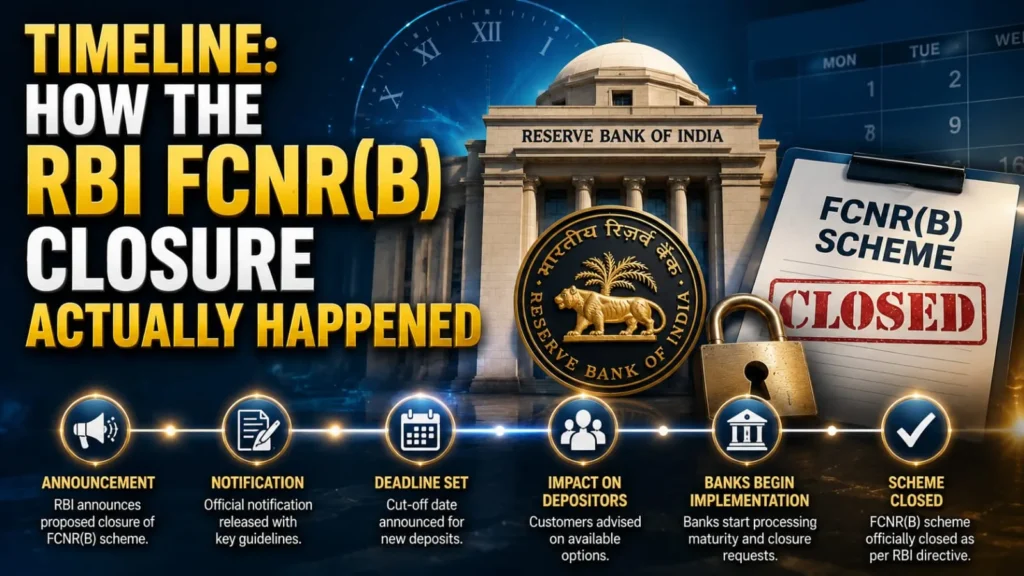
Now let’s talk about how things unfolded, because the timeline itself tells you a lot.
- June 5, 2026: RBI announced the swap window scheme
- June 8, 2026: The scheme became operational for banks
- August 5, 2026: During the post-monetary policy press conference, Governor Malhotra clearly said, “As of now, there is no proposal under consideration to close the scheme prematurely”
- August 13, 2026: Total inflows under the facility touched $56.85 billion, way above expectations
- August 14-15, 2026: RBI officially announced early closure, moving the deadline from September 30 to August 31, 2026
If you think as I do, this jump from “no early closure planned” to “we are closing it early” within just about a week or so is what makes this such a talked-about story in the personal finance and banking space right now.
What Did Sanjay Malhotra Really Say About the FCNR(B) Closure?
This is the part everyone wants to know. Did the Governor go back on his own word?
Not exactly, and here is why. On August 5, Malhotra expressed confidence, saying that we have a strong flow going. We hope that this positive trend will continue in the coming time. But there is no proposal under consideration to close the scheme prematurely. That statement was accurate for that moment, based on the data RBI had at that time.
However, in the following days, inflows nearly doubled. Banks mobilised deposits far faster than RBI had originally projected. So when the RBI eventually announced the FCNR(B) Window Closure, it was framed not as a policy failure or a broken promise, but as a natural response to changed ground realities.
RBI officials and market economists have described this move as a policy calibration rather than a reversal. In simple English, calibration means adjusting your plan as new information comes in, not admitting you were wrong from the start.
Why "Policy Calibration" and Not a Sudden U-Turn?
Buddy, this is where I want to be completely honest with you, because I don’t want to sugarcoat things.
Yes, technically the RBI did change its position within roughly nine days. That part is true and cannot be denied. But if you look at the actual reasoning, it does make practical sense:
- Faster than expected inflows: Deposits jumped from around $41 billion by the end of July to over $52 billion by mid-August. That is a massive jump in just two weeks.
- Rising liquidity costs: RBI bears the full hedging cost under this concessional scheme. More dollars coming in means RBI’s own cost burden keeps growing.
- Balance-sheet considerations: Once RBI feels it has raised enough foreign currency to meet its requirements, there is little benefit in keeping the tap open longer.
- Not a currency outlook shift: Market analysts, including those at Commerzbank, have pointed out that this decision looks more like a cost-benefit recalibration than a bold new signal about where RBI thinks the rupee is headed.
Now let’s talk about whether this is good or bad. Honestly, from a macroeconomic angle, this is good news. It shows the scheme worked better than expected. But if I am being fair, from a communication standpoint, RBI could have been a little more cautious with its August 5 statement, since markets don’t love sudden shifts, even when the reasoning is sound.
What Happens to Deposits Already Made Under the FCNR(B) Scheme?
If you or someone in your family already opened an FCNR(B) deposit under this scheme before August 31, 2026, here is the good news for you.
- Your deposit terms, interest rate, and tenor remain completely unchanged.
- The one-year lock-in condition that applied throughout the scheme still applies.
- Banks can complete their swap transactions with RBI for these deposits until September 11, 2026
So, tell me the truth: this is actually reassuring for anyone who already invested. Nothing about your existing deposit gets disturbed because of the RBI FCNR(B) Closure announcement.
How Does This RBI FCNR(B) Policy Move Affect the Rupee and Forex Reserves?
Here is where things get genuinely interesting for anyone tracking the broader economy.
Thanks to this scheme, India’s forex reserves rose sharply, crossing the $700 billion milestone, with a single-week jump of over $14 billion in early August, the biggest weekly gain since January this year. That is a strong cushion for the Indian economy against global shocks.
At the same time, the rupee has largely traded in a stable band, and the RBI has repeatedly said its job is not to defend a specific exchange rate level, only to prevent excessive volatility or speculative pressure. In my experience watching these announcements, this kind of language usually means RBI is comfortable with where things stand right now.
One side effect worth mentioning, honestly, the early closure of the swap window also reduces one important source of rupee liquidity and demand for government bonds going forward. This is something bond market participants are watching closely.
What Does This Mean for NRIs and Common Investors Right Now?
If you are an NRI who was still planning to open an FCNR(B) deposit under this concessional scheme, here is your action point.
- The window for fresh FCNR(B) deposits under this scheme closed on August 31, 2026
- After this date, banks will still offer FCNR(B) deposits, but likely at regular commercial rates, not the earlier RBI-subsidised concessional rates.
- The ECB and OFCB borrowing route under this scheme continues till December 31, 2026, so that part is unaffected.
If you missed the deadline, don’t worry too much, buddy. FCNR(B) as a deposit product itself is not going away. Only this particular subsidised, high-rate window has closed early.
My Honest Take on the RBI FCNR(B) Closure
If you think as I do, you probably want a straight answer instead of just facts, so here it is.
I genuinely believe RBI made the right call here. Once a scheme collects 50 percent more money than a similar scheme did back in 2013, in a shorter time frame, continuing it further would only add unnecessary cost to RBI’s own balance sheet. That is simply practical decision-making, not policy confusion.
However, I do think the timing of Malhotra’s August 5 statement could have been worded a bit more carefully, given how fast things were moving even at that point. That said, central banks work with the latest available data, and data changes fast in a global economy.
Overall, this episode shows the RBI FCNR(B) Policy was flexible enough to adapt quickly, and that, in my honest opinion, is a good sign for how India’s central bank manages sudden capital inflows.
If you ask me, the biggest lesson from the RBI FCNR(B) Closure is that policy announcements are never set in stone. They are built on the latest data, and when the data changes fast, the policy has to move fast too. That is not weakness; that is actually good governance, buddy.
Quick Recap of the RBI FCNR(B) Closure
Before we wrap up, let’s put everything together in one place, since I know these details can feel scattered.
- The RBI FCNR(B) Closure happened because inflows outpaced RBI’s own expectations.
- Governor Malhotra’s earlier comments were honest, based on data available at that point, not a false promise.
- Existing depositors have nothing to worry about; their terms remain locked in.
- The broader Indian economy benefits through stronger forex reserves and a stable rupee.
I hope this breakdown of the RBI FCNR(B) Closure helped you understand exactly what happened and why, without any confusing banking jargon getting in the way.
Disclaimer
This material is just for general understanding and educational information. It is based on publicly available RBI statements and financial news reports as of August 2026. Interest rates, scheme deadlines, and RBI policies can change without prior notice. Please check official RBI notifications or consult your bank before making any FCNR(B) deposit-related financial decision.
FAQ's
Q1. Why did RBI announce the FCNR(B) closure early?
RBI closed the FCNR(B) swap window early because inflows crossed $52 billion much faster than expected, reducing the need for RBI to keep bearing high hedging costs on the concessional scheme.
Q2. What did Sanjay Malhotra say about FCNR(B) closure before it happened?
On August 5, Malhotra said there was no proposal to close the FCNR(B) scheme prematurely, based on inflow data available at that specific time.
Q3. Will my existing FCNR(B) deposit be affected by this closure?
No, deposits already booked before August 31, 2026, keep their original interest rate, tenor, and one-year lock-in condition, completely unaffected by the closure.
Q4. What is the new deadline for the FCNR(B) swap window?
The window for fresh FCNR(B) deposits closed on August 31, 2026, with banks allowed to complete RBI swaps until September 11, 2026.
Q5. Does the FCNR(B) closure affect ECB and OFCB borrowing schemes too?
No, the External Commercial Borrowings and Overseas Foreign Currency Borrowings routes under this scheme remain open until December 31, 2026, as originally planned.

My name is Subodh Kumar, and I am a finance blogger at Financemantraa.com with a strong interest in personal finance, investing, and financial research spanning 4–5 years.
I enjoy researching financial topics and explaining complex money concepts in simple, easy-to-understand language. My areas of interest include stock market basics, IPOs, mutual funds, financial planning, insurance, saving strategies, and wealth building.
Through Financemantraa.com, I aim to help readers improve their financial knowledge, understand investment concepts, and make informed financial decisions. I focus on creating practical, beginner-friendly guides that make personal finance easier to understand and apply in everyday life.
I believe that financial education and smart money habits can help people work toward long-term financial stability. My goal is to make reliable, accessible, and informative financial content available to everyone.
Disclaimer: The information published on Financemantraa.com is for educational and informational purposes only. It should not be considered professional financial or investment advice.