
Friends, have you ever heard the term ‘Hormuz Strait’ in the news and wondered why there’s so much fuss about it? I remember the first time I heard about it; I was sitting with my dad, who works in the shipping business, and he was sitting in front of the TV checking oil prices every hour while watching the news.
I asked him, ‘Why are you so stressed over such a small waterway?’ And he laughed and said, ‘Son, this small strait can shake the entire world’s economy.’ That day, I decided I would learn more about it in depth, and today I want to explain the Strait of Hormuz to you in the simplest way, like I’m talking to a friend.
The Strait of Hormuz is not just a name on a map. It is one of the busiest and most important water routes on our planet. If you drive a car, cook food on gas, or even buy things online, this narrow channel affects your life in ways you may not realize. Let’s talk about it in easy words, no heavy jargon, no confusion, just plain and honest information.
In This Article
ToggleHighlight key
The Strait of Hormuz is a narrow sea passage between Iran and Oman.
Around 20 million barrels of oil pass through it every single day, in normal times.
It connects the Persian Gulf to open oceans, making it the world’s most important oil chokepoint.
Nearly one-fifth of the world’s oil and a big chunk of natural gas trade depend on this route.
India, China, Japan, and many other Asian countries get most of their oil through the Strait of Hormuz.
Since early 2026, the strait has faced repeated closures and attacks due to conflict, causing oil prices to jump sharply.
If it shuts down completely, prices of petrol, diesel, cooking gas, and even daily goods can rise fast in India.
What is the importance of the Strait of Hormuz, and why is it always in the news?
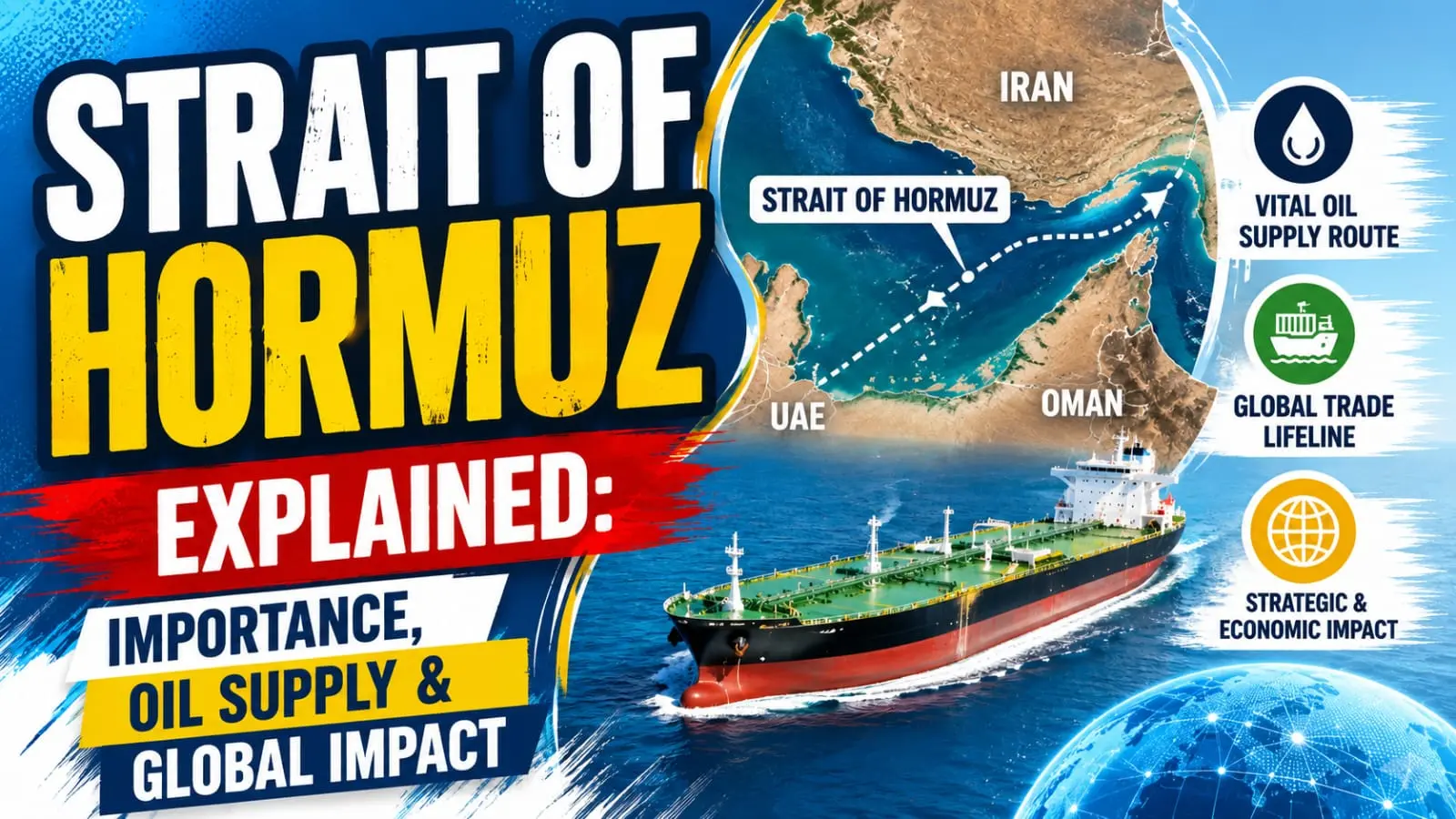
So tell me the truth: before reading this, did you even know where this strait is located? Don’t worry, many people don’t. The Strait of Hormuz is a narrow sea channel that sits between Iran on one side and Oman and the United Arab Emirates on the other side. It connects the Persian Gulf with the Gulf of Oman, and from there, ships move into the wider Arabian Sea and the world’s oceans.
Now here is the interesting part. This channel is only about 21 miles wide at its narrowest point. Just imagine that. A passage so small, yet it carries such a huge share of the world’s energy supply. In my experience, whenever I explain this to friends, they are shocked that something so narrow can control something so big.
The Strait of Hormuz is important because countries like Saudi Arabia, Iraq, Iran, Kuwait, Qatar, and the UAE all send their oil ships through this one route. There is simply no other easy way for most of them to reach the open sea with their oil. This makes the Strait of Hormuz a critical lifeline for global trade, and any trouble here directly hits fuel prices worldwide.
Strait of Hormuz Location and Map
If you look at a map, you will see the Strait of Hormuz sitting right at the mouth of the Persian Gulf. On the north side is Iran, and on the south side you have Oman’s Musandam peninsula, with the UAE close by. The channel is shaped like a funnel, wide on both ends but pinched in the middle.
This location gives Iran a lot of control, since a big part of the strait’s shipping lane runs close to Iranian waters. That is one reason why, whenever there is tension between Iran and other countries, the Strait of Hormuz location becomes the center of attention in global news.
For a normal person like you and me, understanding the Strait of Hormuz map is simple. Just picture the Persian Gulf as a bottle full of oil, and the Strait of Hormuz is the narrow neck of that bottle. If the neck gets blocked, nothing can come out, no matter how full the bottle is.
Strait of Hormuz Oil Supply and Oil Exports
Now let’s talk numbers, but in a simple way, no confusing stuff. In normal times, close to 20 million barrels of oil pass through the Strait of Hormuz every single day. That is roughly one fifth of all the oil the whole world uses daily. Around a quarter of the world’s seaborne oil trade also moves through this one route.
It is not just crude oil either. A large share of the world’s liquefied natural gas, especially from Qatar, also travels through the Strait of Hormuz. There are almost no other routes available for this gas, since pipelines cannot easily replace sea transport for LNG.
Honestly speaking, if you think as I do, this concentration of oil and gas supply through just one narrow channel feels risky. Countries have tried building alternate pipelines through Saudi Arabia and the UAE to bypass the strait, but these pipelines can only carry a small part of the total flow. So the Strait of Hormuz oil supply remains the backbone of global energy trade, whether we like the risk or not.
Strait of Hormuz Shipping Route and Global Trade
The Strait of Hormuz shipping route is not just about oil tankers. Container ships, gas carriers, and cargo vessels also use this passage daily. It links producer countries in the Gulf with buyers across Asia, Europe, and beyond.
In a normal week, dozens of ships cross this strait every single day. When things are calm, this movement barely makes news. But the moment there is any tension, insurance companies raise their rates for ships sailing through this area, shipping companies get nervous, and some vessels choose longer, safer routes instead. This directly affects the Strait of Hormuz global trade flow and pushes up the cost of transporting goods, not just oil.
Think of it like a single-lane bridge connecting two busy cities. When the bridge works fine, traffic flows smoothly. But even a small accident on that bridge creates a traffic jam that affects everyone on both sides. That is exactly how the Strait of Hormuz behaves for world trade.
Strait of Hormuz Strategic Importance in the Middle East
Friends, this is where things get political. The Strait of Hormuz’s strategic importance goes far beyond oil. It sits right next to Iran, one of the most watched countries in world politics. Iran has repeatedly said that if it is attacked or restricted, it can close the strait to ships from countries it considers unfriendly.
This is not just talk. In recent times, Iran has actually taken steps to restrict traffic through the Strait of Hormuz, and other countries, including the United States, have responded with military action to keep the passage open. This tug of war between control and freedom of navigation is why the Strait of Hormuz Iran connection is always in the headlines whenever tension rises in the Middle East.
For the Gulf countries, keeping this passage open is a matter of survival for their economies. For Iran, controlling parts of it gives leverage in bigger political and military disputes. This mix of oil, power, and military pressure is what makes the Strait of Hormuz Middle East story so complicated.
Strait of Hormuz Crisis and Closure in 2026
Now here comes the part that is honestly a bit scary. Since late February 2026, the Strait of Hormuz has gone through repeated periods of crisis. Iran restricted normal shipping through the strait after conflict broke out with the United States and Israel, and for weeks, tanker traffic through the passage dropped sharply below normal levels.
There was a short window in mid-2026 when a temporary agreement allowed ships to move again, but this arrangement broke down after attacks on commercial vessels continued. As of August 2026, the Strait of Hormuz remains effectively closed to routine commercial shipping, with only a handful of vessels crossing each day compared to the usual heavy daily traffic. Naval escorts and alternate routes near Oman’s coastline are being used by some ships, but overall flow remains far below normal.
Because of this ongoing Strait of Hormuz closure, oil prices have climbed noticeably in 2026, and traders are watching every diplomatic move between the US, Iran, and Gulf nations closely. In my experience following energy news, this kind of prolonged disruption is rare, and it shows just how fragile global oil supply chains really are.
What Happens If the Strait of Hormuz Is Closed Completely?
If the Strait of Hormuz shuts down fully for an extended period, the effects would be huge. Oil supply would drop sharply since alternate pipelines can only carry a small fraction of the total flow. This would push crude oil prices up fast, and higher crude prices mean costlier petrol, diesel, and cooking gas almost everywhere.
Shipping insurance costs would rise, and many companies would choose longer routes around Africa instead, adding weeks to delivery times and raising costs for everything from electronics to clothes. Countries that depend heavily on Gulf oil, like India, Japan, South Korea, and China, would feel the pinch the most.
Governments would likely release oil from their emergency reserves to soften the blow, but honestly, that can only help for a limited time. A long closure would be genuinely bad news for the world economy, and that is not an exaggeration.
Strait of Hormuz Impact on India and the Indian Economy
Now let’s bring this closer to home. Why should someone sitting in Delhi or Mumbai care about a strait near Iran? Simple: because India imports a huge share of its crude oil from the Gulf region, and most of it travels through the Strait of Hormuz.
When the Strait of Hormuz faces disruption, India’s import bill goes up immediately. This puts pressure on the rupee, since India has to spend more dollars buying the same amount of oil. Higher oil prices also mean higher transport costs, which slowly push up prices of vegetables, groceries, and daily goods too.
In my own experience, I noticed petrol prices rising in my city right after news of tension in the strait, even before any official announcement. That is how sensitive the market is. For the common Indian household, the Strait of Hormuz’s impact on India is real, even if the place feels far away on a map. If you think as I do, this is one more reason why India has been working on diversifying its oil sources and building bigger reserves.
Countries Most Affected by Strait of Hormuz Closure
Some countries feel the heat more than others. Gulf nations like Saudi Arabia, Iraq, Iran, Kuwait, Qatar, and the UAE lose massive export revenue when the strait is disrupted, since they depend heavily on this one route. Asian importers such as India, China, Japan, and South Korea face rising fuel costs and pressure on their currencies.
Even countries far from the Gulf are not fully safe, since global oil prices affect everyone once they rise. Smaller economies without big oil reserves usually suffer the most, since they cannot absorb sudden price shocks easily. This is why global institutions closely track every development in the Strait of Hormuz crisis, because the ripple effects genuinely spread worldwide.
My Honest Take on the Strait of Hormuz Situation
I will be honest with you here, dost. The Strait of Hormuz situation in 2026 is genuinely serious, not just media drama. Prolonged tension in this narrow passage has already pushed oil prices higher and created real uncertainty for businesses and everyday families. At the same time, I do think the world has learned to respond faster than before, with reserve releases and alternate routes softening some of the shock.
However, there is no permanent fix without long-term diplomatic solutions between Iran and the countries involved. Until that happens, the Strait of Hormuz will keep popping up in the news, and oil prices will keep reacting to every little development. If something is bad, I will call it bad, and right now, this ongoing disruption is genuinely bad for global stability.
Disclaimer
This article is written for general information and educational purposes only. Oil markets and geopolitical situations, especially around the Strait of Hormuz, change quickly. Please check the latest news and official sources before making any financial, business, or travel decisions based on this topic.
FAQ's
Q1. What is the Strait of Hormuz and why is it important?
It is a narrow sea passage between Iran and Oman that carries about one-fifth of the world’s oil supply daily, making it a critical global energy chokepoint.
Q2. Where is the Strait of Hormuz located?
It sits between Iran to the north and Oman and the UAE to the south, connecting the Persian Gulf to the Gulf of Oman and the open seas.
Q3. Why is the Strait of Hormuz important for global oil supply?
Nearly all Gulf oil producers rely on this one route to export crude, since alternate pipelines can carry only a small fraction of total flow.
Q4. What happens if the Strait of Hormuz is closed?
Oil prices rise sharply, shipping costs increase, and countries dependent on Gulf oil, like India, face higher fuel and import bills quickly.
Q5. How does the Strait of Hormuz affect India?
India imports most Gulf crude through this route, so any disruption raises India’s oil import bill, weakens the rupee, and pushes up fuel prices.
Q6. How much oil passes through the Strait of Hormuz normally?
Around 20 million barrels of oil move through the strait daily in normal conditions, roughly a quarter of the world’s seaborne oil trade.

My name is Subodh Kumar, and I am a finance blogger at Financemantraa.com with a strong interest in personal finance, investing, and financial research spanning 4–5 years.
I enjoy researching financial topics and explaining complex money concepts in simple, easy-to-understand language. My areas of interest include stock market basics, IPOs, mutual funds, financial planning, insurance, saving strategies, and wealth building.
Through Financemantraa.com, I aim to help readers improve their financial knowledge, understand investment concepts, and make informed financial decisions. I focus on creating practical, beginner-friendly guides that make personal finance easier to understand and apply in everyday life.
I believe that financial education and smart money habits can help people work toward long-term financial stability. My goal is to make reliable, accessible, and informative financial content available to everyone.
Disclaimer: The information published on Financemantraa.com is for educational and informational purposes only. It should not be considered professional financial or investment advice.