
So, my friend, let’s talk about something that’s currently making quite a buzz in the world of money. Berkshire Hathaway vs S&P 500 2026 has become a hot topic among every investor this year. And honestly, if you hold Berkshire shares, you’re probably a bit worried too, right?
I remember checking my small investment portfolio back in April this year, and I noticed something strange. My index fund was soaring high, but my Berkshire shares were just sitting there, barely moving. At first, I thought maybe it was some glitch in my app. But no, it was real. Berkshire just wasn’t keeping up with me.
In this article, we’ll see why this is happening, what the numbers say, and whether you should still trust Warren Buffett’s old company in 2026. No hype, no fake positivity, just the honest facts for you to see.
Highlight key
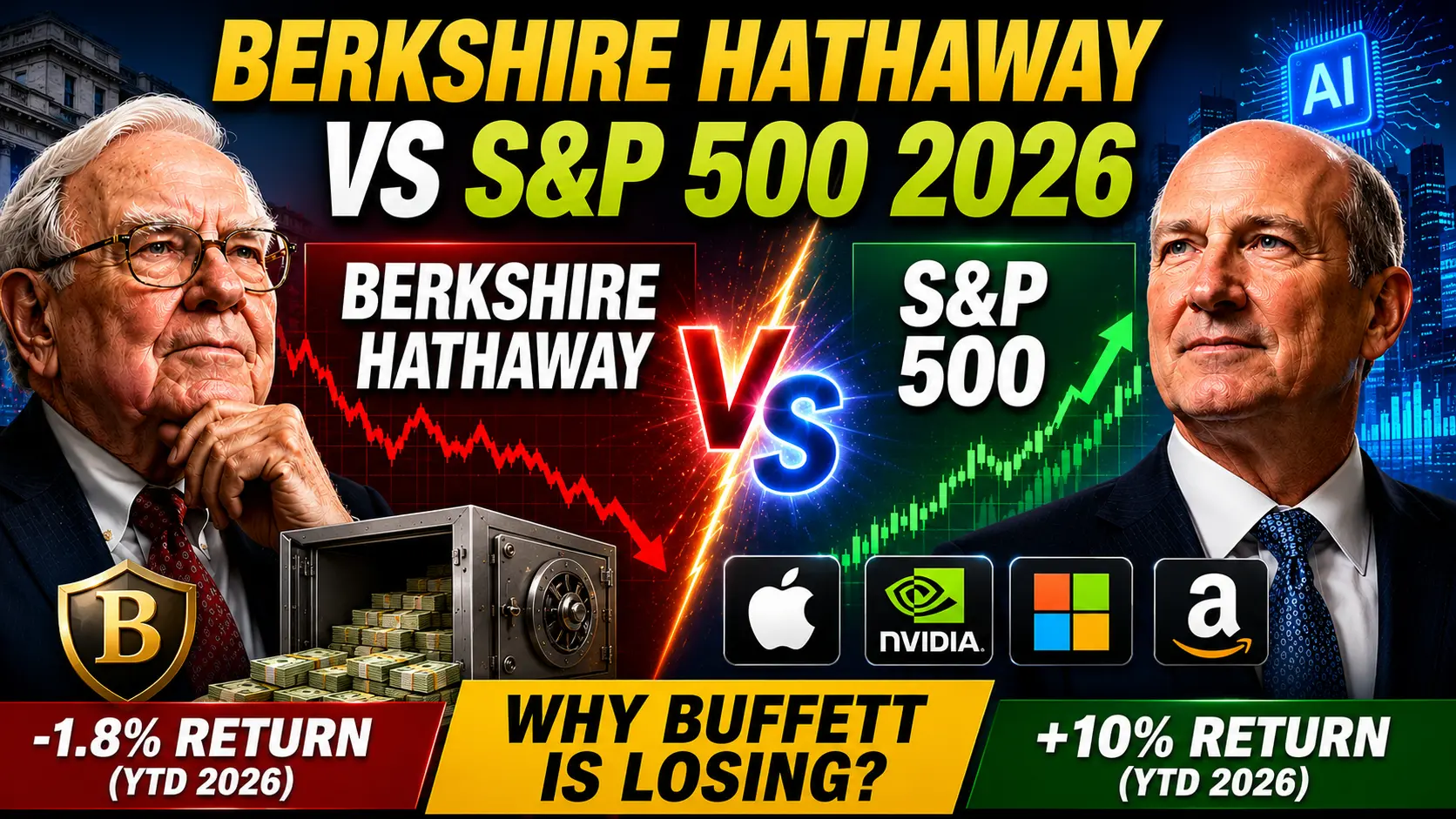
- Berkshire Hathaway is down about 1.8% year-to-date, while the S&P 500 is up over 10% in 2026.
- The gap between the two is now more than 12 percentage points, one of the biggest gaps in years.
- Warren Buffett stepped back as CEO at the start of 2026, and Greg Abel is now running the company.
- Berkshire is sitting on almost $400 billion in cash, which some call smart and others call lazy.
- Berkshire has very little exposure to AI stocks, and that is the biggest reason it’s falling behind.
- Buybacks restarted in March 2026 after almost two years, but they are small compared to Berkshire’s cash pile.
What Is Happening With Berkshire Hathaway vs S&P 500 2026
Now let’s talk about the real numbers, because numbers don’t lie. As we hit the middle of 2026, Berkshire Hathaway’s B shares are down about 1.8% so far this year. Meanwhile, the S&P 500 has jumped over 10% in price, and if you include dividends, the gain goes over 11%. This means Berkshire is trailing the index by around 12 to 13 percentage points. That’s a huge gap, friends, especially for a company that used to be seen as the gold standard of investing.
At the start of the year, especially during March, Berkshire slightly lagged behind the S&P 500. But then April and May happened. The S&P 500 had jumped even more than a big rise in those two months because there was a lot of hype about artificial intelligence companies. But meanwhile, Berkshire’s shares tumbled. That is when the real damage happened to Berkshire Hathaway’s stock performance in 2026.
In my experience watching the market for years, I have never seen Berkshire fall this far behind for such a long stretch. Some analysts are even saying that Berkshire’s relationship with the S&P 500 as a “safe bellwether” is changing for the first time since 2007. That’s a big statement, and it tells you something is different this time.
Berkshire Hathaway Stock Performance: The Full Picture
If you think as I do, you probably want to know exactly how bad this underperformance really is. Let’s break it down simply.
- Berkshire Hathaway B shares: down around 1.8% so far in 2026
- S&P 500 index: up around 10.7% in price, and over 11% with dividends included
- Gap between the two: more than 12 percentage points
- Compared to last year, Berkshire had already underperformed the S&P by over 5 percentage points in 2025
So this isn’t a brand new problem. It has been building for a while. However, 2026 has made the gap much bigger and much more noticeable.
One thing worth mentioning here is that Berkshire did have a strong June. However, it recovered a bit from its fall and brought the gap down from 17 percentage points to around 12. So there is some fight left in the stock, but it’s still far behind the benchmark index.
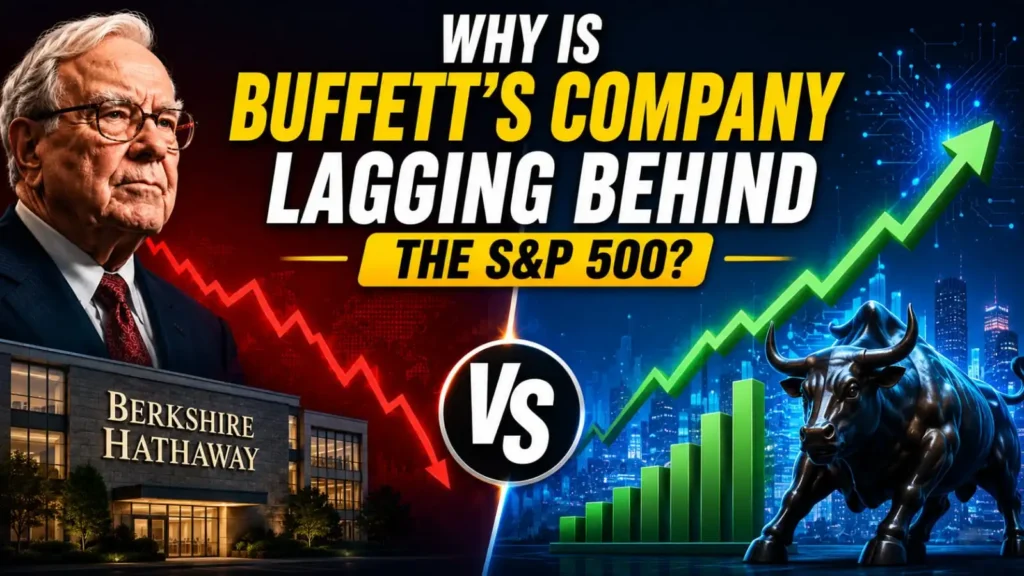
Why is Buffett's company lagging behind the S&P 500 in 2026?
This is the question that every investor wants to know the answer to. Let me explain it in plain simple words.
The AI Boom Is Leaving Berkshire Behind
The S&P 500 today is heavily driven by big tech companies working on artificial intelligence. These companies have seen massive spending and huge investor excitement, which pushed the entire index higher. Berkshire Hathaway, however, has stayed away from most of this AI rush. It has very small exposure to AI-focused companies, which means when tech stocks rally hard, Berkshire simply doesn’t move with them.
brother, this is honestly the number one reason for the gap. Right now the stock market is rewarding those companies because they are chasing the growth of AI. Berkshire is playing a completely different, slower game.
The Massive Cash Pile Is a Double-Edged Sword
Berkshire has around $400 billion stashed in cash. Now, some people see this as smart and safe, a war chest ready for the next market crash. Others see it as a wasted opportunity, money that could be earning better returns if it were invested somewhere active.
Tell me the truth, would you rather have your money sitting quietly in cash, or working hard in the market? That’s exactly the debate going on with Berkshire right now.
Leadership Change From Buffett to Abel
Warren Buffett officially stepped back from the CEO role at the start of 2026, and Greg Abel took over as the new head of Berkshire Hathaway. This is one of the biggest changes in Berkshire’s history. Naturally, investors are watching closely to see if Abel can bring the same magic that Buffett brought for decades.
So far, Abel has been cautious. Buybacks restarted in March 2026 after almost a two-year pause, but the amount has been small. Some analysts wanted a bigger, bolder move from the new CEO, and that hesitation has added to investor uncertainty around Berkshire Hathaway stock performance in 2026.
Slow and Steady Operating Businesses
Berkshire owns insurance companies like GEICO, along with railroads, energy businesses, and manufacturing units. These are steady, profitable businesses, but they are not exciting growth stories. Berkshire’s operating income hasn’t seen much of an increase, which has left it way behind in keeping up with the stock market’s pace that’s being driven by the AI boom.
Berkshire Hathaway Portfolio: What's Inside
Let’s now talk about what Berkshire actually holds, because this tells us a lot about Buffett’s investment strategy.
Berkshire’s portfolio is packed with well-known names, and one big update this year is its involvement with Alphabet. Berkshire agreed in June 2026 to buy shares worth around $10 billion directly from the company, adding to its already large tech-adjacent bets. This shows that even a conservative investor like Buffett’s team is not completely ignoring the tech space, just approaching it carefully.
Apart from that, Berkshire continues to hold major stakes across banking, consumer goods, and energy companies. The portfolio reflects a value investing philosophy, buying solid businesses at fair prices and holding them for years, sometimes decades.
However, friends, this same philosophy is what’s slowing Berkshire down right now. Value investing works beautifully during shaky or falling markets. But during a strong bull run driven by growth stocks, it tends to lag behind.
Should You Invest In Berkshire Hathaway In 2026?
Now comes the big question. Should you put your money into Berkshire Hathaway right now?
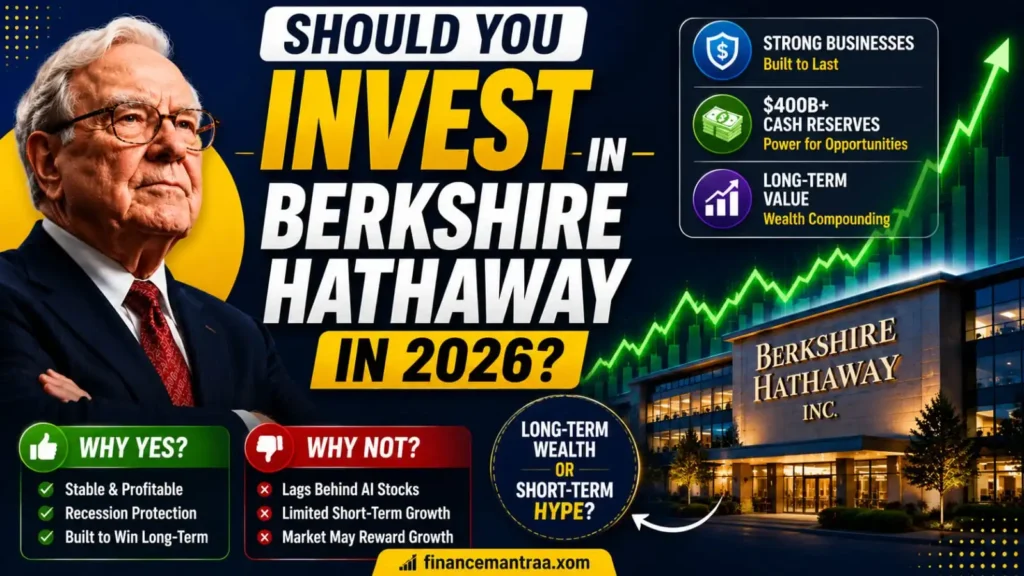
Honestly, here is my take. If you are someone chasing quick gains this year, Berkshire is probably not your best pick. The S&P 500 index has clearly outperformed it in 2026, and chasing short-term wins with Berkshire could leave you disappointed.
But if you are a long-term investor, someone thinking ten or twenty years ahead, Berkshire still has a strong case. Here’s why:
- It has nearly $400 billion in cash ready to deploy during a market crash.
- It performed extremely well during past downturns, like the dot-com bust, when it actually gained value while the broader market fell sharply.
- Its businesses are stable and profitable, even if not flashy.
- Analysts still have a moderate buy rating on the stock, with a price target suggesting some upside from current levels.
So it really depends on what kind of investor you are. Tell me the truth: are you looking for quick excitement, or are you building wealth slowly and safely? Your answer decides whether Berkshire fits your goals.
Berkshire Hathaway vs Index Funds 2026: Which Is Smarter?
This is another common question people ask me. Should you just put your money in an index fund tracking the S&P 500 instead of picking individual stocks like Berkshire?
In 2026, index funds are clearly winning on pure returns. They are giving you broad exposure to the exact companies driving this AI-powered rally. Berkshire, being one single company, cannot match that kind of diversified growth exposure.
However, index funds also carry more risk when the market turns. If the AI bubble cools down or tech stocks correct sharply, an index fund heavy in tech names could fall hard. Berkshire, with its diversified and cash-rich structure, has historically been more protected during such crashes.
In my experience, a mix of both isn’t a bad idea at all. Some investors are actually now considering a near-equal split between the two, treating Berkshire as a safety cushion and the index fund as the growth engine.
Berkshire Hathaway Stock Outlook For The Second Half Of 2026
Looking ahead, the second half of 2026 will likely depend on two big things. First, whether the AI-driven rally in the S&P 500 continues or slows down. Second, how new CEO Greg Abel decides to use Berkshire’s huge cash reserves.
If Abel becomes more aggressive with buybacks or makes a big acquisition, that could boost investor confidence quickly. On the other hand, if the AI rally keeps running hot, Berkshire may continue to lag behind the S&P 500 for the rest of the year.
Friends, nobody can predict the market with full certainty, and I won’t pretend to either. But based on current trends, Berkshire’s underperformance may continue in the short term, while its long-term value proposition remains intact for patient investors.
Final Thoughts
So, to put it briefly, Berkshire Hathaway vs S&P 500 in 2026 is the story of the patient investing style of the old generation versus the fast-growing opportunities of the new generation. Thanks to the strength of AI stocks, the S&P 500 has clearly left Berkshire far behind this year. But that doesn’t mean Buffett’s old way doesn’t work anymore. It just means that in this season, a different style of investing has proven to be more profitable.
If you think like me, making real wealth doesn’t mean winning every single year. The real goal is to not take huge losses when things go wrong. And that has long been Berkshire’s biggest strength.
Disclaimer
This article is written just for information and should not be taken as any kind of investment advice. Always do your own research or definitely talk to a certified financial advisor before making investment decisions.
FAQ's
Why is Berkshire Hathaway trailing the S&P 500 in 2026?
Berkshire has very little exposure to AI stocks, which are driving most of the S&P 500’s gains this year, causing a wide performance gap.
Is Berkshire Hathaway still a good long-term investment?
Yes, for patient investors. Its huge cash reserves and stable businesses make it strong during downturns, even if it lags in bull markets.
Who is the current CEO of Berkshire Hathaway?
Greg Abel took over as CEO at the start of 2026, after Warren Buffett stepped back from daily leadership duties.
Why does Berkshire Hathaway hold so much cash?
Berkshire keeps nearly $400 billion in cash as a safety cushion, ready to invest big when markets fall or opportunities appear.
Should I choose Berkshire Hathaway or an S&P 500 index fund?
It depends on your goals. Index funds offer higher growth now, while Berkshire offers more safety during market crashes.
Will Berkshire Hathaway stock recover in the second half of 2026?
It depends on AI market trends and how CEO Greg Abel uses Berkshire’s cash. Recovery is possible but not guaranteed.