

Friends, let’s talk about money today. Not in a boring way, but in a real way. If you have some cash sitting in your normal bank account doing nothing, you are missing out. I learned this the hard way a few years back. I had almost $3,000 just sitting in my checking account, earning close to zero interest. One day my cousin asked me, “Why don’t you put that in an HYSA?” I didn’t even know what that was at first. Once I learned, I felt a little silly for waiting so long. That is why I want to show you the smart ways to use an HYSA so you don’t make the same mistake I did.
An HYSA, or High Yield Savings Account, is one of the easiest tools to grow your money without any risk. You don’t need to be a stock market expert. You don’t need to time the market. You just need to know where to put your money and why. In this article, I will walk you through the smart ways to use an HYSA, in plain and simple words, like I am explaining it to a friend over coffee.
Highlight key
- An HYSA pays much more interest than a normal savings account.
- It is safe, easy to open, and usually free.
- You can use it for emergency funds, short term goals, and even bill money.
- It is not meant for long term investing like retirement.
- Choosing the right HYSA and using it the smart way can add real money to your pocket every year.
What Exactly Is an HYSA?
Before we get into the smart ways to use an HYSA, let’s make sure we are on the same page about what it actually is. A High Yield Savings Account, or HYSA, is a savings account that pays a much higher interest rate than what you get at your regular bank down the street.
Here is the simple version. A normal savings account at a big bank might pay you 0.01% interest. That is basically nothing. An High Yield Savings Account, on the other hand, might pay you 4% or 5% interest, sometimes even more depending on the market. That difference might not sound like much on paper, but once you see the real numbers, it changes how you think about saving.
Tell me the truth, would you rather earn $1 a year or $150 a year on the same amount of money? That is really the difference between a normal savings account and a high yield savings account. Most HYSAs are offered by online banks, not the big traditional banks. Because online banks don’t have to pay for fancy buildings and branches, they pass that saved money to you as higher interest. Your money is still protected too, since most HYSAs are insured, just like a regular bank account.
Smart Ways to Use an HYSA for Your Emergency Fund
If you ask me the single best use of an High Yield Savings Account, it is your emergency fund. Life throws surprises at us all the time. A car repair, a medical bill, a sudden job loss. These things happen when you least expect them, and having cash ready can save you from a lot of stress.
In my experience, keeping your emergency fund in an High Yield Savings Accountfor an emergency fund is one of the smartest ways to use an High Yield Savings Account. Why? Because your money stays easy to reach, but it also earns a good amount of interest while it just sits there waiting.
So how much money should you keep in an High Yield Savings Account for emergencies? A common rule is three to six months of your normal living expenses. If your monthly costs are $2,000, then aim for somewhere between $6,000 and $12,000. I know that sounds like a lot, and you don’t need to reach that number overnight. Start small. Even $500 in an High Yield Savings Account is better than $0 in a regular account.
The best part is that this money is not locked away. If your car breaks down tomorrow, you can pull the cash out without any penalty. That is the real magic of using an High Yield Savings Account for an emergency fund. Your money works for you quietly in the background, and it is ready the moment you need it.
Smart Ways to Use an HYSA for Short Term Savings
Now let’s talk about short term goals. Maybe you are saving for a vacation, a wedding, a new laptop, or a down payment on a car. These are things you plan to spend money on within the next one to three years. This is exactly where an HYSA shines.
Using an High Yield Savings Account for short term financial goals is smart because you don’t want to risk this money in the stock market. Stocks can go up and down, and if you need that vacation money in six months, you don’t want the market to drop right before your trip. An HYSA keeps your money safe while still growing a little bit through interest.
Here is a real life comparison. Imagine you save $5,000 for a wedding in a regular checking account for one year. You would earn maybe $1 in interest. Now imagine that same $5,000 sitting in an HYSA earning 4.5%. That is around $225 extra, just for doing nothing except picking the right account. Friends, that is basically free money.
I personally use this trick for my yearly vacation fund. Every month I move a little bit into my HYSA, and by the time vacation season comes, I have extra cash from the interest to spend on something fun, like a nice dinner or a better hotel room.
HYSA vs Regular Savings Account: Know the Real Difference
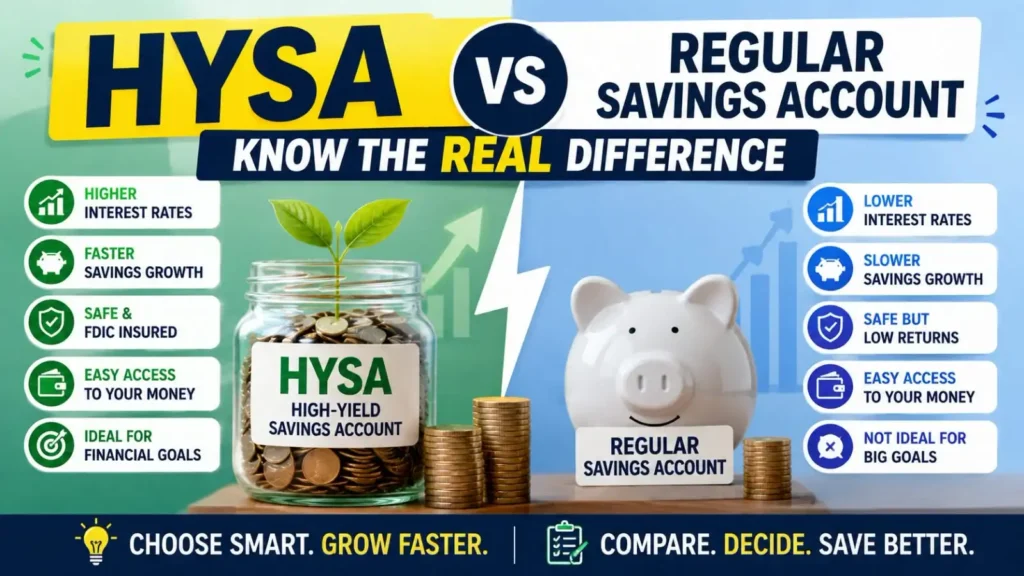
A lot of people ask me about High Yield Savings Account vs regular savings account, and honestly, once you understand the difference, you will never want to go back to a regular one.
A regular savings account, the type most people already have at their main bank, usually pays very little interest. Some banks even charge monthly fees just to keep the account open. On the other hand, most HYSAs charge no monthly fees and pay several times more interest.
However, there are a few honest downsides I need to mention, because I promised to keep it real with you. Most HYSAs are online only, so you won’t find a physical branch to walk into. If you like face to face banking, this might feel strange at first. Also, moving money between your HYSA and your main checking account can take one to three business days, since it is not always instant like a transfer between two accounts at the same bank.
If those two things don’t bother you, then an HYSA is clearly the better choice for your savings strategy. The interest rate difference alone makes it worth the small trade off.
Smart Ways to Use an HYSA to Maximize Your Interest
This next part is about how to maximize HYSA interest, which is really where the smart ways to use an HYSA start to shine. Simply opening an account is not enough. You need to use it the right way to get the most benefit.
First, shop around before you pick a bank. HYSA interest rates are not fixed across the board. Some banks offer better rates than others, and rates can change over time based on the overall economy. Don’t just open an account with the first name you see online. Compare a few options first.
Second, avoid keeping too much idle cash in your regular checking account. If you have extra money sitting there for weeks with no clear purpose, move it into your HYSA. Every day that money sits in a low interest account is a day you are losing out on extra earnings.
Third, consider using an HYSA savings strategy where you set up automatic transfers. Even $50 or $100 a month adds up over time, and the interest keeps compounding along the way. This is one of my favorite tricks because it removes the temptation to spend that money elsewhere.
Fourth, if you have a big goal, like saving for a house down payment, keeping that money in an HYSA for years, instead of a regular account, could genuinely add up to thousands of extra dollars in earned interest over time.
Smart Ways to Use an HYSA for Organizing Multiple Goals
Here is a trick that not many people talk about. You can actually open more than one HYSA, or use sub accounts, to organize your savings by goal. This is one of the more creative smart ways to use an HYSA that I discovered myself.
If you think like I do, mixing all your savings into one big pile can get confusing. Is that $8,000 your emergency fund, your vacation money, or your new car fund? When everything is combined, it is easy to accidentally spend money meant for something else.
Instead, try organizing your savings with multiple HYSAs, or using named sub accounts if your bank offers them. Label one “Emergency Fund,” another “Vacation,” and another “New Car.” This small step brings a surprising amount of clarity to your financial life. You always know exactly how much you have for each goal, and it also feels satisfying to watch each bucket grow separately.
What an HYSA Should Not Be Used For
Now, being honest with you, an HYSA is not perfect for everything. If your goal is long term growth, like saving for retirement twenty or thirty years from now, an HYSA is not the best tool. The stock market, over long periods of time, historically grows much faster than any HYSA interest rate.
Also, if you already have high interest debt, like a credit card charging you 20% interest, it usually makes more sense to pay that off first before stacking cash into an HYSA that only earns 4% or 5%. This is simple math, and no one benefits from ignoring it.
So think of an HYSA as your short term and safety net tool, not your only savings tool for life.
Final Thoughts
Friends, growing your money doesn’t always need to be complicated. Sometimes the smartest ways to use an HYSA are also the simplest ones. Keep your emergency fund safe and growing. Save for short term goals without risking your money. Compare rates to earn the most interest. Organize your savings clearly. And know when an HYSA is not the right fit.
In my experience, once you start using an HYSA the right way, you start to see saving money as something exciting instead of boring. It feels good to watch that number grow every single month, even a little bit. Start today, even with a small amount, and let your money finally start working for you.
FAQ's
What is the biggest benefit of an HYSA?
The biggest benefit is earning much higher interest than a regular savings account, while keeping your money safe and easy to access anytime you need it.
How much money should I keep in an HYSA?
Most experts suggest three to six months of living expenses for emergencies, plus any extra cash saved for short term goals like vacations or big purchases.
Is an HYSA better than a regular savings account?
Yes, an HYSA usually pays several times more interest than a regular savings account, with little to no extra risk or monthly fees involved.
Can I lose money in an HYSA?
No, HYSAs are typically insured, so your money stays protected even though interest rates can change slightly over time based on the market.
Should I use an HYSA for retirement savings?
No, an HYSA is best for short term goals and emergency funds, while retirement savings usually grow faster through long term investment accounts instead.
Can I have more than one HYSA?
Refunds usually take a few weeks to a couple of months, depending on processing speed and bank account validation status.