
Let’s be honest, friends. Have you noticed that your monthly grocery bill keeps increasing, while your salary doesn’t seem to grow at the same pace? This is one of the simplest ways to understand inflation.
In this guide, I’ll explain Inflation Explained in the easiest possible way, using real-life examples and simple tips. We’ll understand what inflation is, how it works, and how rising prices can slowly reduce the value of your money and wealth.
Most importantly, we’ll discuss some practical ways you can protect your finances from the impact of inflation. You don’t need to be a finance expert to understand it. If you can manage your household budget, you can easily understand how inflation affects your daily life.
So, grab a cup of chai, relax, and let’s understand inflation in a simple way.
Highlight key
- Inflation means prices rise over time, so your money buys less.
- Inflation Explained in one line: same money, fewer things.
- Main causes are high demand, high costs, and too much money in the system.
- In India, food and fuel are big drivers of consumer price inflation.
What Is Inflation? Inflation Meaning in Simple Words
So, what is inflation and how does it work? The inflation meaning is very simple. It is the slow rise in the prices of things over time. When prices go up, each rupee in your pocket buys a little less than before. Think about a samosa.
Ten years ago, you may have paid 10 rupees for one. Today it may cost 20 rupees or more. The samosa did not become twice as tasty. Your rupee just became weaker. Experts measure this as a percentage. If the inflation rate is 6 percent, something that cost 100 rupees last year now costs about 106 rupees. A little inflation is normal and even healthy for a growing country.
Trouble starts when prices rise faster than your income. Then you feel poorer even if your salary number looks the same. This is the basic idea behind Inflation Explained for beginners. Remember this, because everything else builds on it.
How Inflation Works and What Causes Inflation in an Economy
Now let’s talk about how inflation works. Prices depend on demand and supply. When people want to buy more than the market can supply, sellers raise prices. This first cause is called demand-pull.
The second cause is rising costs. If oil, wheat, or labour becomes costly, businesses pass that extra cost to you. This is called cost push. The third cause is too much money in the system.
When more money chases the same goods, each rupee loses value. Other causes include a weak monsoon, war, supply problems, and a falling rupee. In my view, many people forget that a weak rupee makes imported things like crude oil costlier.
As a result, petrol goes up, transport goes up, and then vegetables go up too. One price hike slowly spreads to many things. That chain reaction is why the causes of inflation are so hard to escape. Keep this in mind while reading Inflation Explained further.
Types of Inflation and Inflation vs Deflation
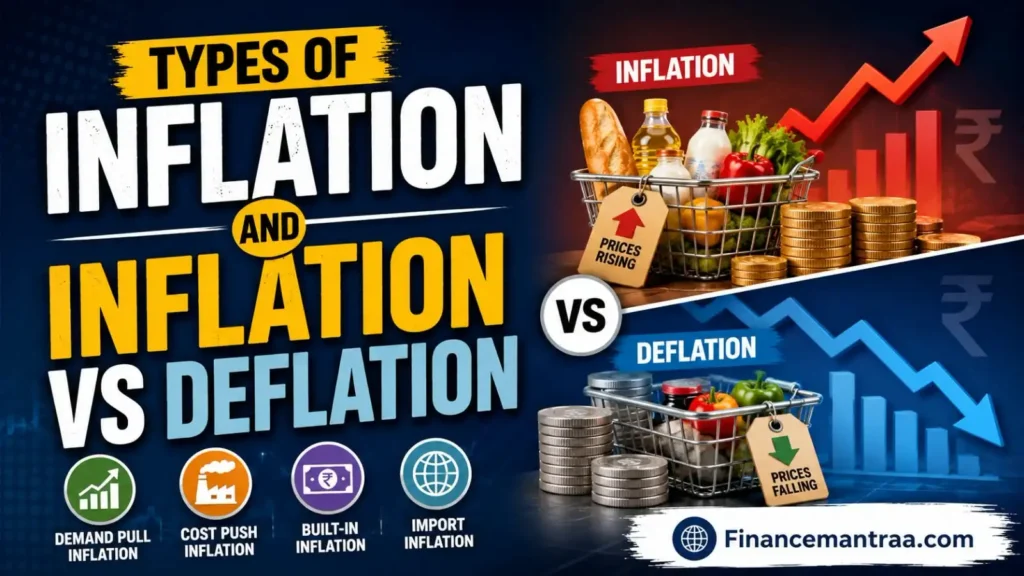
Let’s look at the main types of inflation. First is demand-pull inflation, where high demand pushes prices up. Second is cost-push inflation, where costly inputs raise prices. Third is built-in inflation.
Here, workers ask for higher pay because prices are rising, and then companies raise prices again to pay them. Some people also talk about hyperinflation, which is extreme. Prices double in days, and money almost becomes useless. Thankfully, this is rare.
Now, what about the opposite? Inflation vs deflation: what is the difference? Deflation means prices fall over time. It sounds nice, but it is not. When prices keep falling, people delay buying, companies earn less, and jobs are lost.
Honestly, mild inflation is safer for an economy than deflation. Most central banks, including the Reserve Bank of India, try to keep inflation small and stable, not zero. So the goal is control, not complete removal. Simple as that.
Inflation Explained with Real-Life Examples
Here is Inflation Explained with real-life examples, because theory alone gets boring. In my experience, the best lesson came from my own home. Some years back, my father kept a fixed deposit of 1 lakh rupees for a wedding fund. When the time came, the bank paid a fair amount, yet the money could buy much less because wedding costs had climbed faster.
He felt cheated, and I understood why. Another example is school fees or mobile recharge. Both increase slightly every year, and you don’t even notice it. Now check a simple calculation. If inflation is 6 percent, 1 lakh rupees today will have the buying power of only about 56,000 rupees after 10 years.
That is the hidden tax of inflation. To calculate the impact of inflation on savings, divide your money by (1 + inflation rate) for each year. It is not fun to see, but it is good to know.
Inflation in India and Consumer Price Inflation
Now let’s talk about inflation in India. Why does inflation happen in India? Food prices play a huge role. Vegetables, pulses, and edible oil take a big part of a normal household budget, so when the monsoon is weak, prices jump. Fuel prices and the rupee value also matter.
India mostly tracks Consumer Price Index (CPI) inflation. It measures the price change of things a normal family buys, like food, rent, clothes, fuel, and school fees. The Reserve Bank of India aims to keep CPI inflation near 4 percent, with room of 2 percent on both sides.
That is a good target, but the CPI number does not always match your own life. If your rent and school fees rise faster than the average, your personal inflation rate is higher. So always check your own spending, not just the headline number. This local view makes Inflation Explained useful for every Indian family.
How Inflation Affects Savings, Interest Rates, and Investments
Let’s see the effects of inflation on money. First, inflation and savings. If your savings account gives 3 percent and inflation is 6 percent, you lose 3 percent in real value every year. Second, inflation and interest rates. When inflation goes up, the central bank usually raises interest rates to cool demand. Loans become costly, so your home loan EMI may rise.
However, fixed deposit rates may also rise, which is good for savers. Third, inflation and investments. Stocks, gold, and property have often beaten inflation over long periods, but not in a straight line. Bonds and fixed income can lose value if the return is lower than inflation.
Please note, nothing here is a promise. Markets go up and down. In my view, the safe path is to mix different assets, so no single one can hurt you badly. That is how inflation affects personal finance and investment returns.
How Inflation Affects Middle Class Families and Cost of Living
Middle-class families feel inflation the most, friends. Why? Because their spending is fixed and regular. Rent, groceries, school fees, medicine, petrol, and EMI all come every month. Rich families can absorb price hikes. The middle class often has no such cushion.
When the cost of living rises, people cut small joys first, like eating out, travel, or a new phone. Then they cut savings, which is the real danger.
If you think as I do, you know that skipping savings today creates a bigger problem tomorrow. Also, a salary hike of 5 percent does not help much when real prices grow at 7 percent.
So the effect at home is simple: less saving, more loans, more stress. The answer is not to panic. The answer is to plan, track your expenses, and grow your income along with prices. This is Inflation Explained for a normal home. That is a fair deal for your family.
How to Protect Money From Inflation and Build Wealth
Now for the best part. How to protect your money from inflation? Here are practical steps:
- Invest regularly through SIP in diversified equity mutual funds for the long term.
- Keep some money in gold, as it often holds value when prices rise.
- Keep only your emergency fund in a savings account or liquid fund.
- Grow your skills and income, because a higher salary is the strongest shield.
- Avoid costly debt, especially credit card dues.
To beat inflation and build wealth, your return must be higher than the inflation rate after tax. Honestly, there is no magic trick, and no scheme is risk-free. Start early, stay patient, and invest what you can. Even 500 rupees a month is a good start.
Small steps every month work better than one big step. I am not a financial advisor, so please check your own goals and risk before you invest.
Final Thoughts
To wrap up, Inflation Explained in one line is this: prices go up, and money loses power. You cannot stop it, but you can prepare for it. Understand the inflation rate, watch your spending, and keep your money working.
Tell me the truth, friends: what is one small step you can take this month? Start today, my friends, because inflation never takes a break.
FAQ's
What is inflation and how does it work?
Inflation is the steady rise in prices over time. As prices go up, each rupee buys fewer things, so your money loses buying power over the years.
What causes inflation in an economy?
Inflation mainly comes from high demand, rising production costs, and too much money in the market. Supply problems and a falling rupee can also push prices higher.
How does inflation affect my savings?
Inflation slowly eats the real value of savings. If your bank pays 3 percent and prices rise 6 percent, you lose about 3 percent in buying power yearly.
How can I protect my money from inflation?
Invest regularly in options that can beat inflation over the long run, like equity mutual funds and gold. Keep only emergency money in savings and grow your income.
What is the difference between inflation and deflation?
Inflation means prices rise over time, while deflation means prices fall. Mild inflation is normal, but long deflation can slow spending, cut business profit, and cost jobs.
Why does inflation happen in India?
In India, food prices, fuel costs, weak monsoon, and rupee movement are major reasons. The Reserve Bank of India tracks consumer price inflation and aims for near 4 percent.