
Friends, have you ever picked a stock and wondered if it is really worth the price on your screen? I have been there too. A few years back, I bought a stock just because the chart looked nice. Later, I learned about book value, and honestly, it changed the way I look at companies. In this article, I will explain what is book value in the simplest way possible, so even a total beginner can understand it.
By the end, you will know the book value formula, how to calculate the book value of a company, and why smart investors never skip this important number when evaluating a stock.
Highlight key
- Book value tells you what a company is really worth on paper.
- It is calculated using simple math, no rocket science involved.
- Book value vs market value is a comparison every investor should know.
- Book value per share (BVPS) helps you judge if a stock is cheap or costly.
- Negative book value is a warning sign you should never ignore.
What Is Book Value in Finance?
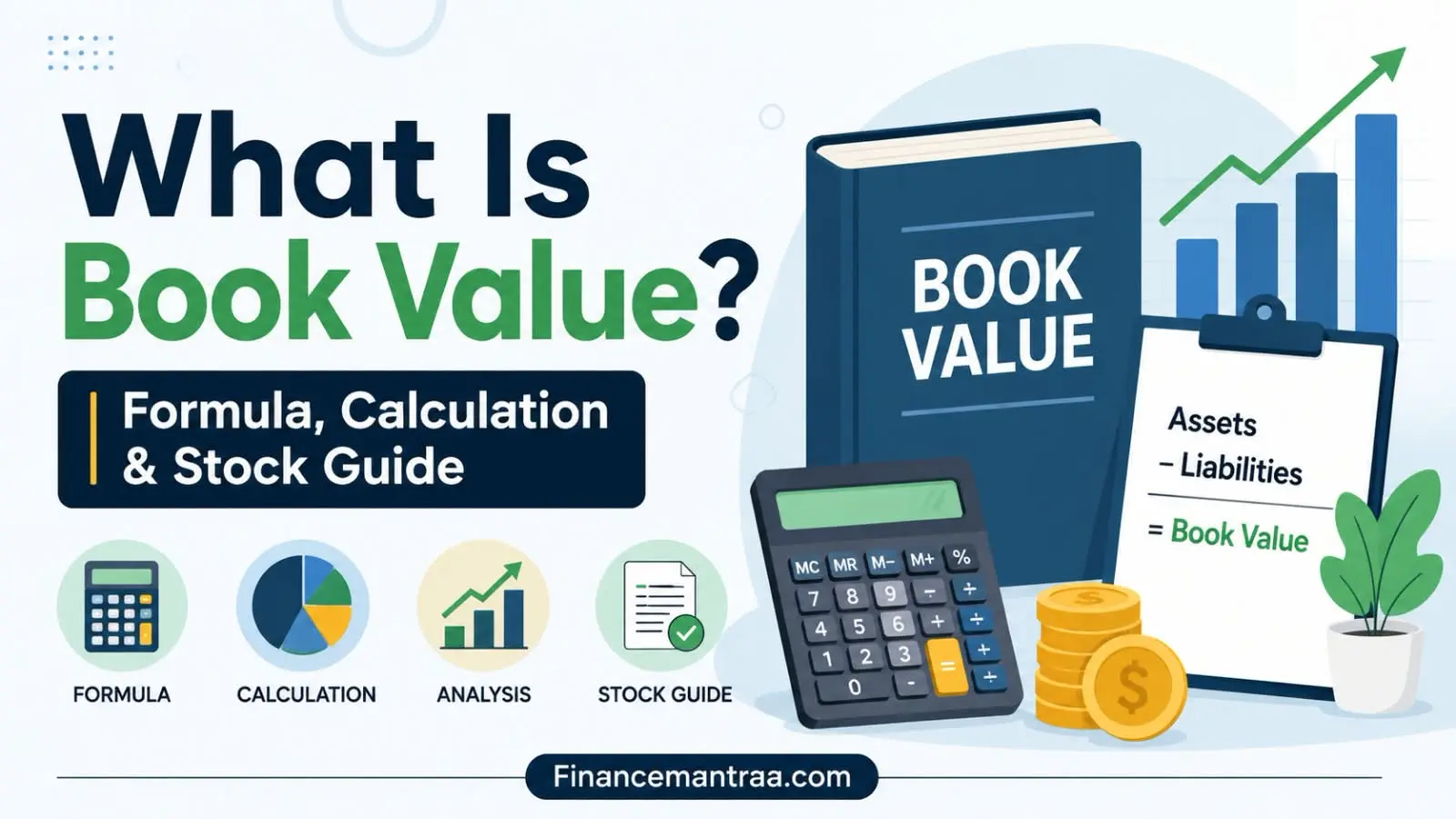
So, what is book value in finance? In simple words, book value is the total value of a company if it sold everything it owns and paid off everything it owes. Think of it like your own home. If you sell your house and your car, and pay off your loans, whatever cash is left in your hand, that is your personal book value.
For a company, this number comes straight from the balance sheet. It shows the actual worth of the business, not what people feel about it or what the news says.
Friends, this is the book value meaning in the plainest terms. It is a real, calculated number. It does not care about hype, trends, or emotions. That is exactly why so many investors trust it.
Book Value of a Company: Why It Matters
Tell me the truth: do you check a company’s real worth before buying its shares, or do you just follow tips from friends? Most people just follow the crowd. That is a mistake.
The book value of a company gives you a clear picture. It tells you how much the company actually owns after clearing all its debts. If a company has strong assets and low debts, its book value will look healthy. If debts are piling up, book value drops fast.
In my experience, checking book value before investing has saved me from a few bad decisions. I once almost invested in a company that looked great on paper because of its stock price, but its book value showed the real weak picture underneath.
Book Value Formula
Now let’s talk about the actual math. The book value formula is not scary at all.
Book Value = Total Assets – Total Liabilities
That’s it. Simple, right?
Here is what each part means:
- Total Assets: everything the company owns, like cash, property, machines, and stock.
- Total Liabilities: everything the company owes, like loans, debts, and unpaid bills.
Once you subtract the liabilities from assets, whatever is left is the book value.
How to Calculate Book Value of a Company (With Example)
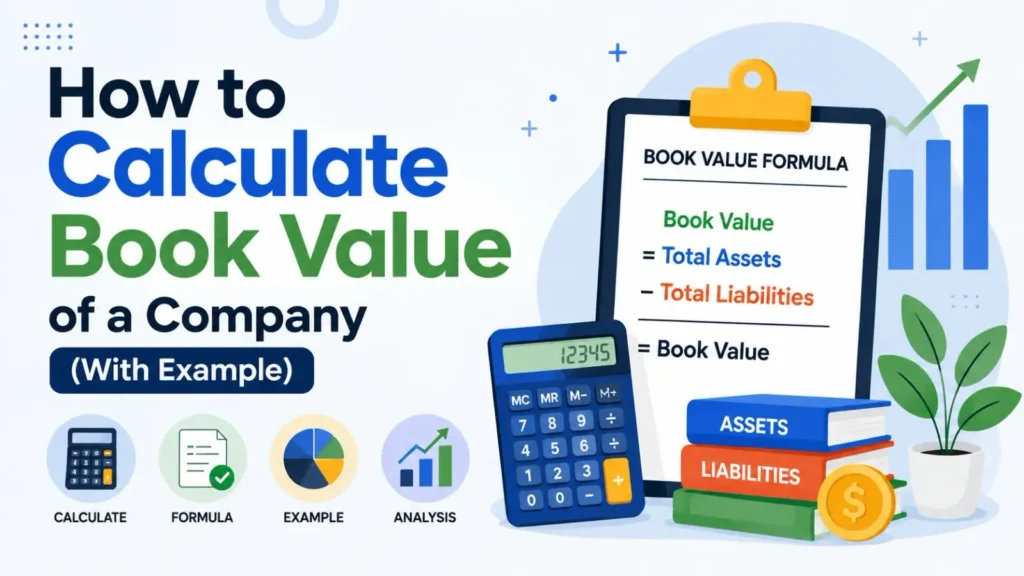
Let’s understand how to calculate the book value of a company using a small example.
Suppose a company has:
- Total Assets: Rs 500 crore
- Total Liabilities: Rs 300 crore
Book Value = 500 – 300 = Rs 200 crore
So, this company has a book value of Rs 200 crore. This is the book value formula with an example in action, and honestly, it is that easy.
If you think as I do, numbers make more sense with real examples than just theory. So whenever you check a company’s balance sheet, just find the total assets and total liabilities, and do this simple subtraction.
Book Value Per Share (BVPS): What Is It?
Now here comes a term you will hear often: book value per share, also called BVPS. This tells you the book value for each single share of the company.
BVPS Formula = Book Value / Total Number of Outstanding Shares
For example, if a company’s book value is Rs 200 crore and it has 20 crore shares, then:
BVPS = 200 / 20 = Rs 10 per share
This means each share is technically backed by Rs 10 worth of company assets. Simple, isn’t it?
What Is a Good Book Value Per Share?
Friends, this is a common question. What is a good book value per share? Honestly, there is no fixed number that works for every company. It depends on the industry.
However, here is a simple trick. Compare the BVPS with the current share price.
- If the share price is much higher than BVPS, the stock might be overpriced.
- If the share price is close to or below BVPS, the stock might be undervalued.
But do not decide only on this one number. Always look at other things too, like company growth, profits, and future plans.
Book Value vs Market Value Explained
This is where most beginners get confused. Let me clear it up for you.
Book value is based on the company’s balance sheet numbers. It does not change every minute.
Market value is what investors are currently willing to pay for the stock. It changes every second the market is open, based on demand, news, and emotions.
So, book value vs market value is basically the difference between the real accounting worth and the crowd’s opinion of worth.
Here’s a simple comparison:
| Point | Book Value | Market Value |
|---|---|---|
|
Based on |
Balance sheet |
Stock market price |
|
Changes |
Rarely |
Every trading second |
|
Driven by |
Company assets and debts |
Investor sentiment |
Now let’s talk about why this comparison actually matters for you as an investor.
How Book Value Helps in Stock Valuation
So, how does book value help in stock valuation? It works like a reality check. When market value is way higher than book value, it often means investors are paying a premium based on future hopes, not current reality.
On the other hand, if market value is close to book value, the stock is priced more on solid ground.
I always tell people, don’t just trust the price you see on the app. Dig a little deeper into the book value too. It gives you a fuller picture before you put your hard-earned money into any stock.
Importance of Book Value for Investors
Why is book value important for investors? Here are a few honest reasons:
- It shows the real financial health of a company.
- It helps you spot undervalued or overvalued stocks.
- It is useful during company mergers, acquisitions, or even bankruptcy cases.
- It works as a safety net number, showing what shareholders would get if the company shut down today.
If something is good about a company, book value will reflect it. If something is bad, like heavy debt, book value will show that too. It does not hide the truth, and that is what makes it so valuable.
Net Asset Value and Book Value of Equity
You may have also heard the term net asset value, especially in mutual funds. It works on a similar idea. Net asset value shows the worth of assets after removing liabilities, just like book value does for a company.
Similarly, book value of equity refers to the value left for shareholders after all debts are paid off. This is basically the same as book value in most simple cases, since equity shareholders are the real owners of a company’s remaining worth.
What Does Negative Book Value Mean?
Here is something important. What does negative book value mean? It means the company’s total liabilities are more than its total assets. In simple words, the company owes more than what it actually owns.
This is a red flag. If you see negative book value, be extra careful before investing. It usually points toward serious financial trouble.
However, some fast-growing companies show negative book value in early stages because of heavy borrowing for expansion. So always check the full story, not just this one number.
Book Value for Beginners: Quick Recap
Let’s do a quick and easy recap for all the beginners reading this:
- Book value shows a company’s real accounting worth.
- Formula: Total Assets minus Total Liabilities.
- BVPS shows book value per individual share.
- Compare book value with market value before investing.
- Negative book value is usually a warning sign.
Friends, once you get comfortable with these basics, checking book value before investing will become second nature, just like checking the price tag before buying anything in a shop.
Final Thoughts
So, what is book value? It is simply the true accounting worth of a company, calculated by subtracting what it owes from what it owns. It is not the flashiest number in finance, but it is one of the most honest ones.
In my experience, combining book value with other factors like profit growth and market trends gives a much stronger investing decision. Don’t rely on just one number, but never skip book value either.
I hope this guide made book value clear and simple for you. Next time you check a stock, take two minutes to look at its book value too. Trust me, your future self will thank you for it.
FAQ's
What is book value in simple words?
Book value means a company’s real worth on paper, found by subtracting total liabilities from total assets, showing the true accounting value clearly.
How to calculate book value per share?
Divide the company’s total book value by its total outstanding shares. This gives you BVPS, showing the worth backing each individual share held.
What is the difference between book value and market value?
Book value comes from balance sheet numbers, while market value is the current stock price, driven by investor demand and daily market sentiment.
Why is book value important for investors?
It reveals real financial health, helps spot undervalued stocks, and shows what shareholders would receive if the company closed operations completely today.
What does negative book value mean for a company?
Negative book value means liabilities exceed assets, signaling financial trouble. However, some growing companies show this temporarily due to heavy borrowing.
Is a higher book value per share always better?
Not always. Compare BVPS with share price and industry standards. A good ratio depends on business type, growth stage, and overall financial condition.