
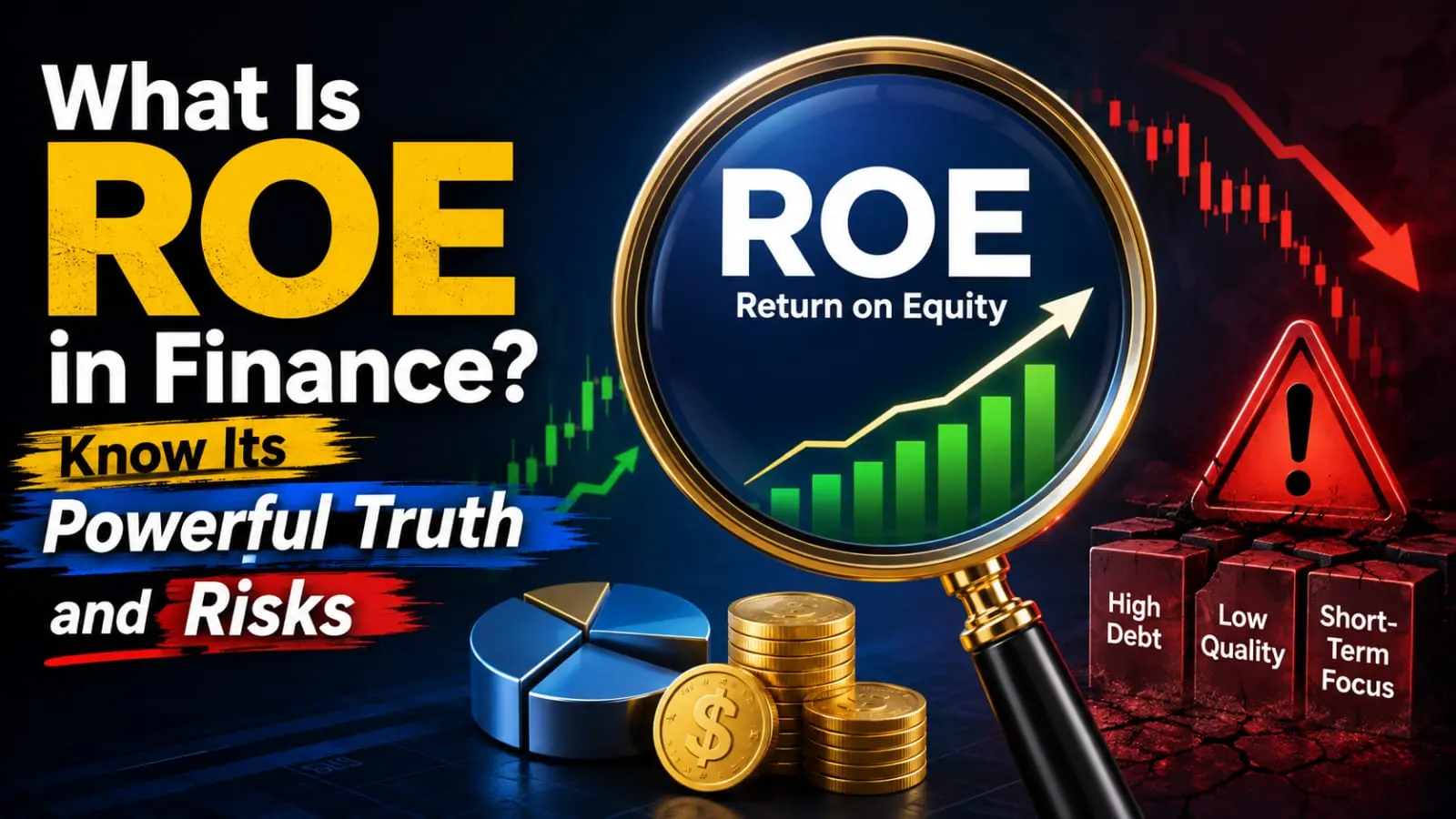
Friends, have you ever looked at a company’s stock and wondered how good it really is? Today, I want to talk about a number that can tell you a lot: ROE. So, what is ROE in finance? In simple terms, ROE stands for Return on Equity. It shows how well a company is using shareholders’ money to earn profits.
I remember when I first started reading about the stock market, this term used to confuse me a lot. I used to think that more profit always means a better company. But that’s not true, friends. A big company can earn huge profits, but if it’s not using the shareholders’ money properly, that money can go to waste. This is exactly where ROE in finance comes in. It shows the real picture, not just the profit numbers on paper.
In this guide, we will explain everything about Return on Equity in simple words. No complicated English, no boring finance jargon. Just simple stuff, like I would explain it to a friend over tea.
Highlight key
- What is ROE in finance and why it matters
- The ROE formula and how to calculate ROE
- What is a good ROE for a company?
- ROE vs ROA and ROE vs ROI
- How to interpret ROE like a smart investor
- Common mistakes people make with ROE analysis
What Is ROE in Finance? The Basic Meaning
Let’s start from the beginning. What is ROE in finance, really? ROE stands for Return on Equity. It is a financial ratio that shows how much profit a company makes for every rupee of shareholders’ equity.
Think of it like this. If you and your friend put money together to open a small shop, and after one year the shop gives you profit, you would naturally want to know how good that profit is compared to the money you invested. That is exactly what ROE is all about, just on a bigger scale for companies.
So, ROE in finance is basically a report card. It tells investors whether the company is using its money wisely or just sitting on it. A company can have a fancy office and big sales numbers, but if the ROE ratio is weak, something is wrong somewhere.
This is why smart investors always check ROE before putting their hard-earned money into any stock. It is one of the first things people look at during ROE analysis because it connects two very important things: profit and the money shareholders have invested.
ROE Formula: How to Calculate ROE
Now let’s talk about the ROE formula, because numbers make more sense once you see them.
The basic formula is:
ROE = Net Income / Shareholders’ Equity x 100
Here is what each part means:
- Net Income: This is the profit the company earns after paying all expenses, taxes, and other costs.
- Shareholders’ Equity: This is the money that belongs to the shareholders, basically the company’s assets minus its debts.
Let’s take a simple example. Suppose a company has a net income of 50 lakh rupees, and the shareholders’ equity is 5 crore rupees. To calculate ROE, we divide 50 lakh by 5 crore, which gives 0.10. Multiply that by 100, and you get a 10 percent ROE.
This means the company is making 10 rupees of profit for every 100 rupees that shareholders have invested. Simple, right? This is exactly what is ROE in finance looks like in real life, with an example. Once you understand this formula, calculating ROE for any company becomes easy.
Friends, in my experience, I always recommend checking this number from the last three to five years, not just one year. A single good year can be lucky, but consistency tells the real story.
What Is a Good ROE for a Company?
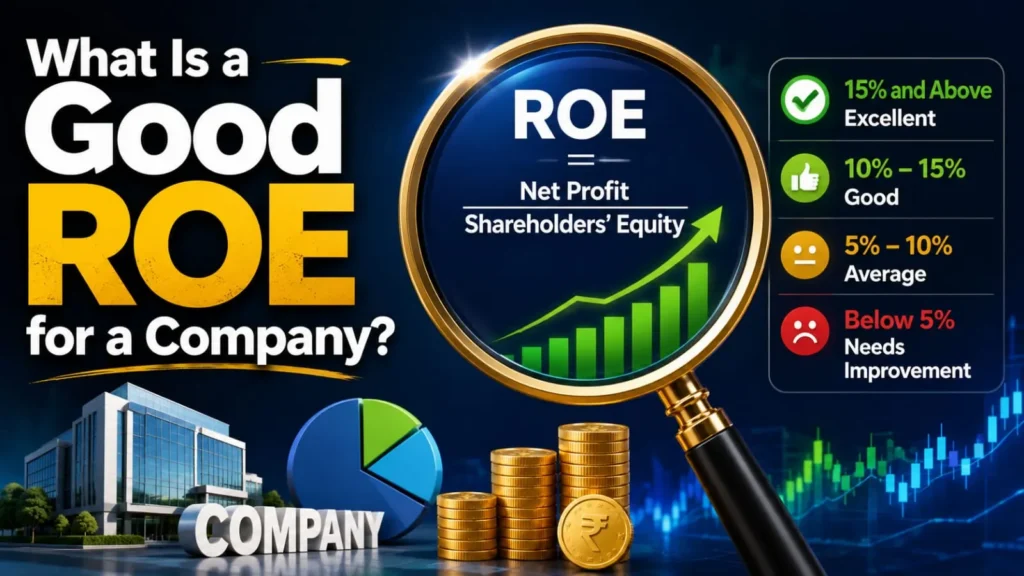
This is the question everyone asks. What is a good ROE, and how do we know if a number is high or low?
Generally speaking, an ROE between 15 percent and 20 percent is considered good in most industries. Anything above that is excellent, but you should also check why it is so high. Sometimes a very high ROE comes from too much debt, and that is risky.
On the other hand, a low ROE is usually a sign that the company is not using shareholders’ money efficiently. It does not always mean the company is bad, but it needs more digging.
Tell me the truth, would you invest your money in a shop that gives very little return compared to what you put in? Probably not. The same logic applies to stocks. This is why an ideal ROE in stock market analysis usually falls in a healthy middle range, not too low and not artificially too high.
Different sectors have different average ROE levels too. For example, ROE in banking is often different from ROE in manufacturing companies. So always compare a company’s ROE with others in the same industry, not across different sectors.
How to Interpret ROE Like a Smart Investor
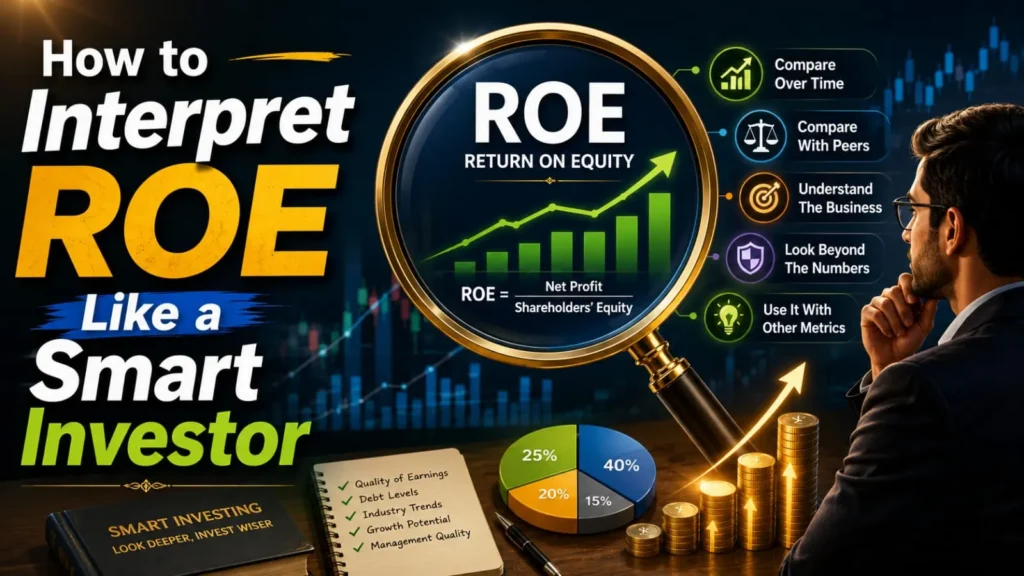
Knowing the number is one thing, but knowing how to interpret ROE is another skill completely.
Here are a few practical points I follow:
- Compare the company’s ROE with its industry average, not with random companies.
- Check if the high ROE is because of real profit growth or just heavy borrowing.
- Look at the trend over multiple years, not just the current year.
- See how the company’s ROE for investors compares with its competitors.
If you think as I do, you will always look beyond the single number. A company showing 25 percent ROE looks great on paper, but if it built that using massive loans, the real risk is much higher than it appears.
This is the heart of proper ROE analysis. Numbers alone don’t tell the full story; you need context around them.
ROE vs ROA: What's the Difference?
Many people get confused between ROE vs ROA, so let’s clear this up.
ROA stands for Return on Assets. It shows how well a company uses all its assets, including debt, to generate profit. ROE, however, only focuses on shareholders’ equity.
So here is the simple difference:
- ROA tells you how good the company is at using everything it owns.
- ROE tells you how good the company is at using shareholders’ money specifically.
If a company has a lot of debt, its ROE can look impressive even if ROA is average. That’s why checking both together gives a fuller picture rather than relying on just one.
ROE vs ROI: Understanding the Difference
Another common mix-up is ROE vs ROI. ROI means Return on Investment, and it is a broader term used across many types of investments, not just stocks.
ROI can apply to real estate, mutual funds, a business you started, or even your side hustle. ROE, however, is specific to companies and shareholders’ equity.
In short, ROI is like a general term for return on any money you put anywhere, while ROE in finance is a specific financial ratio used mainly for evaluating companies and stocks.
Why Is ROE Important for Investors?
Now let’s talk about the importance of ROE for anyone who wants to invest smartly.
Return on Equity helps investors understand:
- Whether a company is profitable in a real, efficient way.
- How management is using the shareholders’ money.
- Whether the company deserves a higher stock price or not.
- How the company compares to competitors in the same field.
Honestly speaking, I always check this ratio before putting money into any stock. High ROE companies often attract more investors because they show efficient use of capital. But friends, never invest based on ROE alone. Always combine it with other numbers like debt levels, sales growth, and cash flow.
Common Mistakes People Make With ROE
Let’s be honest about the mistakes too, because that’s part of being genuine.
- Trusting a single year’s ROE without checking the trend.
- Ignoring the debt level behind a high ROE.
- Comparing ROE across totally different industries.
- Believing higher ROE always means a better company. It doesn’t.
Is higher ROE always better? Not really. If it comes from unhealthy debt, it can actually be a warning sign rather than a good sign. This is one of the biggest traps beginners fall into during stock analysis.
ROE Analysis Across Different Sectors
One more thing I want to share before we wrap up. When you do ROE analysis, remember that every sector plays by different rules. What is ROE in finance for a bank may look very different from a manufacturing company or an IT firm.
Banks and financial institutions often show higher ROE because their business model runs heavily on borrowed money. That is normal for ROE in banking, so don’t panic if you see a bigger number there. On the other hand, capital-heavy industries like infrastructure or steel usually show lower ROE because they need huge equity investment for machinery and plants.
This is why I always tell people: never compare the ROE of a bank with the ROE of a car manufacturer. It is like comparing apples with mangoes; both are good, but they grow differently. Always keep your comparison within the same sector to get a fair and honest picture of the equity profitability ratio.
Final Thoughts on What Is ROE in Finance
So friends, now you understand what ROE in finance is and why it matters so much for investors. It is not just a random number; it is a window into how well a company treats its shareholders’ money.
Whenever you check a stock next time, don’t just look at the profit numbers. Take two minutes to calculate ROE, compare it with similar companies, and check the trend over the years. This simple habit can save you from many bad investment decisions.
I hope this guide made Return on Equity easy to understand. Now let’s move on to some common questions people usually ask about this topic.
FAQ's
Q1. What is ROE in finance in simple words?
ROE means Return on Equity. It shows how much profit a company earns using the money shareholders have invested in it, expressed as a percentage.
Q2. What is the ROE formula?
The ROE formula is Net Income divided by Shareholders’ Equity, multiplied by 100. It gives you the percentage return generated on shareholders’ money.
Q3. What is a good ROE for a company?
Generally, an ROE between 15 percent and 20 percent is considered good. Always compare it with companies in the same industry for accuracy.
Q4. What is the difference between ROE and ROA?
ROE measures returns on shareholders’ equity only, while ROA measures returns on total assets, including money raised through debt.
Q5. Why is ROE important for investors?
ROE helps investors judge how efficiently a company uses shareholders’ money to generate profit, guiding smarter stock investment decisions.
Q6. Can a high ROE be misleading?
Yes, a high ROE can be misleading if it comes from heavy debt rather than real profit growth, so always check the debt levels too.